
Pauline Schafer (she/her)
A few years ago, while at a local coffee shop, I found a small envelope with a handwritten message on it: Free art. I opened it to find a tiny watercolor painting inside! It was clearly created with great thought and care, though it likely didn’t take much time to produce. I still treasure that artwork and have it hanging on my wall. It provides a brief glimpse into an artist’s work and continues to remind me of an unexpected delight, a connection to another human that I haven’t met but who gave me a gift.
I feel fortunate that I can also experience these moments of delight and connection as I move through my day, noticing nature: hearing the call of a Common Nighthawk swooping high overhead on a summer evening, smelling honeysuckle blossoms that evoke memories of summer camp, or discovering a translucent, water-worn agate on the river shore.
At the beginning of 2026, I wrote in this space about nature journaling as a mindfulness practice (tumbleweird.org/how-to-slow-time), one that connects the journaler with the world around them. Nature is always there to be noticed, no matter where you happen to be, even if you only have a few moments to spend noticing. So here’s a six-month check-in… have you tried journaling yet? If making time for a journaling session seems daunting, here’s a bite-sized alternative: make a nature zine.
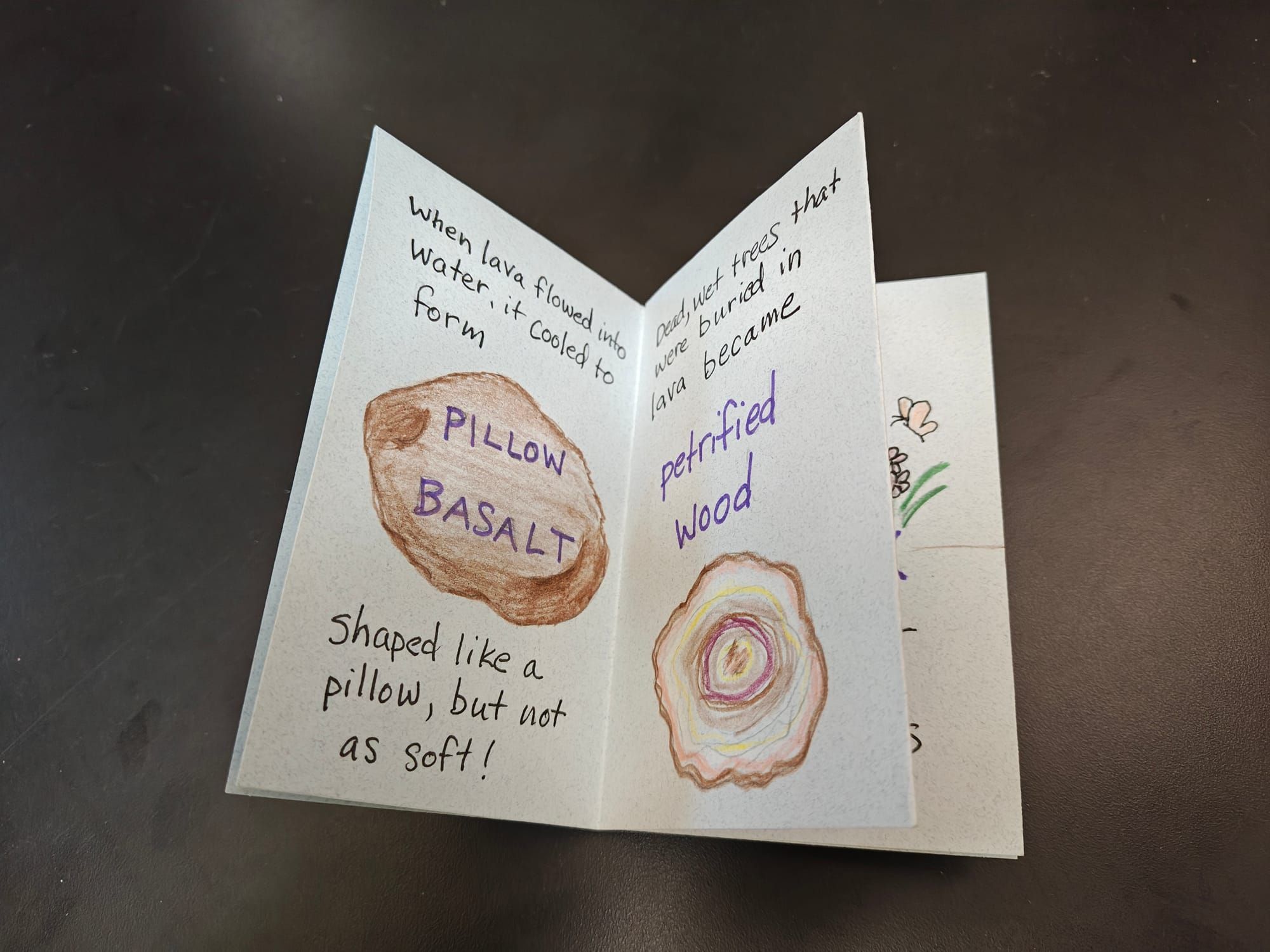
This idea is inspired by Ted Miller’s reminder in the August Tumbleweird about the great American tradition of speaking your mind through zines (tumbleweird.org/zines-are-not-a-crime). A zine is a self-published, limited-edition work of writing and/or art, made to be shared. One small format that has become popular is a booklet folded from one sheet of 8 ½ by 11-inch paper.
The spirit and aesthetic of zine-making is conducive to imperfection, authenticity, and capturing a moment in time (much like nature journaling). And in the case of a one-paper folded book, brevity. A nature zine can be created simply for the sake of creating art, or it can convey a message or teach something. It can help you spread ideas worth sharing.
So, what do you want to crow about? What have you been learning about or noticing that more people should recognize? What is a vital truth that must be shared to remind us that we are connected to all the living things around us?
In this small booklet format, you’ll end up with six pages to fill. Here are some ideas to get you started:
- Six reasons why crows are the best birds in the neighborhood
- Six weeds that you might not have noticed before but you should look for at the park
- Sights, sounds, and smells during sunset along the Columbia River that you wish more people would notice
It’s up to you how you publish your zine. Will you make copies and send them to all your friends, or make it a one-of-kind work of free art, strategically left for a stranger to discover?
Pauline Schafer is the Education Manager at the REACH Museum, a Certified Interpretive Guide, and a nature nerd.
Blue Mountain Forest is getting a glow-up
And the revision plan needs your input!
Alexis Spencer (she/her)
The Blue Mountains, a 15,000 square mile ecoregion in Southeast Washington and Northeast Oregon, is undergoing a forest management plan revision, and needs your input on how best to manage our public land.
If you have ever skied at Bluewood, hunted near the Southfork of the Walla Walla, snowmobiled on any of the trails around the forest, or fished up the Tucannon, then you have enjoyed some of the many ecosystem services and recreational opportunities our unique and wild local mountain range has to offer. The forest plan must account for all of those uses, as well as how to manage the health of the forests. The plan has alternative options that differ in how those things are balanced.
The Malheur, Umatilla, and Wallowa-Whitman National Forests are proposing a revised forest management plan to address “ecological, social, and economic changes over the past 36 years.” When new plans for public lands are proposed, the public can review and offer public comment on possible revisions. The comment period for this plan ends on September 30, 2026.
How the forest will be managed in the future will impact on our ability to engage with, recreate, and enjoy our public lands. Some alternatives proposed would dramatically shape some of the rugged and remoteness of the Blues that make it one of the greatest hidden gems in the West.
What is a land management plan?
A land management plan (or forest plan) is essentially the Forest Service’s long-term guide for how a national forest will be managed. It lays out what the agency wants the forest to look like in the future and establishes the rules, goals, and priorities that guide decisions about things like wildfire, forests, wildlife, water, recreation, grazing, and roads.
It also sets broad guidelines and constraints on how the forests are treated. Land management plans impact how wildfire fuels are managed, how streams and wildlife habitat are protected, and how recreation is balanced. The Blue Mountain plan will also determine how much of our forests will remain protected wilderness.
Think of it as setting the ground rules for how millions of acres of public land will be managed for decades to come.
What is being proposed in the revised draft?
The Draft Environmental Impact Statement (DEIS) is a long, technical document, available to the public through the Umatilla National Forest website: www.fs.usda.gov/r06/umatilla/planning/blue-mountains-forest-plan-revision. Rather than trying to condense hundreds of pages of analysis into this article, I encourage you to look at the table below, which provides a straightforward comparison of the three alternatives being considered.
These three alternatives represent different approaches to managing the Blue Mountains. Alternative 1 would continue the existing 1990s forest plans. Alternative 2, the Forest Service’s proposed action, emphasizes active management and substantially increases the amount of forest targeted for fuel and vegetation treatments. Alternative 3 takes a different approach, retaining some elements of the roadless rule (protecting roadless lands) and adding additional wilderness and stream habitat protections.
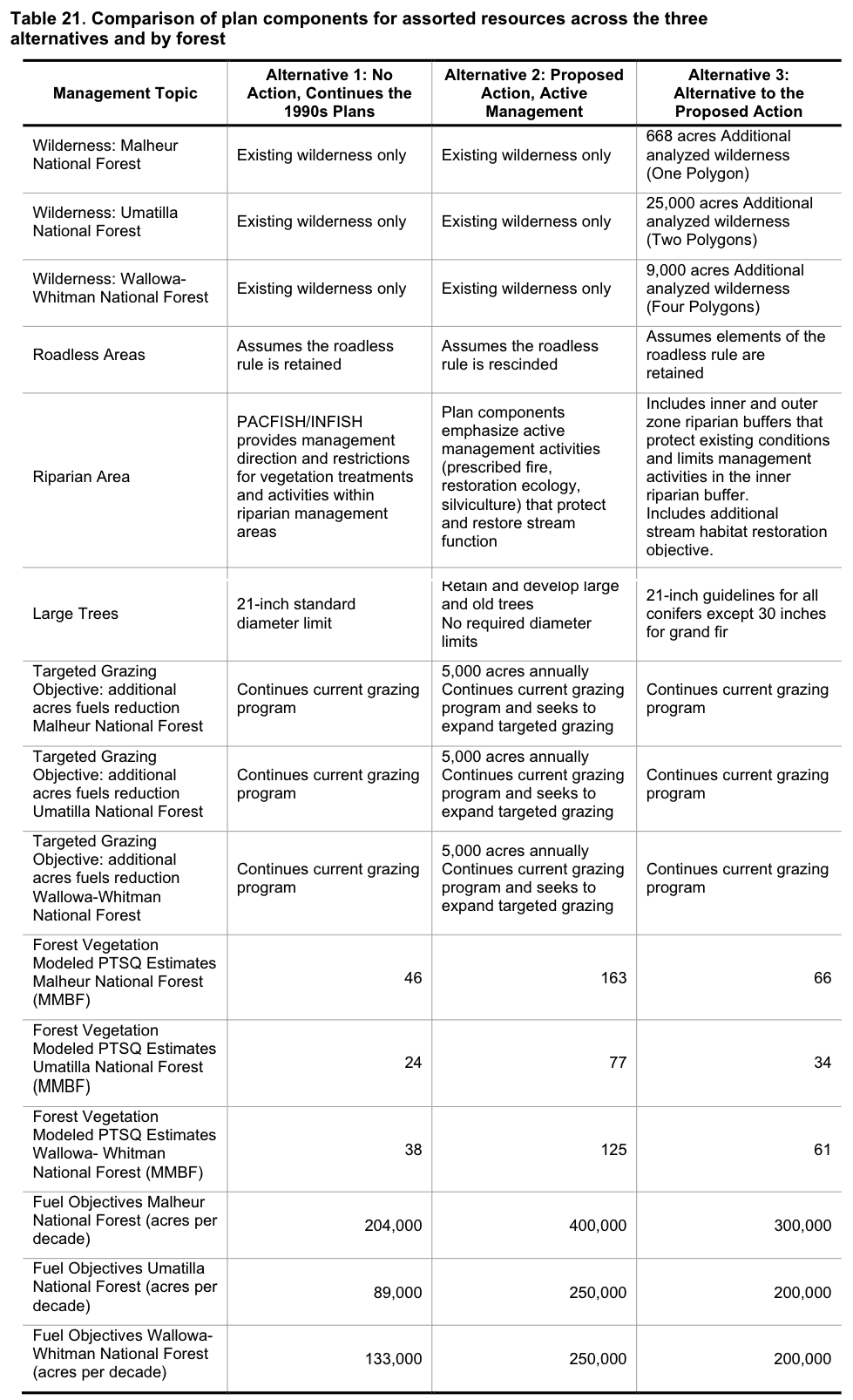
The Forest Service has identified Alternative 2 as the proposed action, and it represents the most intensive management approach of the three alternatives. It proposes fuel-treatment objectives of 400,000 acres per decade on the Malheur, 250,000 acres on the Umatilla, and 250,000 acres on the Wallowa-Whitman. It also assumes the roadless rule is rescinded and removes required diameter limits for large trees.
I think Alternative 2 is the wrong choice for the Blue Mountains.
I understand the appeal of active management, particularly in a region where wildfire is an increasing concern. But managing a forest isn’t simply about reducing fuels. It is also about protecting large trees, riparian areas, wildlife habitat, roadless landscapes, and the ecological processes that keep these forests functioning. Fire management involves strategic consideration of all habitats within it.
Alternative 2 asks us to make too many significant changes, across too much of the landscape, in the name of active management. I don’t think that’s a tradeoff we should make.
But what do you think?
How do I make a public comment?
The forest service provides a handout to guide the public on how to make a comment on a DEIS: fs.usda.gov/sites/nfs/files/r06/umatilla/publication/20260526_HowtoCommentDEIS_FS.pdf. I recommend looking over this handout, but here are some guidelines to get you started.
The public comment period for the current stage of the Blue Mountains Forest Plan Revision is open through September 30, 2026.
- The Forest Service has made the DEIS, maps, and information about the alternatives available online.
- Comments can be submitted through the Forest Service’s online comment system, CARA. Written comments can also be submitted by email or mail.
- You can find the documents, instructions for commenting, and the online comment portal on the Forest Service’s Blue Mountains Forest Plan Revision webpage: fs.usda.gov/r06/umatilla/planning/blue-mountains-forest-plan-revision
- You don’t need to read the entire DEIS to participate.
- Start by thinking about what you value about the Blue Mountains and what you think needs to be considered as these forests are managed in the future. Then look through the portions of the plan that relate to those interests.
If you need help, please feel free to contact me and I will review and provide feedback as time permits. Email: carrotwarrior.botany@gmail.com
You have until September 30
Understand that comments do not need to be perfect, they do not all need to be done by experts, or professionals. This is your public land, and you deserve the opportunity to have a say in how it is managed.
Some people will want more active forest management and wildfire prevention. Others will be more concerned about habitat, water, or wilderness. Many people will care about several of these things at the same time, and many of these things overlap. The purpose of public comment isn’t to make everyone agree.
The Blue Mountains are a big part of the landscape we share here in Eastern Washington and Northeastern Oregon, and are one of the most diverse and remote ecoregions in the country. They provide much more than timber or recreation, and they support ecological systems that extend far beyond the forest boundaries.
Whether you know the Blue Mountains because you spend your summers hiking and fishing there, your fall hunting there, or your winters skiing at Bluewood, these are public lands that belong to all of us. The Forest Service is now planning for their future.
If you have something to say about what that future should look like, you have until September 30 to say it.
Alexis Spencer is a local ecologist and educator in the Tri-Cities. She has worked all over the Pacific Northwest and Great Basin across grassland and forested ecosystems. Alexis has a botany-focused Instagram @carrotwarrior_, and can also be reached via email: carrotwarrior.botany@gmail.com
