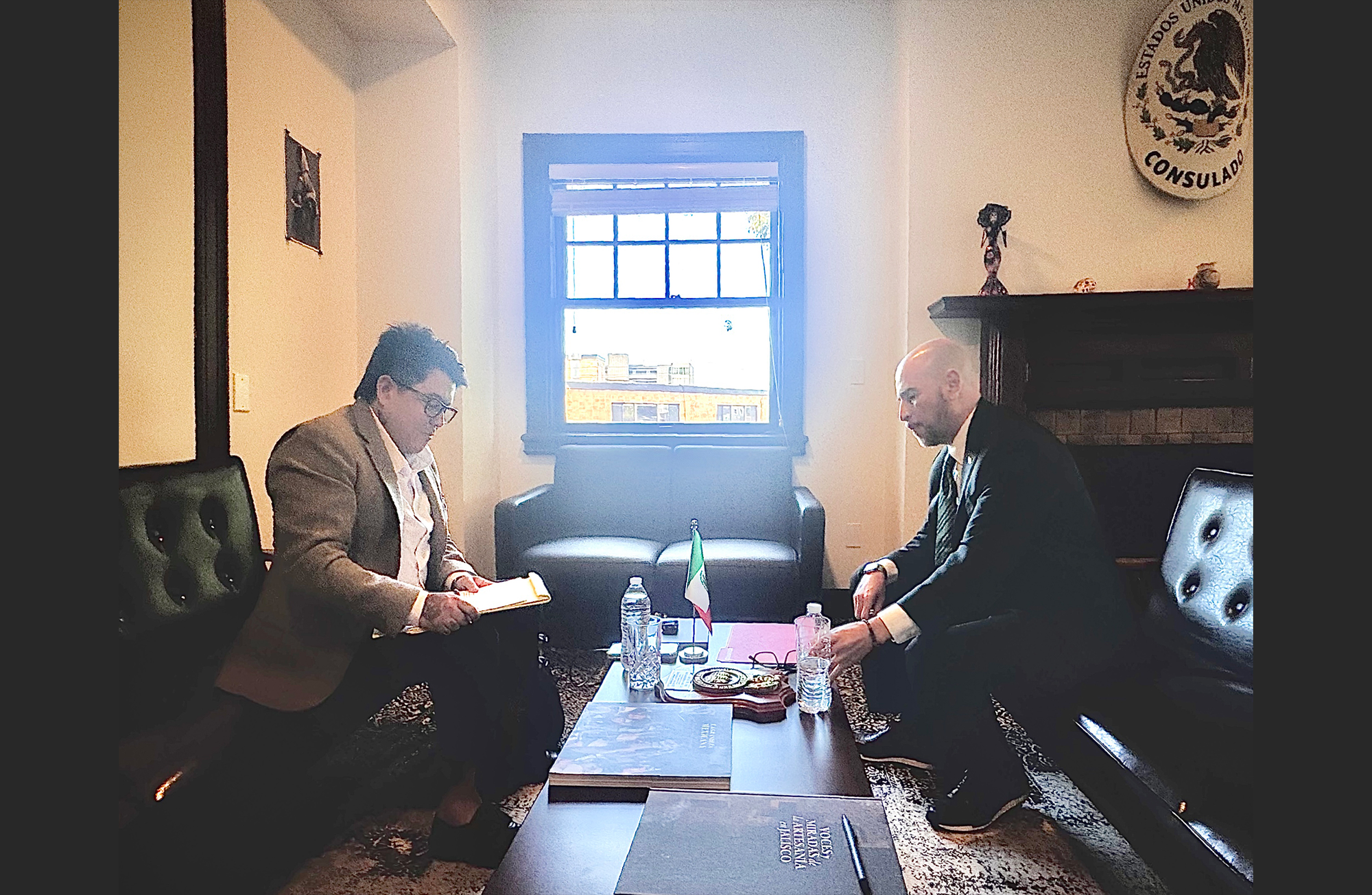
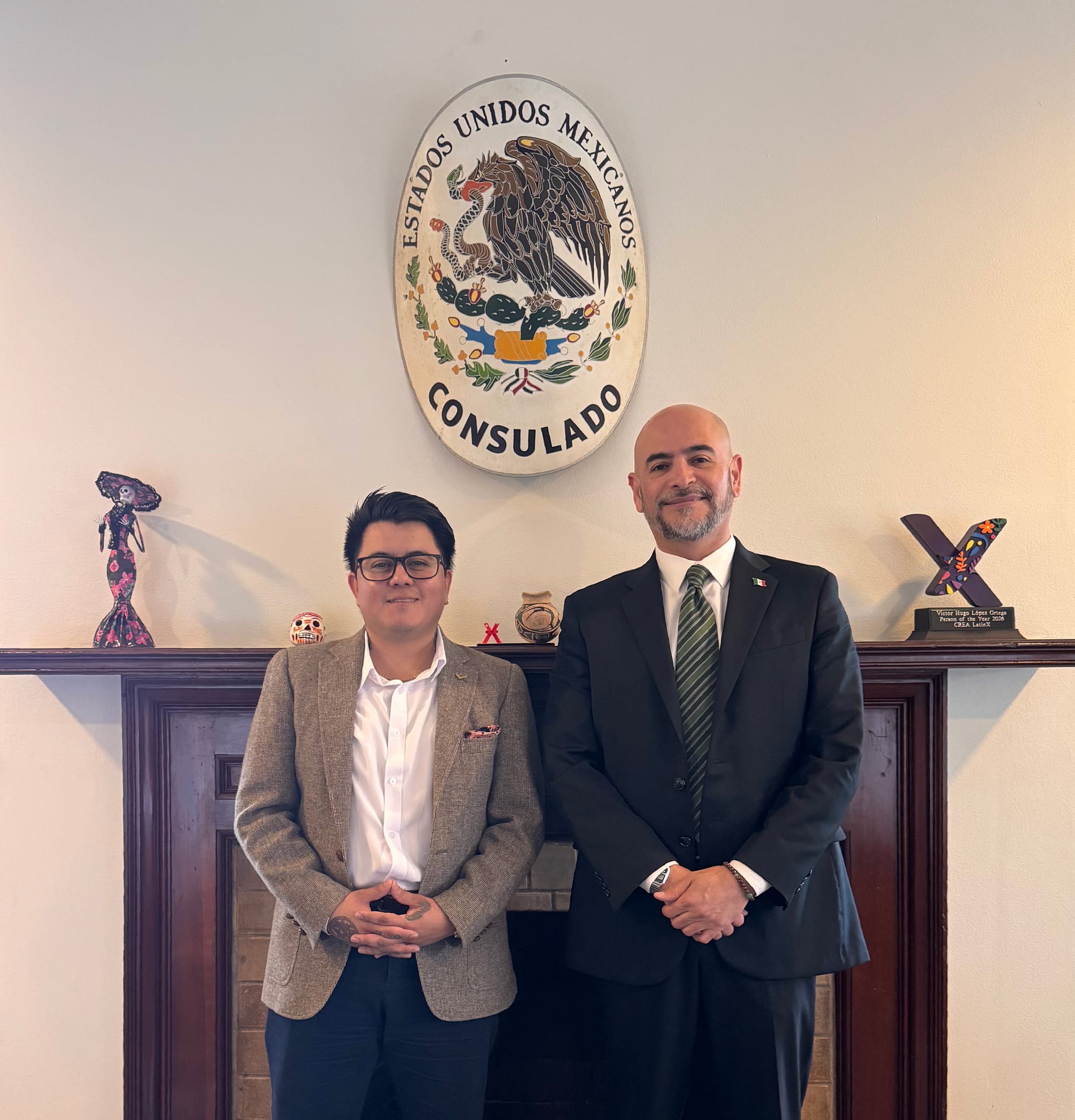
Ulises Navarro y Víctor Hugo López Ortega reúnen en el Consulado de México en Seattle.
This article is bilingual! Scroll down (or click here) for the English translation.
Una conversación con el cónsul Víctor Hugo López Ortega
Hay lugares que, aun estando a miles de kilómetros de nuestra tierra, tienen la responsabilidad de hacernos sentir que México no está tan lejos.
Para miles de mexicanos que viven en Washington, Alaska y parte del norte de Idaho, uno de esos lugares es el Consulado de México en Seattle.
En una conversación para Alcon Media tuve la oportunidad de sentarme con Víctor Hugo López Ortega, cónsul titular de México en Seattle, para conocer no solamente al funcionario detrás de la oficina, sino su visión sobre lo que significa representar a México, servir a una comunidad migrante y mantener vivo ese vínculo con un país que para muchos quedó geográficamente lejos, pero nunca desapareció de la identidad.
Desde el comienzo de la entrevista, López Ortega dejó clara una idea que se repetiría de diferentes maneras a lo largo de nuestra conversación: el Consulado no puede limitarse a ser una oficina donde se tramitan documentos.
Tiene que ser también un espacio de protección, dignidad y comunidad.
Originario de Chihuahua capital, López Ortega contó que vivió más de la mitad de su vida en Ciudad Juárez, una ciudad que considera suya y cuya dinámica fronteriza le permitió conocer de cerca la migración, el encuentro de culturas y las distintas realidades de quienes se mueven dentro y fuera de México. Describió a Juárez como un verdadero crisol en el que convergen personas provenientes del sur, centro y norte del país. Esa experiencia, explicó, terminó acercándose profesionalmente a muchos de los temas que hoy forman parte de su responsabilidad consular.
Su llegada a Seattle comenzó también como un proceso de aprendizaje y transición. Antes de asumir plenamente la responsabilidad como cónsul titular, tuvo la oportunidad de conocer la operación interna del Consulado, su personal, sus capacidades y, sobre todo, a la comunidad a la que tendría que servir.
El lado humano del gobierno
Cuando le pregunté cuáles habían sido las primeras prioridades que identificó al llegar, su respuesta comenzó con algo sencillo: atender a la comunidad.
Documentación, protección y vínculo comunitario.
Esos son, en buena medida, los tres pilares que López Ortega identifica dentro de la misión diaria del Consulado. Un pasaporte, una matrícula consular o un acta no son simplemente papeles. Desde su perspectiva, tener la documentación en orden permite establecer la identidad jurídica de una persona y representa uno de los primeros pasos para proteger sus derechos.
Pero inmediatamente llevó la conversación más allá de los documentos. “Nosotros estamos en el lado humano del gobierno.”
Esa frase probablemente resume gran parte de su visión.
Para López Ortega, existen áreas gubernamentales dedicadas a administrar recursos, reglamentos y procesos, pero existen otras cuyo trabajo llega directamente a la persona, particularmente a aquella que se encuentra en una situación de mayor vulnerabilidad.
Y un mexicano viviendo lejos de México, señaló, puede encontrarse precisamente en esa necesidad extraordinaria de sentirse cobijado.
El cónsul describió su oficina como una oficina de puertas abiertas. Explicó que, siempre que se encuentra disponible, una persona puede acercarse a plantear un problema, una idea o un proyecto. También insistió en que dentro del Consulado todos deben entender que cada integrante del equipo tiene importancia y que el respeto hacia la comunidad comienza desde adentro de la institución.
La función de un cónsul, explicó, es mucho más amplia de lo que muchas personas imaginan.
Es la representación del Estado mexicano dentro de la circunscripción que le corresponde. En el caso de Seattle, señaló que esa responsabilidad comprende Washington, Alaska y algunos condados del norte de Idaho.
Además de coordinar áreas de documentación, protección, visas y comunidades, el Consulado interviene en actos de fe pública y registro civil. Los cónsules pueden desempeñar funciones notariales y realizar determinados actos civiles con validez en México.
Es decir, detrás de esa puerta hay mucho más que pasaportes.
Hay familias, hay identidad, asuntos legales, personas en hospitales, hay detenidos, hay niños que proteger.
Hay mexicanos tratando de resolver, desde miles de kilómetros de distancia, una parte de su vida en México.
“Esta también es su bandera”
Uno de los momentos más humanos de la conversación llegó cuando hablamos de la doble nacionalidad.
López Ortega contó que, cuando su agenda se lo permite, baja personalmente a entregar actas de nacimiento a jóvenes y familias que acaban de completar el reconocimiento de su nacionalidad mexicana.
Podría parecer un trámite administrativo más.
Para él no lo es.
Lo llama un “despertar de las conciencias.”
Al entregar ese documento, busca explicar a las familias que no solamente están recibiendo una hoja que reconoce jurídicamente a una persona como mexicana. También están reconociendo una historia familiar y una identidad que continúa de generación en generación.
Habló de niños y jóvenes nacidos en Estados Unidos, hijos o nietos de mexicanos, que han crecido bajo la bandera de las barras y las estrellas, pero que también tienen derecho a mirar la bandera mexicana y reconocerla como propia.
“Esta otra bandera… es también su bandera.”
No habló de orgullo como confrontación ni como una obligación de demostrar quién es más fuerte.
Al contrario; habló de defender esa identidad mediante un trato humano, digno y respetuoso.
Su mensaje para quienes reciben la nacionalidad mexicana es caminar con la frente en alto y comprender que también representan a México en la manera en que viven, trabajan y se relacionan con los demás.
“La dignidad del pueblo de México siempre debemos llevarla con nosotros.”
Contó incluso que este pequeño acto ceremonial ha hecho llorar a familias. No necesariamente por el documento. Sino porque, en sus palabras, toca “la fibra de nuestro México.”
En ese momento, una persona que nació lejos del país de sus padres puede comprender que existe una historia que también le pertenece.
Una bandera.
Una cultura.
Una familia.
Una memoria.
Una raíz.
Cuando le pregunté cómo describiría a los mexicanos de esta región, su respuesta fue inmediata: trabajadores, solidarios y profundamente ligados a sus familias.
Para el cónsul, la comunidad mexicana de Washington posee una enorme riqueza cultural y una presencia particularmente importante en el sector agrícola.
Durante sus recorridos ha conversado con trabajadores, familias y propietarios de granjas. Según relató, ha escuchado repetidamente el reconocimiento hacia la capacidad de trabajo de la comunidad mexicana, pero destacó algo más: el hermanamiento entre quienes llegan desde distintas regiones de México.
Mencionó particularmente la presencia de comunidades originarias de Michoacán y Oaxaca, estados que describió como poseedores de una extraordinaria riqueza cultural e histórica.
Pero su invitación fue sencilla: sentarse a escuchar.
Conocer de dónde viene una persona.
Preguntarle su historia.
Escuchar qué dejó atrás y qué ha construido aquí.
Porque una comunidad no puede ser entendida solamente a través de estadísticas.
“Nuestra raza es una raza trabajadora.”
López Ortega habló también de la generosidad que reconoce en los mexicanos: esa costumbre de compartir incluso cuando no se tiene demasiado.
Una persona, dijo, puede vivir con muchas limitaciones y aun así ofrecerte la mitad de lo que tiene.
Para él, ahí existe una característica fundamental de nuestra comunidad: buscamos mejores condiciones para nuestras familias, pero junto a ese esfuerzo individual permanece la solidaridad con quien está al lado.
También ha observado un cambio en el perfil migratorio mexicano de la región. Mientras el sector agrícola continúa siendo fundamental, explicó que cada vez encuentra más mexicanos que llegan al área de Seattle para trabajar en tecnología y otros sectores profesionales.
Para López Ortega, esa diversificación también habla de los cambios generacionales y educativos de México y de una comunidad mexicana cuya presencia en Estados Unidos no puede reducirse a una sola profesión o historia migratoria.
La necesidad de sentirse seguros
Le pregunté qué necesidad escucha con mayor frecuencia cuando habla directamente con las familias.
Su respuesta fue: sentirse seguros.
Pero seguridad, explicó, significa muchas cosas.
Es estabilidad económica.
Es vivienda.
Es educación.
Es acceso a servicios de salud.
Es poder tener una vida digna.
También es tener derecho a descansar, asistir a un evento cultural, escuchar música o simplemente salir de la rutina de trabajar, regresar a casa, dormir y
comenzar nuevamente al día siguiente.
Por eso habló de la cultura como una herramienta que también forma parte del bienestar comunitario.
Mencionó el festival MEXAM y los esfuerzos por llevar actividades fuera de Seattle, incluyendo eventos en Yakima.
Para el Consulado, dijo, la cultura debe ser más democrática y accesible. La protección de una comunidad no siempre comienza cuando existe una emergencia. También puede comenzar creando espacios donde una persona vuelva a sentirse parte de algo.
Cuando la protección significa acompañar
La palabra protección apareció constantemente durante nuestra entrevista.
Y quise preguntarle directamente qué significa cuando el Consulado habla de protección al paisano.
Su respuesta fue mucho más amplia que lo que muchas personas pudieran imaginar.
La protección consular comienza, dijo, buscando que las autoridades respeten los derechos de los ciudadanos mexicanos.
El Consulado no ejerce la ley estadounidense ni puede sustituir a los tribunales o abogados, pero sí puede utilizar los mecanismos consulares y diplomáticos disponibles para acompañar a los mexicanos y vigilar que sus derechos sean respetados.
Eso incluye acudir a centros de detención.
El personal consular entrevista a mexicanos detenidos para conocer su estado de salud, determinar si han sufrido algún abuso y conocer si necesitan algún tipo de atención especial.
En algunas ocasiones, el propio cónsul ha acompañado al personal durante esas visitas.
El Consulado también puede convertirse en el puente entre una persona detenida y su familia.
Cuando existe incertidumbre, explicó, una llamada puede significar que una familia finalmente sepa que su padre, madre, hermano, hijo o pareja está vivo y conozca al menos cuál es su situación.
“Nosotros somos muchas veces el vínculo y el enlace y el puente.”
La protección también alcanza a menores cuyos padres enfrentan procesos migratorios, así como a mexicanos hospitalizados.
López Ortega relató casos en los que el Consulado ha coordinado con hospitales y autoridades mexicanas para repatriar a personas enfermas que necesitan continuar recibiendo atención en México.
Contó incluso el caso reciente de un integrante del área de protección que acompañó hasta Ciudad de México a un connacional con problemas de salud que no podía viajar solo.
Para López Ortega, todo esto puede resumirse en una responsabilidad: proteger la vida, la dignidad y la seguridad de las personas.
El Consulado cuenta además con un programa de asesoría legal externa. Debido a que sus funcionarios no pueden ejercer como abogados dentro de Estados Unidos, explicó que mantienen acuerdos con firmas legales que pueden representar a connacionales en determinados asuntos migratorios, penales y algunos casos laborales.
Durante la entrevista señaló que actualmente trabajan con ocho firmas legales. También insistió particularmente en la atención de salud de personas detenidas.
Por su experiencia previa en el sector salud, dijo entender lo delicado que puede resultar enfrentar una enfermedad bajo cualquier circunstancia, y mucho más encontrándose privado temporalmente de la libertad.
Su posición fue clara: garantizar atención digna de salud es parte del respeto fundamental a los derechos humanos.
Un consulado que tiene que salir de Seattle
Existe, sin embargo, un desafío geográfico enorme — no todos los mexicanos viven cerca de Seattle.
Para familias que viven en Eastern Washington, viajar puede significar varias horas de carretera, gastos, faltar al trabajo y reorganizar completamente un día o incluso varios.
Por eso hablamos del programa de Consulados sobre Ruedas.
López Ortega reconoció que una representación consular con un territorio tan amplio no puede esperar que toda la comunidad llegue hasta su puerta; también tiene que salir a buscarla.
Para 2026, explicó, se planearon diez consulados sobre ruedas y estimaban poder concretar nueve, una expansión considerable frente al año anterior.
Estas jornadas movilizan personal de documentación y registro civil durante varios días para llevar servicios directamente a diferentes comunidades.
En una jornada realizada en marzo, recordó que pudieron procesar más de 400 pasaportes.
Además, señaló que durante el año visitaron dos veces una de las regiones con mayor concentración de población mexicana y que para el siguiente año buscaban realizar una tercera visita.
La demanda continúa siendo mucho mayor que la capacidad. Pero el principio es sencillo: acercar el Consulado a las personas que no siempre pueden acercarse al Consulado.
Información contra desinformación
Otro de los desafíos es que la comunidad conozca realmente todos los servicios disponibles.
Muchas personas, explicó López Ortega, llegan pensando únicamente en obtener un pasaporte y descubren una vez dentro que existen otros recursos que podrían ayudarles.
El Consulado difunde jornadas de educación financiera, servicios de la Ventanilla de Salud y otras acciones comunitarias.
Pero hacerlo dentro de una circunscripción territorial tan amplia requiere alianzas.
Ahí entran organizaciones comunitarias y medios de comunicación.
También las redes sociales.
López Ortega conoce de primera mano la velocidad con la que las comunidades migrantes comparten información. Desde su experiencia trabajando temas migratorios desde 2018, observó cómo WhatsApp puede permitir que una noticia conocida por una persona llegue en cuestión de horas a toda una comunidad.
Eso tiene una enorme ventaja.
Pero también un riesgo.
La misma red que distribuye información útil puede distribuir información falsa y engaños.
Por eso su recomendación fue acudir a las páginas y redes oficiales del Consulado y de la Cancillería para verificar información sobre trámites, servicios y programas.
Documentos, pertenencia y participación
Para el cónsul, la documentación y protección están directamente relacionadas.
Un pasaporte vigente, una matrícula o cualquier documento que confirme jurídicamente la identidad puede convertirse en una primera herramienta de protección.
Dentro de esos documentos mencionó también la credencial para votar.
Y aquí surgió otra idea poderosa de la conversación: la participación política desde el extranjero también es una forma de mantener la pertenencia.
“El poder votar te hace generar la visión de pertenencia, aunque estés lejos.”
López Ortega insistió en que la participación debe darse independientemente de la preferencia política de cada ciudadano. Lo importante, señaló, es participar legalmente y formar un criterio propio.
También hizo una aclaración importante respecto a Estados Unidos: quien no tenga legalmente derecho a votar aquí no debe intentar registrarse ni ejercer ese voto, porque hacerlo no proporciona ningún beneficio migratorio y podría ocasionar problemas.
Su llamado general fue al respeto de la ley del lugar donde vivimos y, al mismo tiempo, a ejercer los derechos cívicos que legalmente nos corresponden.
Volver a abrazar a quien alguna vez se sintió lejos de México
Hacia el final de nuestra conversación tocamos uno de los temas más sensibles.
Muchos mexicanos que llegaron a Estados Unidos no salieron de México únicamente buscando dinero.
Algunos llegaron decepcionados. Otros llegaron enojados. Otros sintieron que su país no les había ofrecido oportunidades. Y algunos, después de muchos años, desarrollaron una sensación de orfandad con respecto a México.
Le pregunté qué mensaje tendría para ellos.
López Ortega reconoció esa herida.
Dijo haber conocido personas mayores que todavía recuerdan agravios, autoritarismos o situaciones que los llevaron a dejar el país.
No se puede borrar esa experiencia, reconoció. No se pueden devolver los años.
Pero sí se puede volver a acercar a esas personas mediante algo tan sencillo como escucharlas.
Un abrazo.
Un apretón de manos.
Una pregunta:
¿En qué le puedo ayudar?
Para López Ortega, escuchar es fundamental.
Porque solamente cuando se escucha la historia de una persona se puede comenzar a comprender cómo acercarse y cómo ayudar.
Ese principio se extiende también a su forma de entender el servicio público. “El servidor público es un ser privilegiado porque puede servir a la gente.”
Y quien sirve a México desde el exterior, añadió, tiene una responsabilidad todavía particular: atender a su comunidad estando lejos de su país.
También reconoció límites.
El Consulado no puede resolverlo todo. Existen leyes y facultades que delimitan lo que una representación mexicana puede hacer en Estados Unidos. Pero su compromiso, dijo, es buscar dentro de esas facultades la manera de ayudar.
“Nadie está obligado a lo imposible,” reconoció durante la conversación, “pero eso no significa dejar de buscar soluciones.”
Como ejemplo mencionó el área de fe pública.
Cuando asumió la oficina encontró solicitudes de poderes notariales con tiempos de espera que podían alcanzar seis u ocho meses, además de casos de personas que aseguraban llevar años intentando completar sus trámites.
El Consulado comenzó a reorganizar el servicio.
López Ortega contó que recientemente una persona llegó solicitando información, presentó los documentos necesarios y ese mismo día pudo completar el proceso.
Para él, ese caso demuestra que mejorar el servicio también es una forma de protección.
“Representamos a todos”
Tal vez una de las declaraciones que mejor resume el espíritu de toda la entrevista con López Ortega llegó casi al final.
“Nosotros en este Consulado representamos a todos los mexicanos, a todas las mexicanas.”
Independientemente de preferencias políticas.
Independientemente de dónde vienen.
Independientemente de cuánto tiempo llevan fuera.
“Todos son bienvenidos", afirmó.
Y quizá ahí se encuentre el mensaje más importante de esta conversación.
Un consulado no debería ser solamente un edificio.
No debería ser solamente una ventanilla.
No debería ser solamente el lugar al que acudimos cuando el pasaporte está a punto de vencer.
Para una comunidad migrante, también puede representar ese pequeño vínculo físico con la tierra que dejamos.
Un lugar donde nuestra nacionalidad continúa existiendo.
Donde una segunda generación descubre que México también le pertenece.
Donde una familia recibe información sobre un ser querido detenido.
Donde alguien busca ayuda legal.
Donde otra persona puede regresar a casa con un documento que llevaba meses intentando obtener.
Donde alguien que salió de México sintiéndose olvidado puede, al menos, encontrar una puerta abierta y escuchar una pregunta:
¿En qué le puedo servir?
En una región tan extensa y con comunidades mexicanas tan diferentes, el reto seguirá siendo enorme.
Pero López Ortega regresó constantemente a una misma idea durante nuestra conversación: salir de la oficina, escuchar, acercarse, informar y servir.
Porque para él la representación de México en el exterior tiene que conservar algo profundamente humano.
Un abrazo, una identidad, una bandera.
Y, para quienes estamos lejos de casa, un pedacito de México que nos recuerde que seguimos perteneciendo.
English translation:
A conversation with Consul Víctor Hugo López Ortega
There are places that, even while being thousands of miles away from our land, have the responsibility of making us feel that Mexico is not so far away.
For thousands of Mexicans who live in Washington, Alaska, and parts of northern Idaho, one of those places is the Consulate of Mexico in Seattle.
In a conversation for Alcon Media, I had the opportunity to sit down with Víctor Hugo López Ortega, Consul General of Mexico in Seattle, to get to know not only the official behind the office, but also López Ortega’s vision of what it means to represent Mexico, serve a migrant community, and keep alive that connection with a country that for many has become geographically distant, but has never disappeared from their identity.
From the beginning of the interview, López Ortega made one idea clear, one that would be repeated in different ways throughout our conversation: the Consulate cannot limit itself to being an office where documents are processed.
It must also be a space of protection, dignity, and community.
Originally from Chihuahua City, López Ortega said that he lived more than half of his life in Ciudad Juárez, a city he considers his own, and whose border dynamics allowed him to closely understand migration, the meeting of cultures, and the different realities of those who move within and outside of Mexico. He described Juárez as a true melting pot where people from the south, center, and north of the country come together. That experience, he explained, eventually brought him professionally closer to many of the issues that today are part of his consular responsibility.
His arrival in Seattle also began as a process of learning and transition. Before fully assuming responsibility as Consul General, he had the opportunity to get to know the internal operations of the Consulate, its staff, its capabilities, and, above all, the community he would have to serve.
The human side of government
When I asked López Ortega what the first priorities he identified upon arriving were, his answer began with something simple: serving the community.
Documentation, protection, and community connection.
Those are, to a great extent, the three pillars that López Ortega identifies within the daily mission of the Consulate. A passport, a consular ID card, or a certificate are not simply pieces of paper. From his perspective, having documentation in order allows a person’s legal identity to be established and represents one of the first steps toward protecting their rights.
But he immediately took the conversation beyond documents. “We are on the human side of government,” he said.
That phrase probably summarizes much of his vision.
For López Ortega, there are areas of government dedicated to managing resources, regulations, and processes; but there are others whose work reaches the person directly, particularly someone who finds themselves in a situation of greater vulnerability.
And a Mexican living far away from Mexico, he pointed out, may find themselves precisely in that extraordinary need to feel protected.
The Consul described his office as having an open-door policy. He explained that, whenever he is available, a person can approach him to present a problem, an idea, or a project. He also insisted that everyone within the Consulate must understand that every member of the team is important, and that respect toward the community begins from within the institution.
The role of a consul, he explained, is much broader than many people imagine.
It is the representation of the Mexican State within the jurisdiction for which it is responsible. In Seattle’s case, López Ortega pointed out that this responsibility includes Washington, Alaska, and some counties in northern Idaho.
In addition to coordinating documentation, protection, visa, and community services, the Consulate participates in acts of public faith and civil registry. Consuls can perform notarial functions and carry out certain civil acts that are legally valid in Mexico.
In other words, behind that door there is much more at stake than passports.
There is identity, there are families, legal matters, people in hospitals, detainees, children who need protection.
There are Mexicans trying to resolve, from thousands of miles away, a part of their life in Mexico.
“This is also your flag”
One of the most human moments of my conversation with the Consul came when we talked about dual nationality.
López Ortega said that, when his schedule allows, he personally goes downstairs to deliver birth certificates to young people and families who have just completed recognition of their Mexican nationality.
It might seem like just another administrative procedure.
For him, it is not.
He calls it an “awakening of consciousness.”
When delivering that document, López Ortega seeks to explain to families that they are not only receiving a sheet of paper that legally recognizes a person as Mexican; they are also recognizing a family history and an identity that continues from generation to generation.
He spoke about children and young people born in the United States, children or grandchildren of Mexicans, who have grown up under the Stars and Stripes but who also have the right to look at the Mexican flag and recognize it as their own.
“This other flag… is also your flag.”
He did not speak of pride as confrontation or as an obligation to prove who is stronger.
On the contrary; he spoke of defending that identity through humane, dignified, and respectful treatment.
His message to those who receive Mexican nationality is to walk with their heads held high and understand that they also represent Mexico in the way they live, work, and relate to others.
“We must always carry the dignity of the Mexican people with us.”
He even said that this small ceremonial act has made families cry. Not necessarily because of the document. But because, in his words, it touches “the fiber of our Mexico.”
At that moment, a person who was born far away from their parents’ country can understand that there is a history that also belongs to them.
A flag.
A culture.
A family.
A memory.
A root.
When I asked López Ortega how he would describe the Mexicans of this region, his answer was immediate: hardworking, supportive, and deeply connected to their families.
For the Consul, Washington’s Mexican community possesses enormous cultural richness and a particularly important presence in the agricultural sector.
During his travels, he has spoken with workers, families, and farm owners. According to what López Ortega shared, he has repeatedly heard recognition of the Mexican community’s capacity for work, but he highlighted something more: the sense of brotherhood among those who arrive from different regions of Mexico.
He specifically spoke of the presence of communities originally from Michoacán and Oaxaca, states he described as possessing extraordinary cultural and historical richness.
His invitation was simple: Sit down and listen.
Learn where a person comes from.
Ask them their story.
Listen to what they left behind and what they have built here.
Because a community cannot be understood only through statistics.
“Our race is a hardworking race.”
López Ortega also spoke about the generosity he recognizes in Mexicans: that habit of sharing even when one does not have very much.
A person, he said, can live with many limitations and still offer you half of what they have.
For him, there is a fundamental characteristic of our community there: we seek better conditions for our families, but alongside that individual effort remains solidarity with the person beside us.
He has also observed a change in the Mexican migratory profile of the region. While the agricultural sector continues to be fundamental, he explained that he increasingly encounters more Mexicans arriving in the Seattle area to work in technology and other professional sectors.
For López Ortega, that diversification also speaks to the generational and educational changes in Mexico and to a Mexican community whose presence in the United States cannot be reduced to a single profession or migration story.
The need to feel safe
I asked López Ortega what need he hears most frequently when he speaks directly with families.
His answer was: to feel safe.
But safety, he explained, means many things.
It is economic stability.
It is housing.
It is education.
It is access to health services.
It is being able to have a dignified life.
It is also having the right to rest, attend a cultural event, listen to music, or simply step outside the routine of working, returning home, sleeping, and starting all over again the next day.
That is why he spoke of culture as a tool that is also part of community wellbeing.
He mentioned the MEXAM festival and efforts to bring activities outside Seattle, including events in Yakima.
For the Consulate, he said, culture must be more democratic and accessible. Protecting a community does not always begin when an emergency exists. It can also begin by creating spaces where a person can once again feel part of something.
When protection means accompanying
The word protection appeared constantly throughout our interview, and I wanted to ask López Ortega directly what it means when the Consulate speaks about protecting our countrymen.
His answer was much broader than what many people might imagine.
Consular protection begins, he said, by seeking to ensure that authorities respect the rights of Mexican citizens.
The Consulate does not enforce U.S. law and cannot replace courts or attorneys, but it can use the available consular and diplomatic mechanisms to accompany Mexicans and make sure their rights are respected.
That includes going to detention centers.
Consular staff interview detained Mexicans to learn about their health, determine whether they have suffered any abuse, and find out whether they need any type of special attention.
On some occasions, the Consul himself has accompanied staff during those visits.
The Consulate can also become the bridge between a detained person and their family.
When there is uncertainty, he explained, a phone call can mean that a family finally knows that their father, mother, brother, child, or partner is alive and at least knows what their situation is.
“Many times, we are the connection and the link and the bridge.”
Protection also extends to minors whose parents face immigration proceedings, as well as to hospitalized Mexicans.
López Ortega described cases in which the Consulate has coordinated with hospitals and Mexican authorities to repatriate sick people who need to continue receiving treatment in Mexico.
He even shared the recent case of a member of the protection department who accompanied a fellow Mexican with health problems all the way to Mexico City because the person could not travel alone.
For López Ortega, all of this can be summarized in one responsibility: protecting the life, dignity, and safety of people.
The Consulate also has an external legal advisory program. Because its officials cannot practice as attorneys in the United States, he explained that they maintain agreements with law firms that can represent Mexican nationals in certain immigration, criminal, and sometimes even labor matters.
During the interview, López Ortega said that they currently work with eight law firms. He also particularly emphasized health care for detained people.
Because of his previous experience in the health sector, López Ortega said he understands how delicate it can be to face an illness under any circumstances, and much more while temporarily deprived of one’s freedom.
His position was clear: guaranteeing dignified healthcare is part of the fundamental respect for human rights.
A Consulate that has to leave Seattle
There is an enormous geographic challenge to the Consulate’s work — not all Mexicans live near Seattle.
For families living in Eastern Washington, traveling to the Consulate can mean several hours on the road, expenses, missing work, and completely reorganizing a day or even several days.
That is why we talked about the Consulates on Wheels program.
López Ortega acknowledged that a consular representation with such a large territory cannot expect the entire community to come to its door; it also has to go out and find them.
For 2026, he explained, ten Consulates on Wheels were planned, and they estimated they would be able to complete nine, a considerable expansion compared with the previous year.
These events mobilize documentation and civil registry staff for several days to take services directly to different communities.
During one event held in March, López Ortega recalled that they were able to process more than 400 passports.
He also pointed out that during the year, they visited one of the regions with the highest concentration of Mexican population twice, and that the following year, they hoped to make a third visit.
Demand continues to be much greater than capacity. But the principle is simple: bring the Consulate closer to people who cannot always get closer to the Consulate.
Information against disinformation
A constant challenge is making sure the community truly knows all the services available.
Many people, López Ortega explained, arrive thinking only about obtaining a passport, and discover once inside that there are other resources that could help them.
The Consulate promotes financial education events, services through the Health Window, and other community efforts.
But doing this throughout such a large territorial jurisdiction requires alliances. That is where community organizations and media outlets come in, including social media.
López Ortega knows first hand the speed at which migrant communities share information. From his experience working on migration issues since 2018, he observed how WhatsApp can allow news known by one person to reach an entire community within a matter of hours.
That has an enormous advantage.
But also a risk.
The same network that distributes useful information can distribute false information and scams.
That is why his recommendation was to go to the official pages and social media accounts of the Consulate and the Foreign Ministry to verify information about procedures, services, and programs.
Documents, belonging, and participation
For the Consul, documentation and protection are directly connected.
A valid passport, a consular ID card, or any document that legally confirms identity can become the first tool of protection.
Among those documents, López Ortega also mentioned the importance of a voter identification card.
And here, another powerful idea emerged from our conversation: political participation from abroad is also a way of maintaining belonging.
“Being able to vote gives you a sense of belonging, even when you are far away.”
López Ortega insisted that civic participation should take place regardless of each citizen’s political preference. What matters, he said, is participating legally and forming one’s own judgment.
He also made an important clarification regarding the United States: anyone who does not legally have the right to vote here should not attempt to register or cast a vote, because doing so provides no immigration benefit and could create problems.
His general call was to respect the law of the place where we live and, at the same time, exercise the civic rights that legally belong to us.
Embracing again those who once felt far from Mexico
Toward the end of our conversation, we touched on one of the most sensitive subjects.
Many Mexicans who came to the United States did not leave Mexico only in search of money.
Some arrived disappointed. Others arrived angry. A few felt that their country had not given them opportunities. And some, after many years, developed a sense of being orphaned from Mexico. I asked him what message he would have for them.
López Ortega acknowledged that wound.
He said he has met older people who still remember grievances, authoritarianism, or situations that led them to leave the country.
That experience cannot be erased, he acknowledged. The years cannot be returned.
But those people can be brought closer again through something as simple as listening to them.
A hug.
A handshake.
A question:
How can I help you?
For López Ortega, listening is fundamental.
Because only when a person’s story is heard can we begin to understand how to approach them and how to help.
That principle also extends to his way of understanding public service.
“A public servant is a privileged person because they have the opportunity to serve people.”
And anyone who serves Mexico from abroad, he added, has an even more particular responsibility: to serve their community while being far away from their country.
He also acknowledged limitations.
The Consulate cannot solve everything. There are laws and powers that define what a Mexican representative can do in the United States. But his commitment, he said, is to find within those powers a way to help.
“No one is obligated to do the impossible,” he acknowledged during the conversation, “but that does not mean one should stop looking for solutions.”
As an example, López Ortega spoke about the Public Faith Department.
When he took over the office, he found requests for notarized powers of attorney with waiting times that could reach six or eight months, as well as cases of people who said they had spent years trying to complete their procedures.
The Consulate began reorganizing the service.
López Ortega said that recently, a person arrived asking for information, presented the necessary documents, and that same day was able to complete the process.
For him, that case demonstrates that improving service is also a form of protection.
“We represent everyone”
Perhaps one of the statements that best summarizes the spirit of the entire interview with López Ortega came near the end.
“Here at this Consulate, we represent all Mexican men and all Mexican women.”
Regardless of political preferences.
Regardless of where they come from.
Regardless of how long they have been away.
“Everyone is welcome,” he said.
And perhaps that is where the most important message of this conversation can be found.
A consulate should not be only a building.
It should not be only a service window.
It should not be only the place we go when our passport is about to expire.
For a migrant community, it can also represent that small physical connection to the land we left behind.
A place where our nationality continues to exist.
Where a second generation discovers that Mexico also belongs to them.
Where a family receives information about a detained loved one.
Where someone seeks legal help.
Where another person can return home with a document they had spent months trying to obtain.
Where someone who left Mexico feeling forgotten can, at the very least, find an open door and hear a question:
How may I serve you?
In a region so large and with such different Mexican communities, the challenge will continue to be enormous.
But López Ortega constantly returned to the same idea throughout our conversation: leaving the office to listen, reach out, inform, and serve.
Because for him, Mexico’s representation abroad has to preserve something profoundly human.
A hug, an identity, a flag.
And, for those of us who are far from home, a little piece of Mexico that reminds us that we still belong.
Ulises Navarro es el director de operaciones de Alcon Media, LLC, donde combina su pasión por las operaciones de los medios con su dedicación a la justicia social, el folklore y el periodismo independiente. También es el presidente de klaindastino kors. Originario de Guadalajara, México, es un filósofo y escritor autodidacta que emigró a los Estados Unidos a la edad de 21 años, trabajando inicialmente como agricultor en los campos de Washington y Oregón. Fue allí donde nació su deseo de lucha social por los derechos de los migrantes.
Ulises Navarro is the Chief Operating Officer of Alcon Media, LLC, where he combines his passion for media operations with his dedication to social justice, folklore, and independent journalism. He is also the president of klaindastino kors. Originally from Guadalajara, Mexico, he is a self-taught philosopher and writer who migrated to the United States at the age of 21, working initially as a farmer in the fields of Washington and Oregon. It was there where his desire for social struggle for the rights of migrants was born.
Este artículo es presentado por El Vuelo Informativo, una asociación entre Alcon Media, LLC y Tumbleweird, SPC.
This article is brought to you by El Vuelo Informativo, a partnership between Alcon Media, LLC and Tumbleweird, SPC.
