
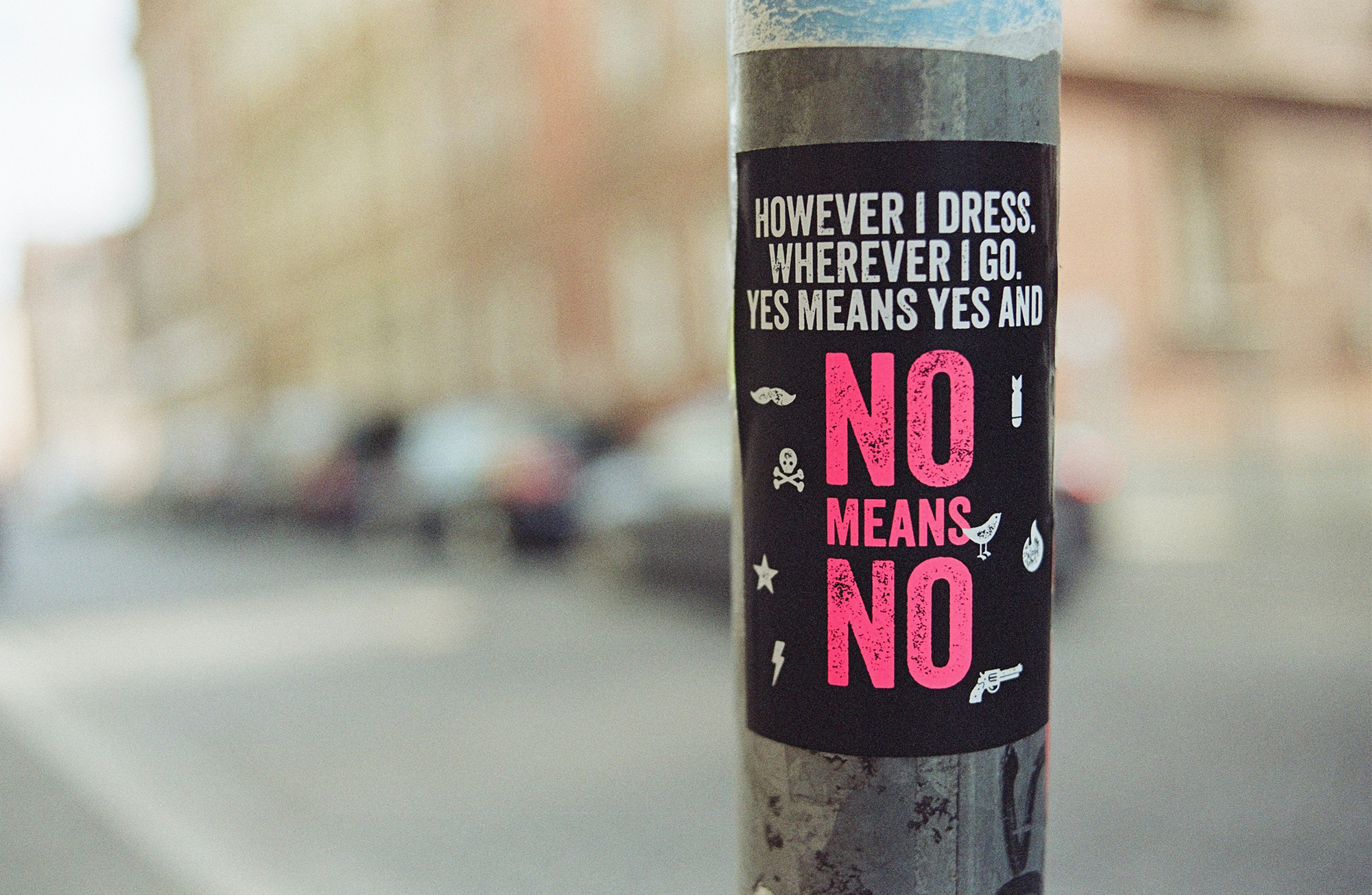
CONTENT ADVISORY: This essay discusses sexual assault.
I want to acknowledge here that both men and women can be victims of sexual violence, and both men and women can be perpetrators. My focus on men assaulting women is not meant to minimize sexual crimes against men and boys. I also want to acknowledge that no one is defined by something that was done to them, and for that and other reasons, many survivors of sexual violence do not use the term ‘victim’ to describe themselves. I use the word ‘victim’ in this essay for its legal definition, in order to underline the fact that sexual assault is a crime.
To the men who are not rapists:
Someone you know — a friend, a family member, a coworker, someone who attends your church, someone you know personally — is a survivor of sexual assault. You may not realize it, but it is almost certain that at least one person in your social circle has experienced sexual assault.
According to RAINN, a sexual assault occurs every minute in the United States. In 60% of rape cases, the survivor knows the perpetrator. More than half of women and nearly one third of men have experienced sexual violence.
And yet, for every 1000 sexual assaults, 50 reports lead to an arrest, 29 cases lead to felony convictions, and only 25 perpetrators are sentenced to incarceration. That means that 98% of perpetrators of sexual violence walk free.
Why?
Tumbleweird reported in September 2025 that Dr. Mark Mulholland, an OB-GYN practicing in Richland, Washington for decades, had been credibly accused of sexual misconduct and assault on his patients and coworkers for years, yet he was allowed to continue practicing even after complaints were reported to the Washington State medical board. Kadlec Regional Medical Center records obtained by ProPublica show that the hospital concluded as early as 2018 that Mulholland was acting inappropriately with patients, yet he continued seeing patients until 2025. At least 84 patients have filed lawsuits against Mulholland, indicating that the pattern of abuse was extensive, and lasted for many years without action being taken by either the hospital or the state medical board.
Why?
Last month, Nina Powers — a Tri-Cities violinist, business owner, and mother — wrote about her experience as a teenager while attending the Seattle Youth Symphony Orchestra (SYSO) camp for young musicians. In her Substack essay, ‘They Kept His Reputation: I Kept the Memory’, she recalls the abuse she experienced at the hands of Grammy nominated violinist Mark Sokol. At the time of the assault, Powers reported the crime. She was expelled. Sokol continued to work with children for the rest of his career. After telling her story publicly last year, others have come forward with similar stories about Sokol. SYSO has yet to reach out to Nina Powers, and for decades has failed to investigate allegations of abuse.
Why?
USA Gymnastics doctor Larry Nassar sexually assaulted hundreds of young girls for years before he was finally stopped, and even then, it was only after hundreds of his victims spoke up.
Harvey Weinstein assaulted women for decades before the ‘Me Too’ movement gained enough momentum that he was finally held accountable.
Churches, universities, high schools, youth camps, sports teams (not to mention Jeffrey Epstein) — there are so many egregious examples of abuse and coverups that stories like these are no longer shocking.
And in every single case, it seems to be the victims of the abuse who bear the burden of stopping the cycle.
Why?
Think about how our culture treats the relationship between men and women, boys and girls. Girls are taught that they must be ‘modest’ to protect themselves from boys who can’t control their urges. Boys are taught that girls are conquests — objects to be won.
So called ‘locker room talk’ normalizes assault and ignores consent. Think about the misogynistic words and language about women. Here are just a few examples:
- “Your body, my choice”: Claiming a man has the right to a woman’s body
- “You’re too sensitive” or “You can’t take a joke”: Silencing those who speak up
- “Boys will be boys”: Rationalizing harassment or assault and avoiding accountability
- “She must have asked for it”: Blaming the victim instead of the perpetrator
- “I’d like to get some of that”: Objectifying women
- “Did you score last night?” Making sexual conquest a game instead of a consensual act
In March of this year, a CNN investigative report exposed a global “rape academy” that was teaching men how to drug and assault their wives and partners. It was a network of thousands of men offering advice, recording themselves assaulting women, and sharing videos of their assaults. One of the websites referenced in the report had 62 million visits in February alone.
When that statistic hit social media, the comments devolved in to arguing about whether there were 62 million men involved or there were just 62 million visits to the site, as if the number of men accessing and viewing the site had any bearing on the fact that thousands of men are drugging and raping women, then recording and sharing videos of their crimes.
And, of course, there was the predictable claim of “not all men” — as if all men don’t bear a responsibility for the violent misogynistic culture we live in.
I keep asking myself why this continues — why so many men get away with so much for so long.
I think one of the biggest reasons is also the simplest one: because too many of us stay silent. We go along to get along. We have internalized the misogyny of our culture and accept that this is just the way things are. We aren’t rapists, we don’t assault women, and we think that is enough. We are the good guys.
As a young man, I was in a male dominated career. I was a member of the last all-male class at the U.S. Naval Academy. I served on nuclear submarines when women were still prohibited from submarine service. I heard plenty of locker room talk.
I have nervously laughed along with the guys at those locker room jokes, stayed silent when they talked about their conquests, and thought quietly to myself that I was ‘one of the good guys’ because I would never do the things those men described. I’m sure I even repeated some of those off-color jokes.
Too often I centered my own feelings, prioritizing my personal comfort and my desire to be ‘one of the guys’ instead of speaking up to break the cycle.
When we hear a survivor’s story, we are conditioned to automatically question the motives of the victim and give the perpetrator the benefit of the doubt.
And that’s the problem. We need to center the stories of the victims instead of the careers and reputations of the perpetrators. Institutions need to protect the vulnerable instead of the institution. Rapists must be held accountable.
The next time you hear someone speak up about sexual assault, don’t distance yourself from the harm. Center the victim. Picture the victim as your wife, your daughter, or someone else in your life.
Maybe you didn’t assault someone, but your silence allows it to continue. Not all men rape, but all men are responsible for the culture that allows rape to occur in the darkness, and then fails to shine a light on the evil that lives among us. It is our responsibility as men to turn rape from something that thousands of men brag about to something that is so abhorrent that an online ‘rape academy’ is no longer possible.
Author Mary Pipher said it best: “Young men need to be socialized in such a way that rape is as unthinkable to them as cannibalism.”
Ted Miller grew up around the world but now lives in Richland with his wife. He’s a runner, actor, singer, nuclear engineer, and graduate of the U.S. Naval Academy.
Ted believes that if more people worked toward love and understanding instead of giving in to fear and divisiveness, the world would be a better place.
