
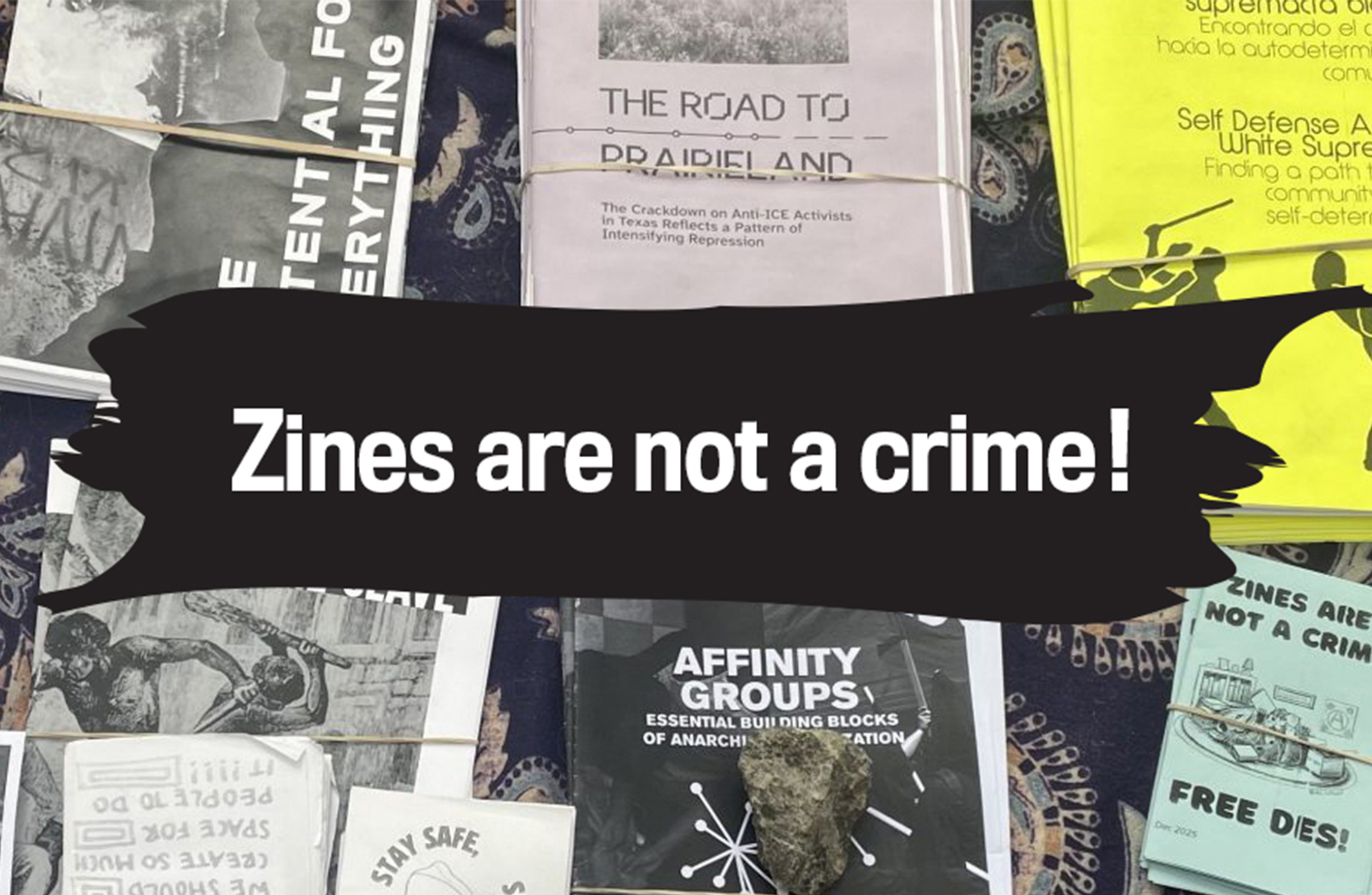
Some of the zines on display outside the Federal Courthouse in Fort Worth / Sara Van Horn, n+1 magazine
The essay incited a revolution.
The government had become tyrannical; its constitution could not protect the people from a man with absolute power. The man with all the power could bend the country to his whim – taxing without consent, concentrating his own wealth while the people suffered, starting wars the people didn’t want, ignoring the petitions of the people, and threatening violence whenever he didn’t get his way.
The essay said that the constitution was blatantly in error, giving too much power to one man and allowing that man to oppress the people. It called for a new form of government, one that worked for the people instead of a king. Published anonymously because the ideas were so radical, the author called the king a tyrant. The call for independence would soon lead to war.
The author was Thomas Paine, and his publication of Common Sense in January 1776 spread rapidly across America and Britain. The ideas were reflected in the Declaration of Independence with the words: “[W]henever any form of government becomes destructive … it is the right of the people to alter or to abolish it, and to institute new government.”
Thirteen years later, as they wrote their new constitution, the founders of the newly independent United States knew that unchecked power could lead to a tyrannical government like the one they had just fought to overthrow. So they gave the people the right to hold government accountable. It is no accident that the First Amendment gives us the rights we often take for granted — freedom of religion, freedom of speech, freedom of the press, freedom to peaceably assemble, and freedom to petition the government when we are wronged.
But once in power, those who use the government for their own benefit find ways to erode, bypass, or infringe on our rights.
And as Thomas Paine demonstrated, words can empower the people and topple the powerful. So the powerful try to silence those words.
Victor L. Berger was a socialist first elected to Congress in 1911, representing Milwaukee, Wisconsin.
Berger had long advocated for the working class, calling for labor protections against the industrial capitalists at the time. A newspaper man, he promoted ideas like labor unions, limits on working hours, care for seniors, and workplace safety. He wrote about how big-moneyed corporate interests had corrupted government, using the analogy of “malaria in a swampy country.” He said, “We should have to drain the swamp — change the capitalist system — if we want to get rid of those mosquitos.”
The government tried to keep his ideas from spreading. Under government directive, the postal service revoked mail privileges for his newspaper, the Milwaukee Leader, and refused to distribute it.
Berger opposed the United States entering World War I, believing that military capitalists were profiting at the expense of the average worker. As part of the socialist party, he drafted a position that stated war was "a crime of our capitalist class against the people of the United States and against the nations of the world," and pledged "continuous active and public opposition to the war, through demonstration, mass petition, and all other means within our power."
After entering the war, Congress passed the Espionage Act in 1917, and that act was used to prosecute Berger solely on the basis of his speeches and writings. He was convicted in 1919 and sentenced to 20 years in prison for conspiracy against the United States. The people of Milwaukee re-elected him to Congress anyway, but Congress refused to seat him. After an appeal, the Supreme Court overturned the conviction in 1921 on a technicality. Berger then served three more terms in Congress.
The constitutionality of the Espionage Act continues to be debated and, although it has been revised, remains in effect today.
The government doesn’t like to be challenged. For every bit of progress over the last 250 years, there has been an attempt to silence the voices of those demanding change.
The latest effort to go after dissenting voices is National Security Presidential Memorandum-7 (NSPM-7), titled ‘Countering Domestic Terrorism and Organized Political Violence’, issued by Donald Trump on September 25, 2025. NSPM-7 describes domestic terrorism as “anti-Americanism, anti-capitalism, and anti-Christianity; support for the overthrow of the United States Government; extremism on migration, race, and gender; and hostility towards those who hold traditional American views on family, religion, and morality.”
The claims in NSPM-7 of domestic terrorism are so biased against dissenters of this administration, and the basis for being labeled a domestic terrorist are so broad, that anyone who criticizes the government can be arrested, tried, and convicted — not for a criminal act, but for what this administration considers criminal ideas.
It is curious to note that the examples of political violence in NSPM-7 are under the broad leftist umbrella of ‘antifa’ (short for ‘anti-fascist’), but there is no mention at all of the political violence by right wing white supremacists and Christian nationalists, which according to the Center for Strategic and International Studies, have historically far exceeded the violence on the left.
On June 23, 2026, Elizabeth Soto was sentenced to 50 years in federal prison for publishing a zine. A week later, her husband, Ines Soto, was also given a 50 year sentence. A jury found them guilty of “providing material support to terrorists.” The evidence the government used included their office printer used to print zines, membership in a leftist book club, and possessing boxes of anti-government zines, books on feminism, and a book of poetry about cancer.
The Sotos had attended a protest at the Prairieland ICE detention center in Texas about a year before their convictions. A few of the protesters at the protest began spray painting graffiti on cars and slashed tires on a government vehicle. When guards ordered the protesters to leave, most of them complied.
Then, a police officer arrived, drew his gun, and aimed it at fleeing protesters. Another protester fired her rifle at the ground near the officer. She said that from her military training as a marine, she thought the police officer was about to kill a protester. The officer was grazed by the bullet, and was taken to a hospital, treated, and released in a few hours. The Sotos were not at the protest when the shots were fired.
Another woman, Maricela Rueda, was arrested for being at the protest, even though she had left when officers began dispersing protesters and was not present at the time of the shooting. She called her husband, Daniel ‘Des’ Sanchez-Estrada, from jail to have her car towed from the protest site and to check on their home. The government listened in on that conversation and had the police stop Des (with questionable probable cause), who was subsequently sentenced to 30 years in prison for moving a box of zines that criticized ICE and the police.
The exorbitant, decades-long prison sentences for protestors at the Prairieland ICE detention center have been widely criticized by critics and civil liberties experts as a dangerous expansion of domestic terrorism laws to criminalize First Amendment-protected protest and political dissent.
Zines are not a crime.
TUMBLEWEIRD is a zine that has been a valuable alternative progressive voice for the Tri-Cities community since 2016. We started by printing a few dozen little black-and-white zines on an office printer; now, we have a loyal and growing following with a readership of over 10,000.
But not everyone in our community appreciates our bold and progressive editorial stance. I remember in the early days when an entire stack of free zines at a distribution site would suddenly disappear, only to be found in a nearby dumpster. Somebody must not have liked what we had to say. When our reporting calls out unethical behavior or corruption by our local politicians, we get pushback from elected officials. But we keep publishing, month after month. With a civic-minded focus, we always aim to be positive in our approach to improving our community. We are never timid in speaking truth to power.
We have specifically called out the violence and cruelty of ICE tactics and detention. We have called out the genocide in Gaza. We have called out local politicians for opposing LGBTQ+ rights. We write about climate change and saving the environment. We are against fascism, which makes us anti-fascist. I have personally written on every one of these topics.
Will our publication lead to our arrest? If a protester is found with a stack of TUMBLEWEIRD issues in their car, will they be labeled a domestic terrorist? Will we on the staff of TUMBLEWEIRD be arrested for exercising our first amendment rights?
Publications that call for change are an essential part of any democracy. Without dissenting voices, we will soon be under the thumb of a tyrannical government's thirst for power, much like Thomas Paine railed against 250 years ago.
Ideas aren’t criminal, holding government accountable isn’t treason, and the press is not the enemy of the state.
Robert Arnold, speaking of the Prairieland convictions, said, “Presumption of innocence, freedom of association, freedom of the press, and freedom of speech are not inefficiencies in the system; they are the system's immune response against the concentration of power.” Arnold went on to say, “The moment we begin treating the existence of ideas as evidence of violence rather than the alternative to violence, we invert the very purpose of free expression.” I encourage you to listen to his entire post ‘On Prairieland’ (Substack.com/@defiance13, June 28, 2026).
I’m committed to non-violence. I oppose political violence in any form.
Publishing a zine is not violence. Distributing a zine is not terrorism. Exercising our first amendment rights is not a crime.
Long live independent media!!!
Ted Miller grew up around the world but now lives in Richland with his wife. He’s a runner, actor, singer, nuclear engineer, and graduate of the U.S. Naval Academy.
Ted believes that if more people worked toward love and understanding instead of giving in to fear and divisiveness, the world would be a better place.
 Ted Miller
