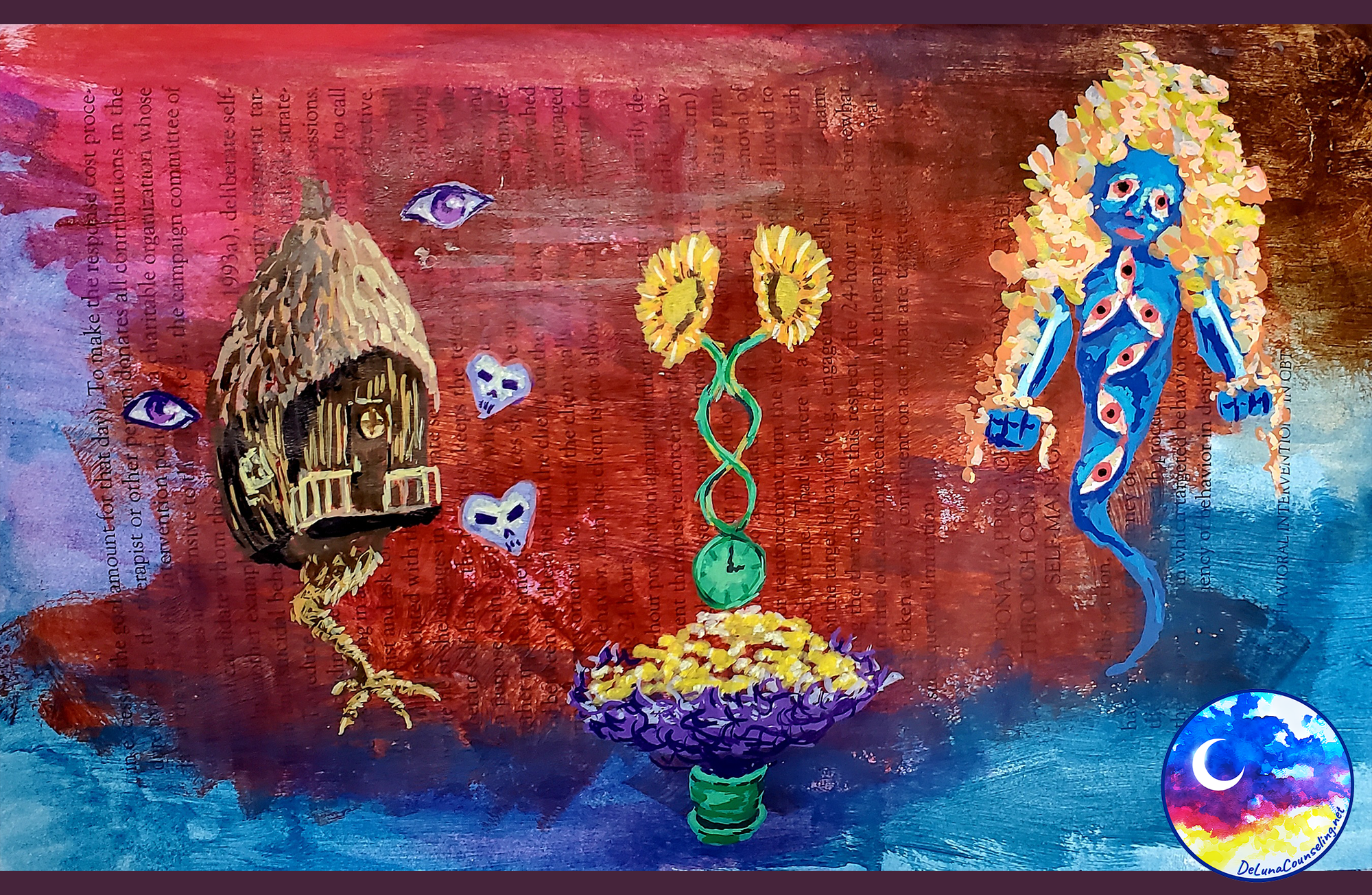
One of the therapists at DeLuna Counseling shared this art piece as an example of how they processed a past friendship:
Where Do I Put These Memories of You?
“This art piece represents a friendship that spanned over a decade. I created the piece as a way to try and have some peace of mind over how things ended, as it felt like external forces created a divide that was too painful to really circumvent. The hut represents the way that this person felt to me over the course of our friendship, where it was easy to be spiritual and creative whenever she was around. The second image of the clock and flowers represents the divide that began to form, when our friendship began to fracture. The final little creature represents how I feel about the myself, a little haunted and uncertain about my own choices and actions, unable to shake free from the sense that maybe I could have done something different.”
Art and art therapy are useful tools for understanding ourselves and the world around us. Expressive therapies are presently used by many therapists to facilitate growth and change, while not having to rely on talk therapy exclusively.
The goal of this column is to present a topic from a place of vulnerability, followed by an art exercise that might facilitate curiosity and insight. It is not a guide for how to make a specific type of art, nor is it a replacement for therapy. (Editor’s note: Check out Ashleigh Rogers’ “Acts of Art” for some additional art making ideas: https://tumbleweird.org/topic/acts-of-art)
This column is written by counselors familiar with creative and expressive therapies, and we welcome questions or comments. If you would like to engage in the act of making or sharing your art from this column, feel free to contact DeLuna Counseling, or join us in person at our monthly gathering at Earth Spirit in Kennewick. Information for the event and how to contact us can be found at http://delunacounseling.net.
I often question my capacity to engage in this thing we call ‘friendship’. It can be hard to count the massive number of times I feel l have failed people. I sort through memory after memory, finding myself coming up short and wishing I had done better (or at least done something different). So many people have offered me care, compassion, kindness, and love; yet, I allowed them to fade away and be lost to time.
I know that I am not the only person dealing with this issue; my friends and clients have talked to me about similar struggles as they reflect on the impact they have had on people. I have heard countless stories from people feeling like a ‘bad’ friend to others who were hurting, isolated, or needing more support than was available. In the midst of this grief and shame, it can be hard to center compassion, kindness, and curiosity into the postmortem of an important relationship.
To be clear, there are times where these conversations are about toxic relationships and bad actors, where blame and denial are utilized to avoid accountability. In these instances, there is nothing quite as satisfying as engaging in the time-honored tradition of talking mad shit about the person we are releasing from our lives. The examination of past relationships and the abusive or toxic traits present therein can genuinely have massive therapeutic benefits that improve our mental health and future relationships (Iverson, Taverna, 2026). However, I am left wondering about the relationships that don’t fit the ‘abuse’ or ‘toxic’ category — relationships where I carried more responsibility for the breakdown than I can comfortably admit. I still want to know what it means to be a good friend, and why I end up being a bad friend much more often than I would like.
A review of research articles indicated that a good friend is someone who is honest, reliable, and has been present in your life for a prolonged period of time (Apostolou, Vetsa, 2023; Pezirkianidis, Stalikas, & Moraitou, 2022; Roberts-Griffin, 2011). As trust and honesty were themes that emerged from several studies, I decided to start there. I truly believe that most people try to be reliable and trustworthy in relationships. So then, why all the heartache?
Honesty, in my view, means having the insight and the courage to take stock of our shadows — the parts of us that we prefer not to think about. My childhood was riddled with false promises of spending time together, taking trips, or celebrating my accomplishments. Few of these promises came to fruition, regardless of how many assurances I received that “this time will be different.” This dynamic made it difficult to trust the people in my life. It began an insidious pattern in which I learned it was best to not expect anything at all, especially not from loved ones. No expectations meant no disappointments.
Now that I am an adult, it is easy for me to say, “Yes, I want to have coffee with you!” and “We should hang out!” — which then leads to nothing. I tell myself that it is due to my insane schedule, and not having the resources I need, emotional or otherwise. However, the reality is that it is dishonest, and harms my friendships. I want to believe that I have not become like those disappointing adults from my childhood; but functionally, the behavior is the same. Those adults probably also made promises based on who they wished they were, and not who they actually could be at that moment.
In other words, lying to myself about the state of my life turns into an inability to be honest or reliable with the people who care about me. They can’t depend on me, nor can they offer me feedback if I continue to ignore that part of my shadow. At least, not without me becoming defensive. And this specific brand of my own lack of followthrough is only one example of my many shadows! I have to ask myself, How many friendships have I harmed simply through lack of insight, and not being capable of understanding who I am?
As a therapist, I know I have to forgive myself enough to be able to do my best to nurture the people who are still in my life. Shaming myself will only re-create old harms and lead to further disconnection from truths about myself that might generate better, more honest relationships. I have to accept that honesty requires a deeper assessment of my flaws; and even more, it requires me to talk about them frankly, with compassion and kindness. It means admitting that I have been a bad friend, and that I deserve to be loved anyway.
So how do we practice self-forgiveness? How do we accept that we are capable of harm, but still worthy of love? Archbishop Desmond Tutu literally wrote The Book of Forgiving (2014), offering us a road map and some assistance. The most important aspect to keep in mind on our path towards forgiveness is to center compassion and understanding. Seeing our humanity, which includes our capacity to be flawed, allows us to heal and move through the harms we have engaged in towards ourselves and others. What follows will be an art exercise to help walk us through that process. This can be done with any preferred art medium.
Please note: Try not to do these in isolation, and make sure you have space to receive comfort and compassion. Healing is often about having the right people around — people who support you, and who can help you continue the path towards understanding. Allow yourself to use any creative outlets that you are familiar with while engaging in the exercise, such as writing, painting, collage, drawing, sculpting, or movement.
Start by taking a few deep breaths. Once you are feeling centered, allow your mind to reach for an old friendship that has been on your mind. Sit with that friend for a few nurturing breaths. Next, give yourself five to ten minutes to ‘tell’ the story of your friendship, using your chosen art medium. Allow yourself to include the emotions that are present for you when thinking about memories that you shared with this person. You may also include your perceptions of how your friend felt about you in the past.
Take a few more deep breaths. In the same piece of art (or in the same space), give yourself the opportunity to reflect on the end of the friendship and what transpired. Are there actions you took that still elicit large emotions for you? Give yourself time to think about who you were within that friendship. Now ask yourself: Can I forgive the choices I made? What advice or reassurance would you have offered this past version of yourself? Take time to create art around these questions, knowing that it's also okay if forgiveness is not accessible for you at this time. Simply considering the friendship with a focus on your own sense of self is already moving you towards being more honest and compassionate towards yourself.
As the last step, take a few deep breaths and offer yourself encouragement. Allow yourself to consider how you feel about the relationship having ended. What has been your grief process when thinking about this person who shaped your life? Also, allow yourself time and space to consider if there is any grief for the version of you that existed within that friendship. Are there aspects of yourself within the relationship that you miss, or that you are glad are gone? Conversely, are there aspects of that old friendship that are present in your new relationships?
Allow yourself to create more art as a response to these questions, remembering that there is no wrong way to feel. This process should be about inviting curiosity and self-compassion into those questions that cling to our minds.
References:
- Apostolou, M., & Vetsa, P. (2023). Friendship preferences: Examining desirable and undesirable traits in a friend. Evolutionary Psychological Science, 9(1), 38-49.
- Iverson, Katherine M., and Emily Taverna, ‘Psychosocial Treatments to Improve the Mental Health of Intimate Partner Violence Survivors’, in Connie Mitchell, and others (eds), Intimate Partner Violence: A Health-Based Perspective, 2nd edn (New York, 2026; online edn, Oxford Academic, 20 Nov. 2025), https://doi.org/10.1093/oso/9780197758991.003.0036, accessed 7 July 2026.
- Pezirkianidis, C., Stalikas, A., & Moraitou, D. (2022). Character strengths as a predictor of adult friendship quality and satisfaction: Implications for psychological interventions. The European Journal of Counselling Psychology.
- Roberts-Griffin, C. P. (2011). ‘What is a good friend: A qualitative analysis of desired friendship qualities’.
- Tutu, D., & Tutu, M. (2014). The book of forgiving: The fourfold path for healing ourselves and our world. HarperOne.
