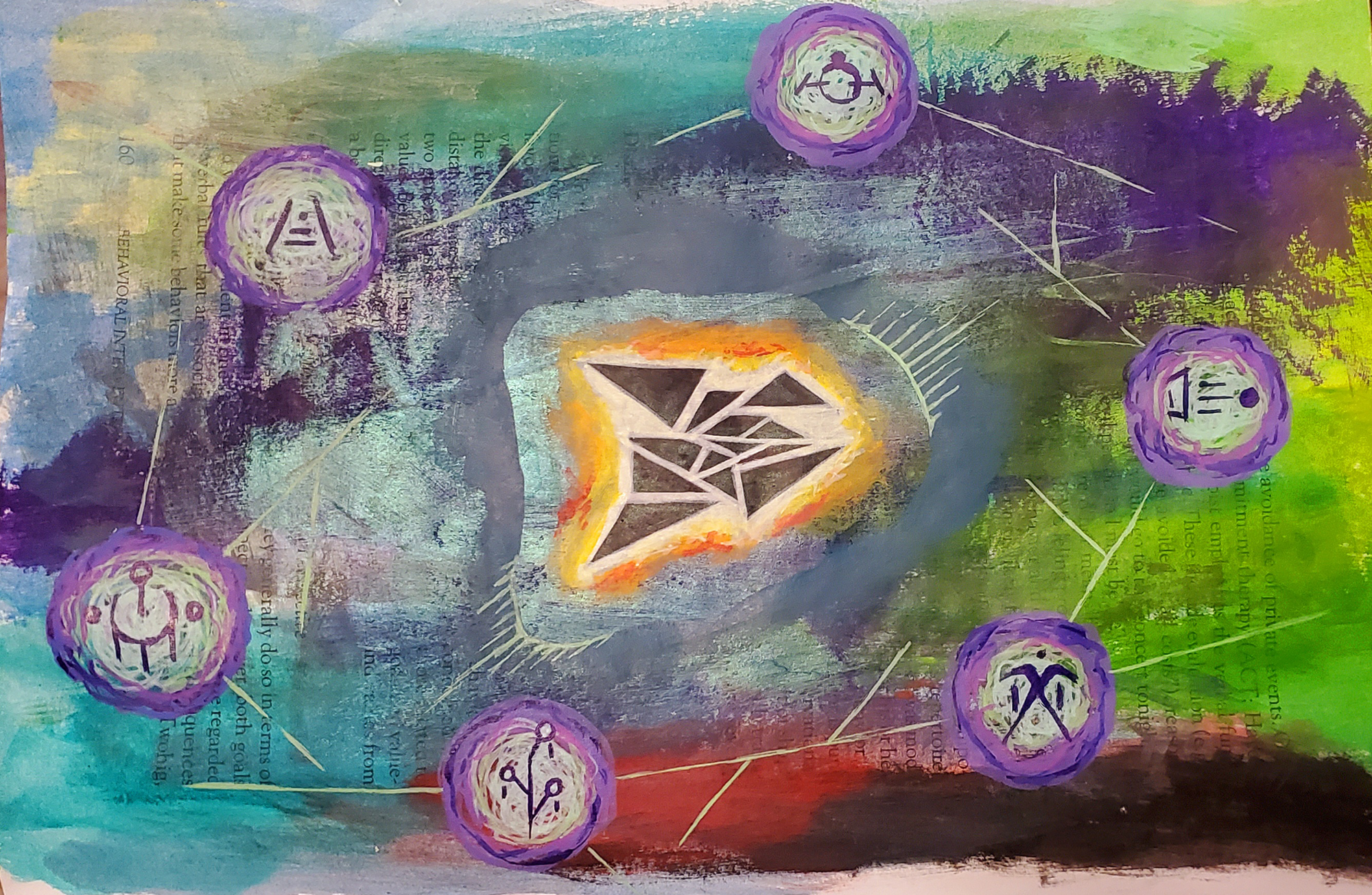
This art piece comes from the art journal of DeLuna: “The black jagged pieces are a representation of the way it feels when I'm tired across my shoulders and neck. Underneath that heavy jagged feeling is hot and sharp pain that I ignore by keeping my mind and body as busy as possible. Rest is hard to access, and sometimes feels like it requires a code to unlock, which is represented by the orbs.”
Art and art therapy are useful tools for understanding ourselves and the world around us. Expressive therapies are presently used by many therapists to facilitate growth and change, while not having to rely on talk therapy exclusively.
The goal of this column is to present a topic from a place of vulnerability, followed by an art exercise that might facilitate curiosity and insight. It is not a guide for how to make a specific type of art, nor is it a replacement for therapy.
This column is written by counselors familiar with creative and expressive therapies, and we welcome questions or comments. If you would like to engage in the act of making or sharing your art from this column, feel free to contact DeLuna Counseling, or join us in person at our monthly gathering at Earth Spirit in Kennewick. Information for the event and how to contact us can be found at http://delunacounseling.net.
After receiving a lot of feedback, I have come to understand that I am in need of tackling my relationship with work. But every time I try to improve my work life balance, it feels like attempting to re-pot a cactus — I tend to come away pained and regretting my decision to take it on.
I have delved into research articles on workaholism, burnout, resiliency, and socio-political factors driving scarcity; and in the process of doing so, I’ve written about three versions of this article. Originally, I envisioned writing this piece as an exploration of my personal relationship with workaholism and burnout, which would lead to me finding some solutions that I could implement and share with others. This is not that type of article.
What I encountered in my research was a bit darker, less individualistic in nature, and lacking in easy solutions. What I read validated some of the dark hopelessness I feel in the pit in my stomach on those days when I am too exhausted to function. The flavor of capitalism we suffer under is built so that overworking ourselves is normalized, and there is little relief from the day-to-day financial burdens placed on us. Our country has a high percentage of people who live paycheck to paycheck, and who are trapped in jobs due to the fear of losing everything (Oxfam). Even as someone with a professional degree, I relate to this feeling; every time I make a little progress on my savings, my student loan debts rise up to scrape back the little headway I’ve made. I can’t help but notice that I (and my clients) seem to overwork ourselves not because it is addictive, but rather because we are forced to focus on making money; and when trying to rest our attention is diverted to not having enough money creating an insidious perpetual loop. It is how the system is built to affect us.
Which leads me to the next thing I learned about on my writing journey: what is happening to all of us psychologically on this awful hamster wheel. I suggest reading the Anne Helen Peterson article titled ‘How Millennials Became the Burnout Generation’ (Peterson), as it covers this topic better than I ever could. The take away from the piece for me was that we are facing an ongoing, systemic, and chronic issue with burnout due to how fucked we have been for almost two decades. Peterson discusses the ways in which stressing out a person’s nervous system creates difficulties and dysfunctions that affect our concentration, our interpersonal skills, and our ability to manage mental health issues and disabilities.
Finding solutions for these systemic problems will require huge political and systemic shifts, and it will take a lot of us working together to make that happen. It also does not escape me that ‘they’ — the people who benefit from the working class continuing on exactly as they are — are motivated to keep us too tired to change the system. Even with that exhaustion, I strongly encourage anyone reading this to conserve a little energy to make sure you vote, volunteer, and stay engaged with your community as much as you can.
I need to interject something here. After reading the Peterson article, I had to stop and remind myself that, although systemic answers are important, looking at my partner and saying, “I can’t be more present in our relationship right now because I have been rendered powerless by capitalism and we are attempting a revolution” is a cop-out for the commitment I have made to him. I have to continue to work on my skills to express my emotional distress and exhaustion in ways that don’t damage my relationships. This was not modeled for me at all growing up, with the pains of the world my parents suffered through being passed on directly to their children. There were many explosive and damaging moments that I was blamed for causing because I was such a lazy child, and some part of me still reacts from that place of trauma.
While researching this article, I allowed it to evolve and take the shape it needed to. For me, that mostly meant coming to the realization that I was looking for ways to be gentler and kinder to this tired, sad, stressed, cranky version of myself that wants to run away from it all. This helps me feel more compassion for my impulse to want to run from an environment that operates through power, control, and abuse. For me and many of my loved ones, there is no easy exit from this abusive relationship with capitalism, but I can stop blaming that hurt part of myself for the pain and exhaustion I experience daily. Shifting the anger and frustration I have onto the systems of power responsible for the inequity in our society, and instead having compassion and creating steps for rest and recovery, is the real challenge.
Rest, for me, continues to be an amorphous and ephemeral creature that shifts the minute I feel like I have landed somewhere helpful. At times, listening to audiobooks while sitting outside feels like the best thing in the world; while at other times, I am overcome with anxiety if I don’t get out to do something active. While writing this, I have also come to understand that work itself can be a refuge and a place of rest for me. Having the privilege of being a therapist and offering comfort and kindness towards others can be a reprieve from the pain of the world. Meanwhile, it’s my personal relationships that can feel like work that I am unprepared to tackle, as they can require a level of personal vulnerability that feels insurmountable at times.
The next step for me is to create the space I need to have consistent conversations with my present self — and my inner child that felt scared to look like he was resting. Resting isn’t laziness; it is “medicine for a sick and exhausted world” (Hersey). What follows is a meditation that helps me offer myself the compassion I need and deserve. It won’t work if I wait until I am too tired to know what I need, and too frustrated to have a healthy conversation about what I am going through. I need to catch myself at times when I have the energy to explore my pain and exhaustion. This is also not meant to be a solution I engage with only once, but rather a ritual that I can come back to as my life and needs shift and change.
Please note: Try not to do these exercises in isolation, and make sure you have space to receive comfort and compassion. Healing is often about having the right people around — people who support you, and who can help you continue on your path towards understanding yourself better. Allow yourself to use any creative outlets that you are familiar with while engaging in the exercise, such as visualization, writing, painting, collage, drawing, sculpting, or movement.
Begin by taking three deep breaths in through your nose and then slowly exhaling through your mouth. Allow yourself to conjure up a mental image of yourself the last time you felt exhausted. This might be how you feel at present, and that is okay. Take the time to try and see yourself as clearly as possible — what you look like, what you’re wearing, and how this version of you in your mind’s eye is sitting or standing. Take a few deep breaths as you hold that image of yourself in your mind.
Next, ask yourself what your exhaustion feels like in your body. Is there a part of your body that holds this feeling in particular, or is it more diffused? Are there colors, textures, or movement associated with how the exhaustion feels inside of your body? Is there a weight to this emotion, a movement, a voice? Allow yourself to take some time to paint, draw, or describe the feeling of exhaustion through your preferred art medium. It can be hard to sit with an emotion for a prolonged time, so be sure to take breaks if needed (remember, rest is medicine!), and keep breathing. Be gentle and remember that this visualization of your exhaustion is not the enemy!
Imagine yourself offering kindness, compassion, and rest to the feeling of exhaustion inside your body. You can begin by offering things that have helped you feel more rested in the past, like taking a walk in the park, sleeping in, or watching a good show.
As you offer your exhaustion possible ways to provide comfort and respite, notice how your body responds and what emotions are evoked. Is there resistance or rejection of these offers, or is there acceptance and relief? Allow yourself the opportunity to turn back to your art to create a representation of how your exhaustion is presently responding to these offers of comfort, taking note of which ones feel more accessible and which ones are not presently being welcomed. Think of this as a living breathing art piece, one in which your exhaustion can be more clearly heard and understood through visual representation or movement.
If it feels helpful to do so, give yourself an opportunity to finish the art piece with written messages and/or internal reminders for future exhausted versions of yourself that are yet to come. What do you believe they need to hear?
If issues with rest and exhaustion are consistent parts of your mental health struggles, and you make a visual art piece during this meditation, it might be beneficial to add it to a part of your home where you can access it more easily. Before periods of rest, such as weekends or vacations, give yourself an opportunity to access your art piece and work through what you might need to help you recover.
For me, personally, thinking of getting proper rest as a giant ‘fuck you’ to the world and to the systems that harm me does make it easier and more delicious. For those of us that need the extra motivation and permission to rest, remember that rest is resistance and healing cannot happen without spaces for stillness and recovery.
DeLuna is an art therapist based out of Richland. They are interested in the connection between healing, art, and community.
References:
- Petersen, Anne Helen.‘How Millennials Became The Burnout Generation’: buzzfeednews.com/article/annehelenpetersen/millennials-burnout-generation-debt-work
- Oxfam. ‘Hard work, hard lives’: oxfamamerica.org/explore/research-publications/hard-work-hard-lives
- Hersey, Tricia. Rest Is Resistance: A Manifesto: bookshop.org/p/books/rest-is-resistance-a-manifesto-tricia-hersey/72039c1cbdfea3ed
