Narrated by Chad Fox
As a strong ally of the LGBTQ+ community, I see Pride in Pasco as a fun event geared towards accepting people as they are and celebrating our differences, be it sexuality, gender, or whatever else makes you YOU. This year, from my booth at the event, I was delighted to see folks from all walks of life coming together and having a fun day in the sun! It was heartening to see friends join us for good conversation and some great chill time with coloring and plenty of water!
However, not everyone who showed up to Pride did so with the intention of joining the fun.
In the latter half of the day, protesters from Lexington Reformed Baptist Church arrived at the festival to do what their website called an ‘outreach event’. These ‘outreach events’ — which I would refer to as protests — are a regular part of this church's practice.
According to their website:
Throughout the year we do multiple outreach events (Mardi Gras, Pendleton Round-Up, Farmers Markets, Abortion Rallies, LGBT Parades, Portland Rose Festival and Saturday Markets, Leavenworth City-of-Lights, etc.). We also do numerous door-to-door outreaches.
In the words of their pastor, Eric Schonbachler (who was kind enough to give me an interview):
“I want to make this clear: it's not just pride events that we go to. We, as Christians, care enough about people that we actually believe what the Bible says. That we're all dead in sin, so we're all sinners. We all should receive God's judgment.”
The core message I received from my conversation with Schonbachler was that their church believes that if they do not educate people on the message of the Bible, then they are allowing people to go to hell. Schonbachler went on to say, “We love the people but hate the sin,” — a statement that left me reminiscing about my first interaction with this group.
Three years ago, in a rainy Peanuts Park, I was manning my first booth at Pride for my business. I wanted to show the community that there are allies in every occupation. A few minutes before that year's protest, a member of this group — who I have seen protesting with them every year since — approached us and asked me, “Are you gay?” To me, that was an immediate red flag. I knew something was about to happen. Sure enough, shortly after, protesters started walking up and down the aisle, reading from the Bible and engaging in arguments with anyone who would listen. It completely distracted from the event and pulled attention away from the supportive environment Pasco Pride is known for.
This show would be repeated the following year in Memorial Park, the new home of Pride. This time, they showed up with the same signs, and set up near the main stage. The protest was largely the same song-and-dance as the year before, but it had the added effect of distracting from the program running on the main stage. It was disrespectful to the people, families, performers, and vendors present, and this lack of respect made me angry. I struggled (and still do, despite my conversation with Pastor Schonbachler) to see how it accomplishes anything other than driving folks away from churches.
So many people who attend Pride have been rejected by their families and faith. While some churches attend Pride in support, and have provided a new religious home for the community, there are many people who have experienced severe religious trauma. They lost their families and support systems, and were told they were evil sinners simply because they love who they love, and want to be who they truly are.
I have long held the belief that there is no way someone chooses the harsh and isolating life that comes with being different in our society, particularly members of the LGBTQ+ community, whose existence is actively contested by groups like Lexington Reformed Baptist.
During my conversation with Schonbachler, I asked him, “If you want to have conversations, why not get a booth here set up and be present to have calm conversations?” I mentioned that a handful of churches table at Pride every year.
His answer was not what I expected, but I found it to be even more shocking: “Whoever these quote unquote ‘churches’ are, I would say they're not churches… The biblically-defined churches.”
He referenced a passage from the Bible to explain his reasoning:
“[I]n the book of Ephesians, chapter five, it talks about that Christians are light. And so we're not to participate in fellowship with darkness. So it actually would define what’s happening here as that very thing. So it’d be like part of that. So we’re not to participate in fellowship with it in any fashion; rather, to expose it.”
The truth was clear: Schonbachler’s church thinks that Pride events, if not the people, are evil; and they see it as their job to expose them to the ‘light’ — a notion that I find to be personally offensive. It’s yet more confirmation that however much they claim to “love all people”, this church would never accept members of the LGBTQ+ community, nor those who support them, even if those people are using the same Bible as the basis for their faith.
Throughout our interaction, Pastor Schonbachler was pointedly disinterested in discussing any new information, and dismissed any points I brought up, oftentimes outright ignoring what I said while attacking my beliefs. He also kept repeating that they simply wanted to have “conversations” with people, despite his obvious unwillingness to converse with me, and said that the ‘aggressive style’ of interaction was not what they wanted, suggesting that it was the fault of the event organizers for not allowing them to talk to people calmly.
A week after Pasco Pride, I called A’isha Martin, the lead organizer of Tri-Cities Pride, to discuss the claims raised by Pastor Schonbachler. When asked about organizers preventing conversation with participants, she had a lot to share. Like myself, she had seen the same group from Lexington Reformed Baptist show up for years, always failing to have respectful conversations. She said that they cannot stop these people from showing up because “when you do a public event in the park, you don’t own [the space], unless you can afford to do a ticketed event with fencing. This isn’t affordable, but it also opens it up to anyone who wants to be there.”
The protesters may have a right to be there, but that doesn’t make them effective in reaching their supposed goals, a perception confirmed by Martin: “It's the way they come in, the way they talk down to people. And when we disagree, they say, ‘Bless you; you’re living in sin.’”
One Pride attendee was very upset by the aggression shown by the Lexington Reformed Baptist protesters, especially one who shows up every year with a huge sign depicting images of mangled babies. “Why are they even showing us that graphic material at a family-friendly event?” they asked.
The aggression from the protesters appears to be genuine; they show up year after year with megaphones and hateful signs. But what about their claim against the event organizers? Tri-Cities Pride organizers have a clear message in response. Martin said:
“[We] want to simply keep things peaceful. It's on us as organizers to create a safer space for attendees, and we are creating a safer space so people are not being antagonized into conversations they don’t want to have.”
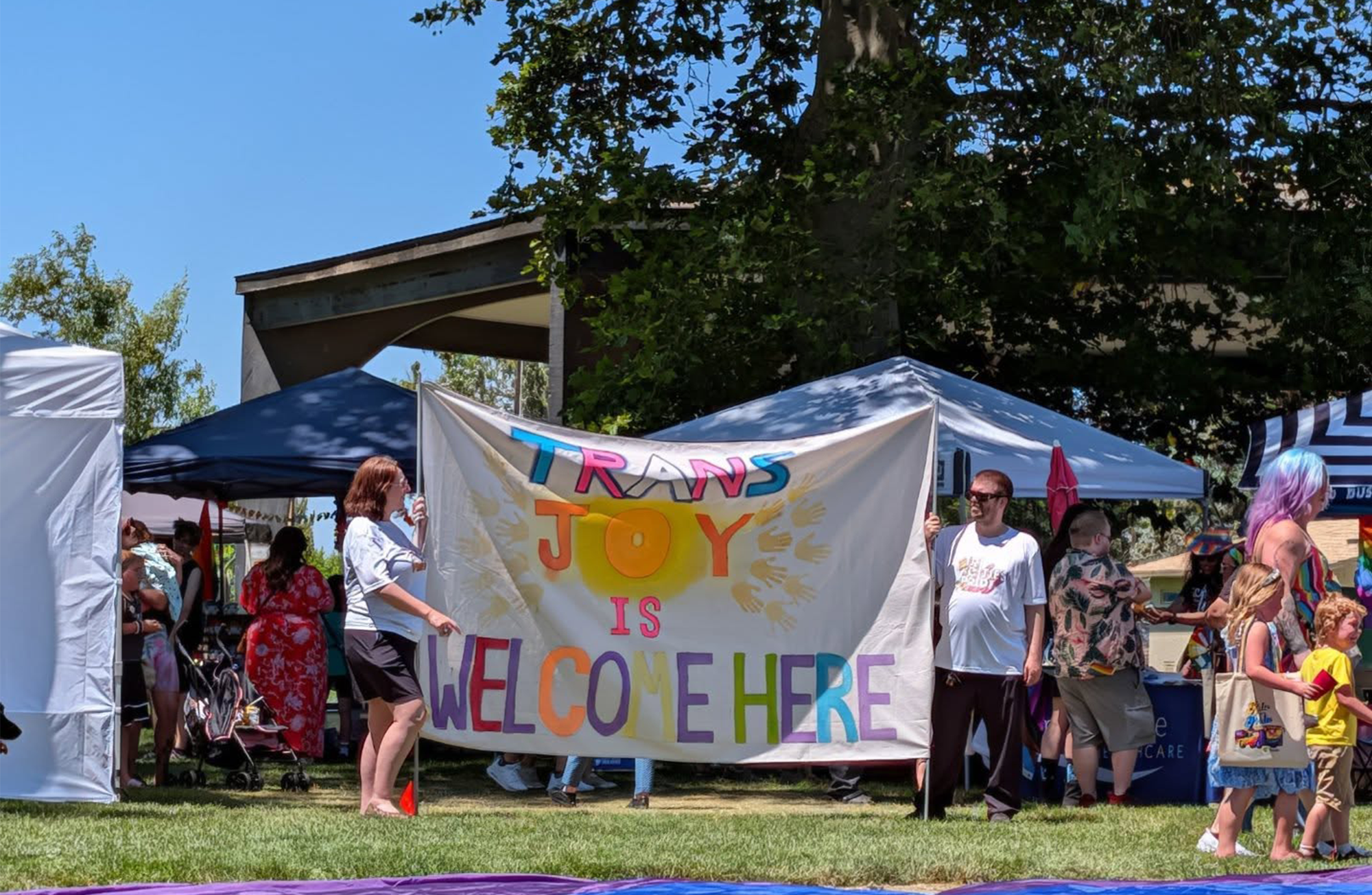
This year, with the goal of a safer, peaceful space in mind, the organization had a plan in place. The disruption from Lexington Reformed Baptist was expected. So when they showed up ready to cause chaos, volunteers armed with banners that hosted uplifting messages for the community swiftly surrounded the protest from a respectful distance to create a barrier, protecting festival attendees from being exposed to taunting and graphic images on signs.
“We looked into what the law was, and we had open spaces so people could walk in and out of the barriers and could have conversations if they chose it,” Martin confirmed. She went on to say, “For safety reasons, this year went very well; the banners kept the peace and some distance.”
Another attendee, Quinn, said that Pride this year felt much more peaceful, much safer. “A lot of people I talked to weren’t even aware that the protesters showed up,” they said. “Tri-Cities Pride is doing a wonderful job!”
Bryan Verhei graduated with a degree in Political Science from Eastern Washington University and is currently a small business owner in real estate. He has worked with FairVote Washington and other local nonprofits that share his passion for political literacy.
