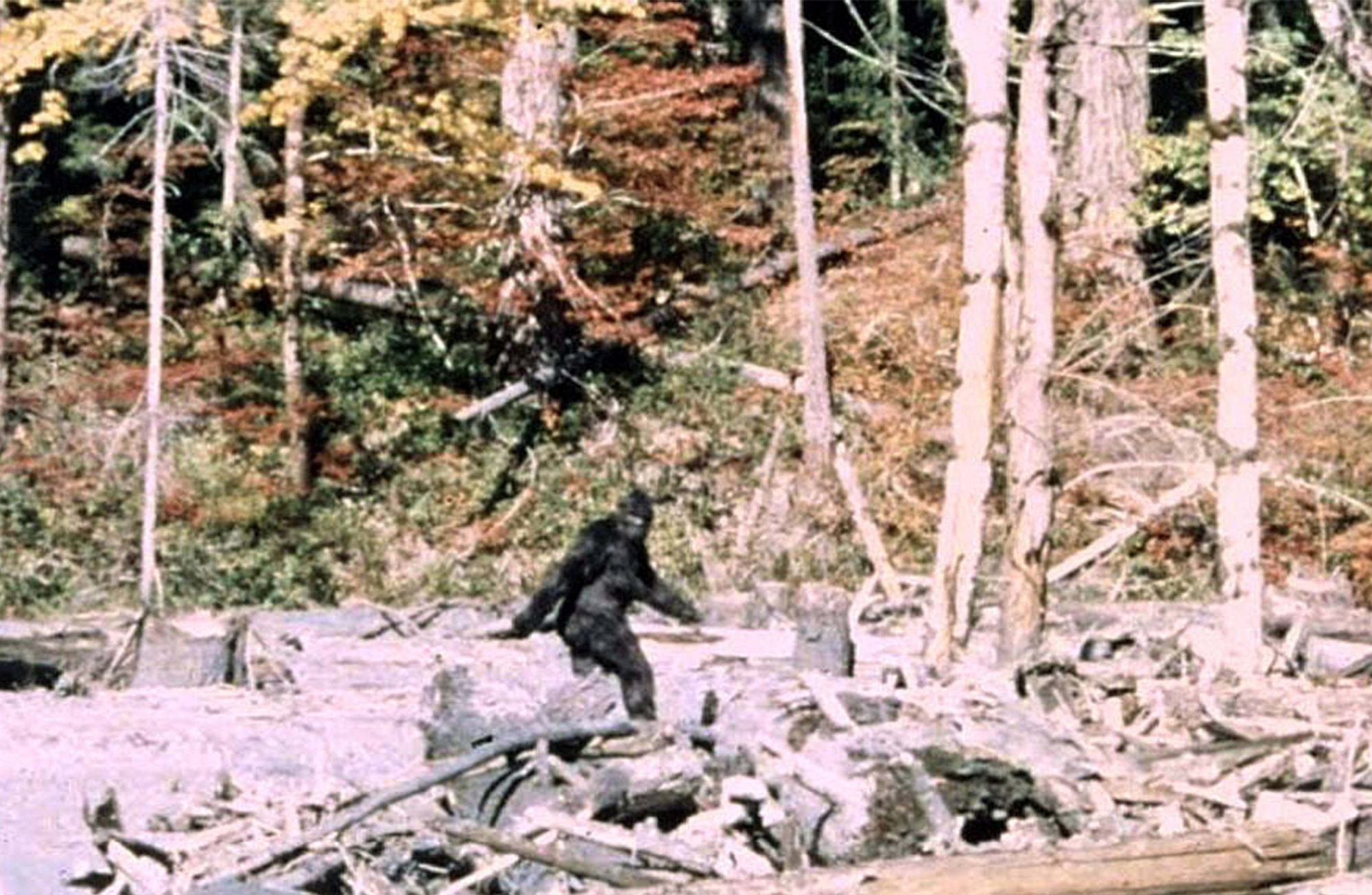
‘Bigfoot’ from the 1967 Patterson–Gimlin film
The following account is based on several interviews with Marc Myrsell, with supporting details from Myrsell’s book: Mountain Devil! The 1924 Ape Canyon Attack and Its Aftermath.
Bigfoot is an icon of Washington State. The hairy hominid has a long history of sightings statewide, but only once in Washington history was Bigfoot the main headline: In 1924, five miners emerged from the Mount St. Helens area with a winding tale to tell — culminating in a fight for their lives.
The men entered Ape Canyon near Spirit Lake in Spring 1924. Their names were Marion Smith, Leroy Smith (Marion’s son), Fred Beck (Marion’s son-in-law), Gabe Lafever, and John Peterson. They planned to prospect for gold on a claim made long before, and stayed in a log cabin they had built over the preceding years.
Nothing they had experienced on the land had raised concern before, but this trip was very different. From the beginning of their stay they would hear thumping, howling, and whistling around the cabin. Each night, they found large footprints in the bare earth outside. They never saw what was making the noises, and the nervous men took their guns to bed with them.
On July 1, Fred Beck and Marion Smith were visiting the local spring to get water for the day, and finally caught a glimpse of the creature. Smith saw it first, and shouted while raising his rifle. Beck raised his head in time to see the creature before Smith shot it. The startled creature attempted to hide behind a tree, and Smith shot at it three times before it fled into the forest, apparently unharmed. Smith fired three more shots after the creature as it ran, sure he had made his target. But when they investigated the site afterward, there was no evidence that it had been hit — not even a trace of blood.
Smith and Beck returned to the other miners and told the group what they had witnessed. Concerned that the creature would return, the group agreed that they would leave the cabin in the morning, and spent the rest of the night preparing for the trip. However, after celebrating the Fourth of July down the mountain, they returned to the claim to continue mining — a decision they would soon come to regret.
On July 10, Leroy Smith was outside the cabin when the creature came out of the bush. Startled, he shot several bullets at it. The shots alerted the other miners, and they came pouring out of the cabin, guns blazing, firing a total of 16 shots. Beck spotted another creature about 80 feet away, near the edge of a cliff, and fired at it. The bullet hit its mark and the creature stumbled, then fell 200 feet down the gorge.
Night was quickly approaching, and the men retreated to their cabin. They didn't want to risk the trail down the mountain in the dark, but they knew they were going to leave for sure in the morning. The group locked everything up tightly, and waited. The real terror began close to midnight.
It started with a very hard thud on the side of the cabin — so hard that some of the clinking (mortar-like material between the logs) flew out of the wall, hitting Marion Smith. The men jumped up and readied their rifles, while from outside came the sound of thumping and running from what sounded like many, many feet.
The terrified men peered out through the gaps in the walls, and saw multiple creatures dashing around the cabin, throwing large rocks at the roof. The men positioned their rifles between the slots in the logs, shooting wildly, until they realized that they would run out of ammunition unless they calmed down. They didn’t know how many bullets would be needed to take down the creatures.
The violence escalated when one of the creatures jumped onto the roof of the cabin, prompting Fred Beck and Marion Smith to fire their weapons at the ceiling. At the same time, a second creature banged on the door. The other three men started reinforcing the door, barricading it with the beds and furniture in the cabin. The banging continued to cause gaps in the cabin's chinking, and before long, large holes began to appear. One creature was able to stick its arm into the cabin and grab an axe, which it then swung around wildly. Fred Smith grabbed the axe and held onto it while Marion Smith shot at the creature's arm, causing it to retreat.
The attack lasted for around five hours, up until daybreak around 4:00am. As the light rose, the creatures slowly disappeared. As things grew quiet, the men unblocked the door, and stepped cautiously outside with their rifles ready. When they checked around the cabin, they found that in addition to the assault on the cabin’s walls, door, and roof, the creatures had been trying to dig under their cabin, and had left a large hole to one side.
The group of men left as fast as they could. They went first to Spirit Lake, seven miles away, and reported the night's events to ranger Bill Welch, before heading home to Kelso, Washington. Welch would later comment that he never had seen a group of grown men so frightened and wild looking. Once they returned to Kelso, the story spread fast, and people started hunting for the ‘ape men’ in Ape Canyon.
In the years that followed, many questions remained unanswered, and when Mount St. Helens erupted, most of the clues were buried, and the landscape changed, leaving the mystery forever unsolved. That hasn’t stopped people from speculating, though! The tale of a family of bigfoot attacking a log cabin seems fantastical, and many attempted to find a reasonable explanation of the experience.
One theory is that a YMCA group camping nearby were the ones who attacked the cabin after an angry encounter with the miners a few days earlier. Jorg Totagi, a Native American journalist from Port Gamble, went public shortly after the event, declaring that the so-called ‘ape men’ were Seeahtik from Indigenous folklore.
In 1967, over 40 years after that night, Fred Beck wrote about his experience. He continued to claim it was absolutely true, even when some of the other men tried to distance themselves from the experience.
Decades later, surveyor Marc Myrsell took up the mystery. He dug through years of newspapers and archives, and even sought out the site himself. Ultimately, he came to the conclusion that the reported events were real, and has told the story in his book Mountain Devil! The 1924 Ape Canyon Attack and Its Aftermath.
Ashleigh Malin is a historian, folklorist, and cosplayer just living her best life.
