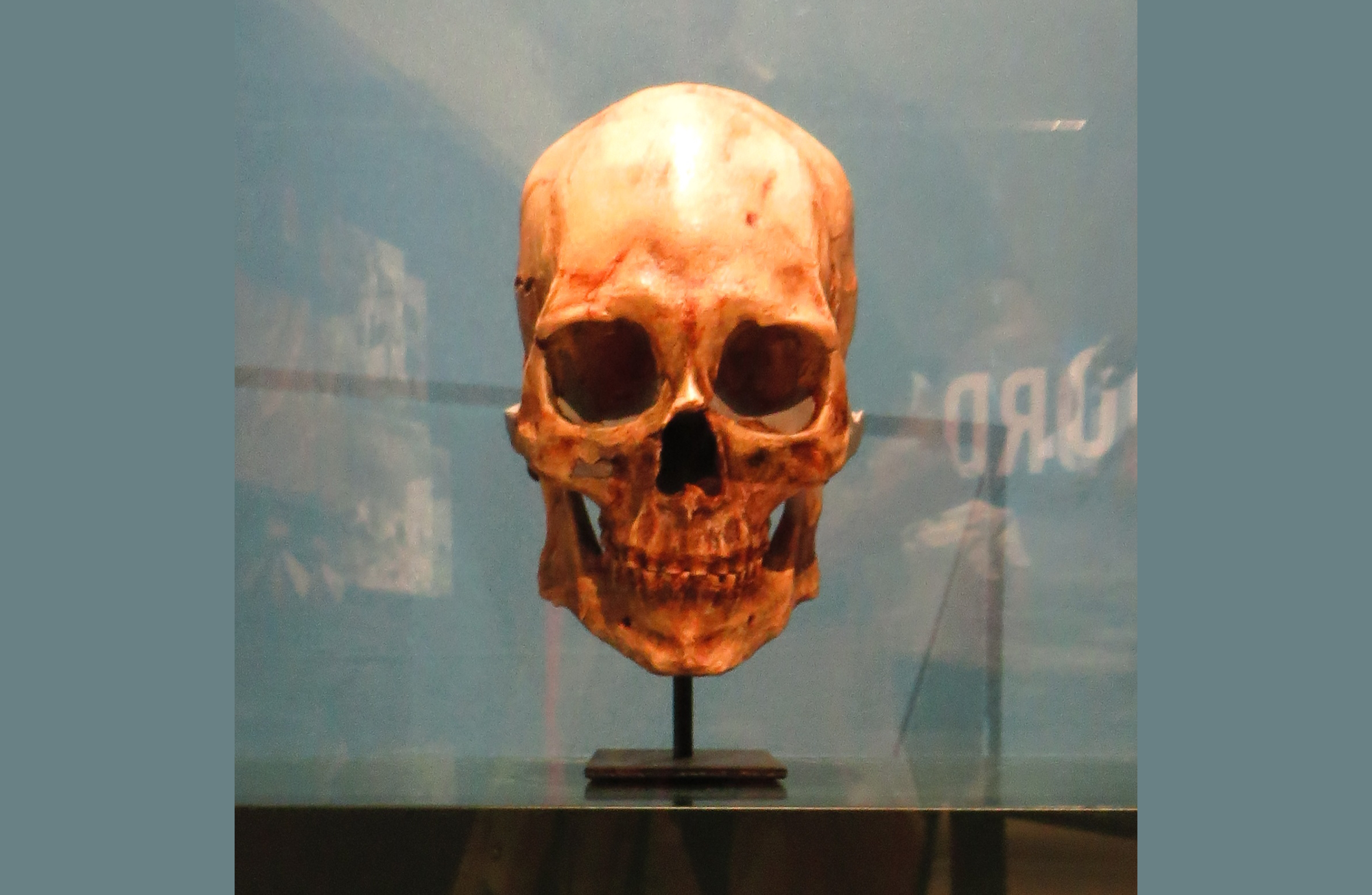
Replica of the original ‘Kennewick Man’ skull in the Natural History Museum in Karlsruhe, Germany. Resin cast by James Chatters. CC BY-SA 4.0
It has been 30 years since the skeleton dubbed ‘Kennewick Man’ was discovered on the banks of the Columbia River. Over the years, it became the subject of Native American rights, scientific study, Kennewick history, and DNA research. It is a story that is rarely told correctly, and is still talked about as a case study today.
On July 28, 1996, the annual Water Follies had attracted large crowds to Kennewick’s Columbia Park, including two young men, Will Thomas (19) and David Deacy (20). Will and David had been drinking for most of the day, as they watched the boat races from a distance, and decided to sneak into the main area to get a better view. This one act of mischief would put Kennewick, Washington on the map in a whole new way!
The discovery
The two young men slipped into the Columbia River from the west side of the barrier, and waded through the shallow water. About ten feet from shore, Thomas’ foot struck something heavy, and he reached down and pulled up a skull. Being young and ignorant (and probably very tipsy), he simply placed the skull on the bank, and they continued their sneak into the main area of the boat races.
Hours later, the two of them went back the way they came, and found the skull again. They carried it to the trunk of their car, where they were showing it off to passersby. Someone flagged down a police officer, who, noticing that the men were drunk, asked where they had found the skull. After a brief look around the area of discovery, the officer confirmed that there were more bones, and contacted the Benton County Coroner, Floyd Johnson.
At first, Johnson thought that the collection of bones was the remains of a white settler — Columbia Park was a popular spot for farming, and people were often buried where they lived; but the more he analyzed the skeleton, the more he realized that the bones were too aged for that to be possible. Instead, he concluded it was likely an ancestor to one of the regional Indigenous Tribes.
Johnson called an archeology consultant, James Chatters, realizing that this was an ancient burial site and that he needed someone with more knowledge to assist. Chatters looked at the skull and agreed that it was very old. Over the next week, Chatters searched the riverbank for more bones. As he assembled them, something struck him as odd — the features of the skeleton were more similar to someone of European descent than to a Native American. This observation would set off a firestorm that lasted for over twenty years.
Fighting for the bones
Many Native American Tribes believe that a soul cannot rest if it is disturbed, and a soul who is not rested can bring ill luck. To honor this belief, in 1990, Congress passed the Native American Graves Protection and Repatriation Act (NAGPRA), which stated: “Any skeleton that could be dated from before 1492 (the year Columbus arrived) would automatically be considered Native American in origin and should be sent to local Tribes for repatriation.” The Kennewick Man skeleton was dated at approximately 9000 years old when Chatters did his study of the bones.
Knowing that this find was at the very least unique, Chatters called Douglas Owsley, a well-known forensic anthropologist with a long record of identifying bones, including bodies from the siege on the Branch Davidians in Waco, Texas in 1993, and mass graves in Croatia. He would later help identify people from American Flight 77 which crashed into the Pentagon on 9/11. Owsley weighed in on the age of the skeleton, and agreed with Chatters’ findings.
When the Army Corp of Engineers became aware of the find, they demanded the bones be handed over for scientific research. Due to a dispute over jurisdiction between the Corp and the Coroner, the bones were placed under temporary protection by the Benton County Sheriff's department. The Corp eventually won the dispute, and moved the bones to the Department of Energy at the Northwest National Laboratory. During transportation, the skeleton’s femur bones went missing. The Corp suspected Johnson and Chatters, and when Johnson was questioned and polygraphed, he ripped off his wires in disgust and walked out. Years later, the bones were found tucked away in the County Coroner’s Office.
From this point forward, there was an ongoing dispute between Native American Tribes and the Corp, despite a promise from the Corp that the bones would be returned within a month. This dispute marked a continuation of historical tension over theft of Indigenous artifacts, and the robbing of Native American graves to study the bodies. Owsley argued that because Kennewick Man had ‘European features’, they needed to confirm Tribal affiliation before returning the bones, and launched a massive campaign against their re-burial, including privately hiring a lawyer to fight for his so-called right to study them further, despite massive public disapproval.
The truth is, determining a skeleton's ethnicity without DNA is extremely unreliable. A forensic scientist can use facial features of a skull to determine an assumed ethnicity — it can give them clues to narrow down who the skeleton may belong to. But, if a person has a mixed ethnic background, or does not have strong features associated with their ethnicity, it often yields false results. That is why forensic anthropology relying only on morphological details cannot be used as evidence in a court of law without additional DNA evidence.
Scientists used this debate to hold up the courts from repatriating Kennewick Man to local Tribes for years, arguing that there was no way to produce DNA evidence from such an old skeleton, which by this time was determined to be 8500 to 9500 years old.
Of course, it shouldn’t have mattered, as NAGPRA clearly stated that Kennewick Man should be repatriated due to its age. The very notion that the skeleton was of European descent was ludicrous, as the bones far predated any prior evidence of white people on the North American continent. However, without DNA evidence, the fight for control continued, and the skeleton was placed in the care of the Burke Museum at University of Washington’s Seattle Campus.
Meanwhile, before Congress could enact a bill requiring preservation of the site, the Corp had dumped millions of pounds of rocks and sand onto the area, preventing any further digging or study at the location.
Ultimately, the scientists won the lawsuit in 2002 (upheld on appeal in 2004). The court concluded that the bones could not belong to any living Tribe, and thus NAGPRA did not apply. The Corps was ordered to make the bones available to scientists at the Burke Museum.
A breakthrough, and the conclusion of battle
It would be years after Kennewick Man was found before DNA testing on the skeleton was even possible. The DNA in the bones was believed to be decayed, and that there would be nothing to test; but when the laboratory at the University of Copenhagen's Danish National Sequencing Centre, led by Dr. Eske Willerslev, took up the cause, they found some viable DNA in Kennewick Man’s teeth!
After a first attempt at crushing a tooth failed to yield any DNA, the lab appealed for permission to try with one more tooth. This time, they were successful. The laboratory was at last able to compare the extracted DNA to previously submitted samples from local Native Americans. The findings were clear: Kennewick Man is more closely related to modern day Native Americans than to Siberians or Europeans. The members of the Colville and Kennewick Tribes shared common ancestry about 600 to 700 years before Kennewick Man was born, and several matches were found from within these Tribes, as well as within other Tribes in Central America.
In June 2015, the courts concluded that Kennewick Man is an ancestor of modern Native Americans (both in the United States and in South America), who more often call him The Ancient One. His bones were repatriated to the Colville Tribe on February 17, 2017, after over twenty years of legal battles. Their final burial location is secret. The hope is that The Ancient One can finally rest, and that no one — not scientists, not conspiracy theorists, nor drunken adults — will find the bones to study them again.
The story of Kennewick Man/The Ancient One isn’t unique — not when it comes to broken promises with Indigenous peoples, not for its scientific merit, and not even the location of the bones. However, the court case and the battle over allowing the bones to rest, along with the discovery of DNA still residing in such an old skeleton, is what makes this story one for the history books — worth keeping in mind the next time a drunken fool stumbles into the river and trips over a skull.
Ashleigh Malin is a historian, folklorist, and cosplayer, living her best life.
Additional sources:
- Rasmussen, Morten, et al. “The Ancestry and Affiliations of Kennewick Man.” Nature, U.S. National Library of Medicine, 23 July 2015, pmc.ncbi.nlm.nih.gov/articles/PMC4878456/
- Thomas, David Hurst. Skull Wars: Kennewick Man, Archaeology, and the Battle for Native American Identity
- Tri-City Herald, 1996-2004
