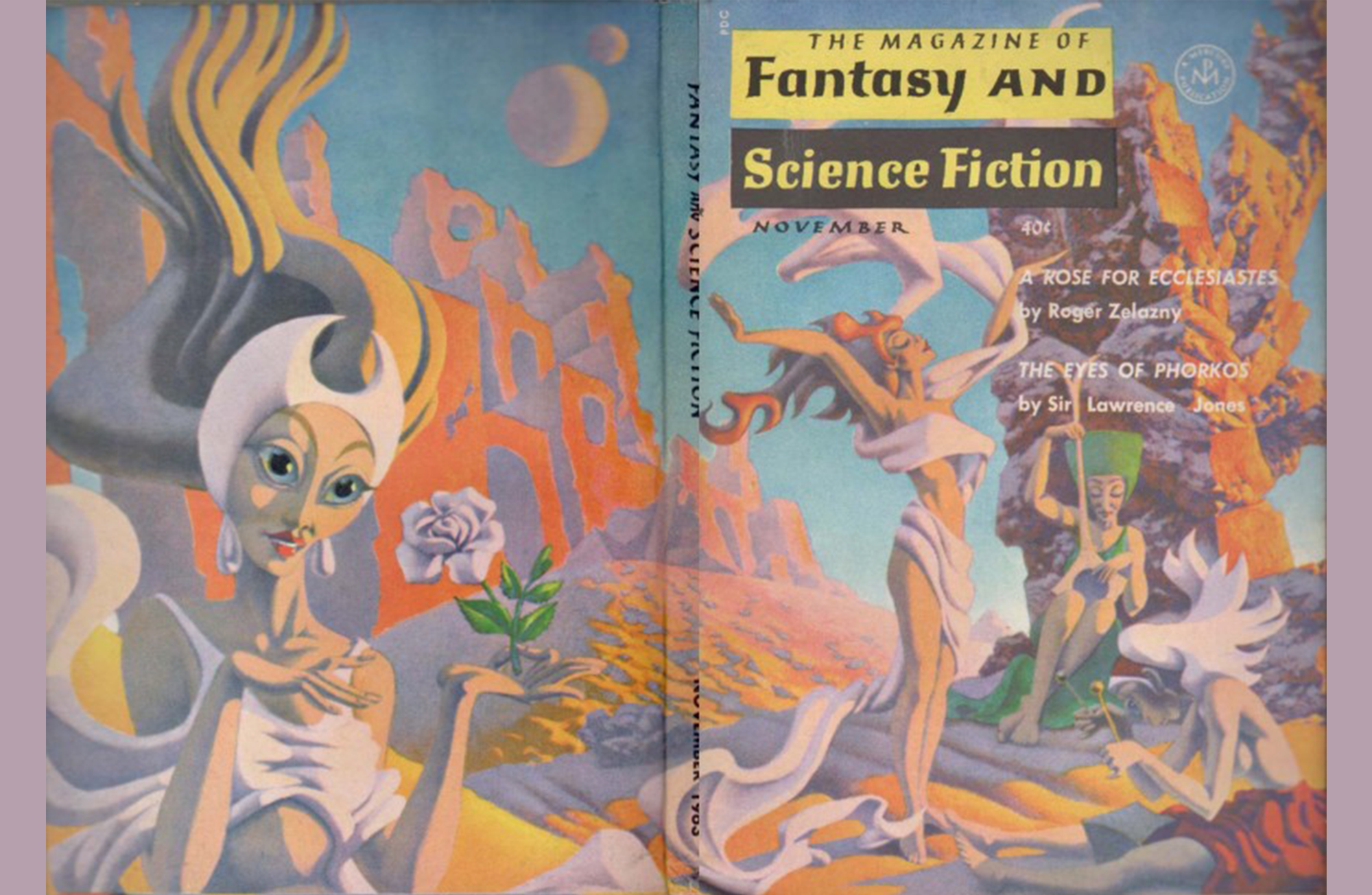
The Magazine of Fantasy and Science Fiction, November 1963
Narrated by John Golden
Roger Zelazny was a major force in fantasy fiction from the 1960s until his death in 1995. He won the Nebula Award three times and the Hugo Award six times, twice for best novel. Alongside Michael Moorcock, he is one of the two most important writers of high fantasy centered on mythology and religion, and not on dragons or sword-and-sorcery.
Roger Joseph Zelazny was born in Euclid, Ohio in 1937, the child of a Polish immigrant father and an Irish American mother. He began writing in high school, and in 1959, he graduated from Western Reserve University with a B.A. in English and then, in 1962, with an M.A. in Elizabethan and Jacobean drama from Columbia University. In 1969, he quit his job for the Social Security Administration to become a full-time writer. Zelazny, along with Jack Chalker and Joe and Jack Haldeman, was a member of the Baltimore Science Fiction Society. He also belonged to the Swordsmen and Sorcerers’ Guild of America (SAGA), a 1960s group of heroic fantasy authors, and studied martial arts and fencing. Although Zelazny was born into a Catholic family, as an adult, he considered himself a ‘lapsed Catholic’ and did not participate in organized religion.
Zelazny’s first publication was ‘Conditional Benefit’, which appeared in the fanzine Thurban 1 #3, 1953. His first professional publication, ‘Mr. Fuller’s Revolt’ in Literary Cavalcade, appeared a year later, and in 1963, he first attracted attention in the science fiction community for his story ‘A Rose for Ecclesiastes’, which was published in The Magazine of Fantasy and Science Fiction.
In 1965, Fantasy and Science Fiction serialized his novel And Call Me Conrad, which was subsequently published by Ace Books as The Immortal. It won the Hugo Award in 1966 in a tie with Frank Herbert’s Dune. His 1965 novella He Who Shapes (first published in Amazing Stories and then as The Dream Master by Ace Books) won the 1966 Nebula Award.
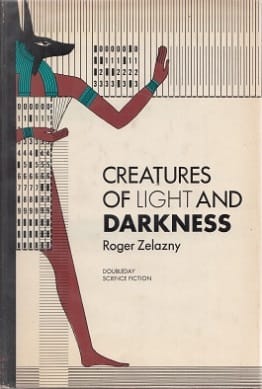
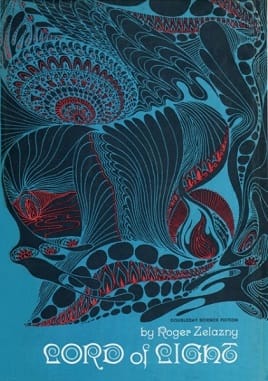
Doubleday First Editions of Lord of Light and Creatures of Light and Darkness
Lord of Light, published in 1967, is one of the rarest first editions by Zelazny, although it supposedly had a reasonable print run. Science fiction fandom has embraced an anecdotal (and possibly apocryphal) story that Doubleday’s management wanted to pulp the remaining inventory of Creatures of Light and Darkness because it wasn’t selling well, and sent a message to the warehouse to “pulp the Zelazny book.” But, as the story goes, the warehouse crew assumed that management was referring to Lord of Light and sent the remaining copies of Lord of Light to be destroyed instead. (Every year around the world, millions of unsold books are “pulped” — their covers are stripped and their pages dissolved into a milky liquid to be reconstituted as recycled paper for printing more books.)
In 1970, Zelazny published his seminal work, Nine Princes in Amber, the first book in the Amber series. He eventually wrote five books in the first Amber series and five in the second series; and after his death, other writers (such as John Betancourt) continued to write stories set in the Amber universe. The Amber books have been a cornerstone of fantasy literature for decades, and have inspired folk songs, role-playing games, and other written works.
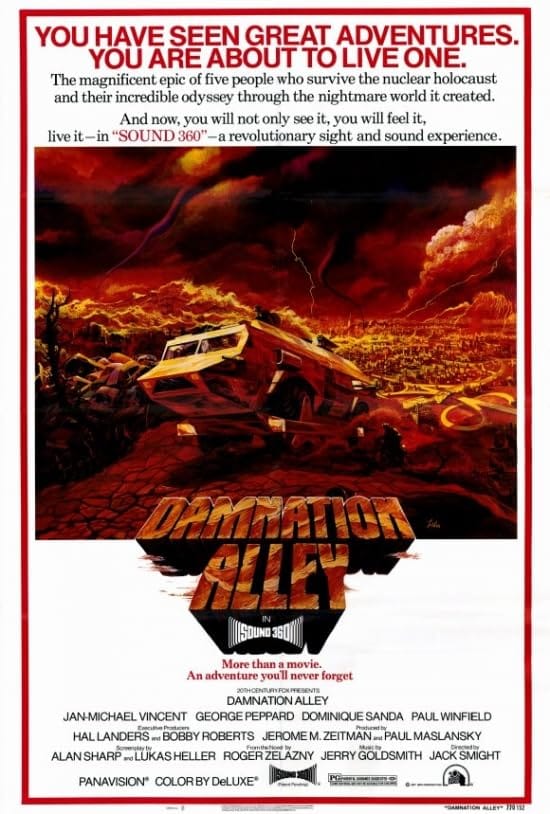
Roger Zelazny inspired many fantasy and science fiction authors, including Samuel R. Delany, Algis Budrys, and J.G. Ballard, as well as newer authors such as Neil Gaiman and Andrzej Sapkowski. So far, however, Hollywood has shown little interest in Zelazny’s work. The film Damnation Alley (1977), loosely based on his novel, was an exception. Finally, the ostracod (a class of the Crustacea) Sclerocypris Zelazny was named after him, conferring immortality of yet another sort.
Zelazny continued writing fantasy and science fiction until his death in 1995. His output included 50 novels, about 150 short stories, three collections of poetry, and more than 150 pieces of nonfiction. He also edited at least eight short story anthologies. Roger Zelazny is part of the foundation for authors of high fantasy in the 1960s, in contrast to the dragon or sword-and-sorcery fantasies by others during this period. He is an icon of fantasy, who provided great stories and inspiration for future fantasy authors.
Steven Woolfolk is the owner of Xenophile Bibliopole & Armorer, Chronopolis, a rare books specialty bookstore in Richland.
References:
- https://en.wikipedia.org/wiki/Roger_Zelazny
- Krulik, Theodore. Roger Zelazny, Ungar, 1986
