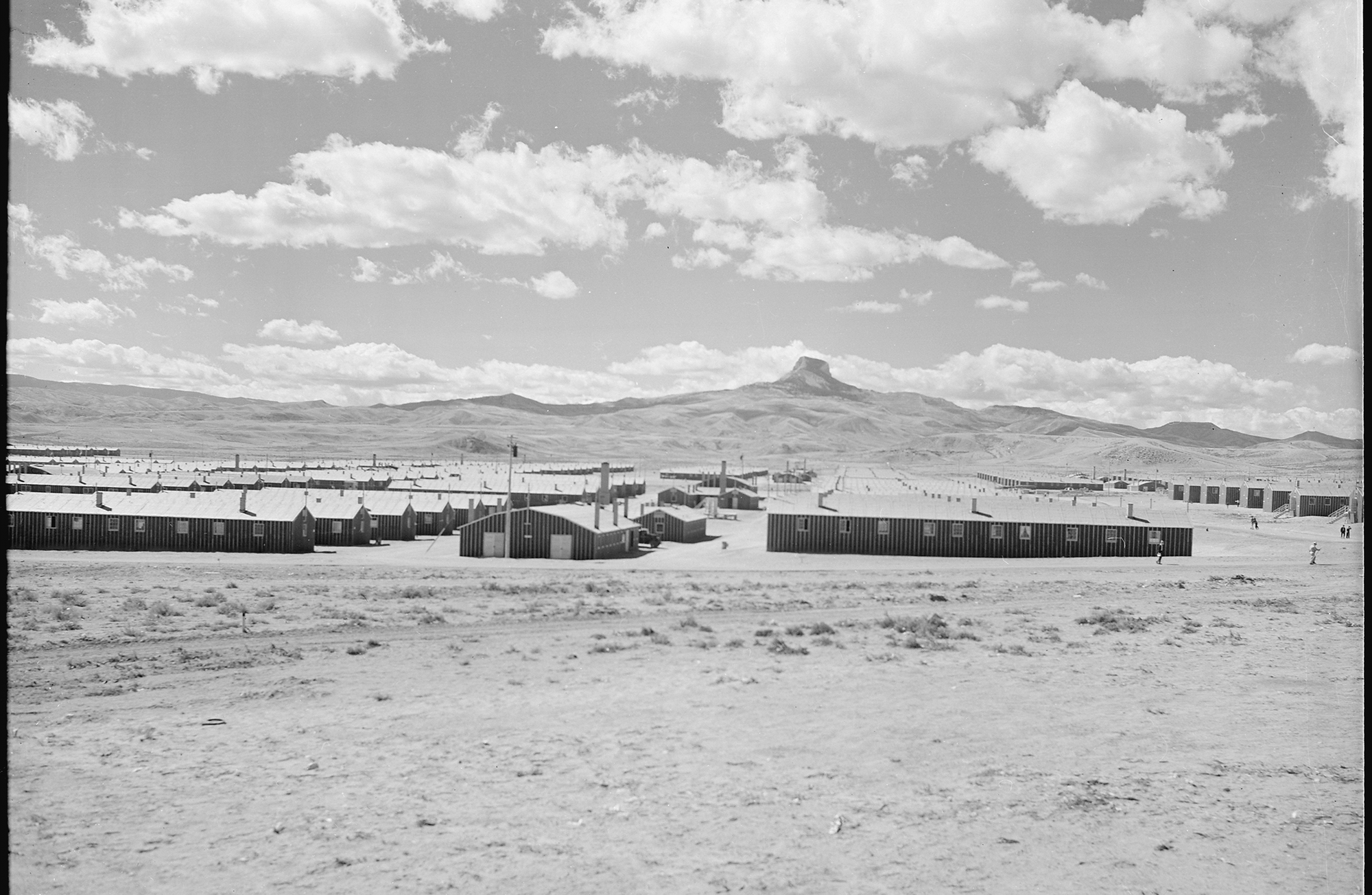
Heart Mountain, Wyoming prison camp. (U.S. National Archives and Records Administration)
Eighty-five years ago, Japanese planes flew into Pearl Harbor, raining destruction on the military base and throwing the United States into World War II. Within months, people of Japanese descent on the West Coast were rounded up and forced into incarceration camps (which they often called ‘internment camps’), and branded enemies of the state. As we near this milestone anniversary and face the state of our current union, let’s look back on a group of people who were once called enemies.
After 300 years of Tokugawa isolationist policies, Japan opened its borders for emigration in the 1860s. There was not a flood of people that came out of the nation; most Japanese immigrants entered the U.S. in the 1880s, including newcomers to the state of Washington and the Tri-Cities. Most of the Japanese immigrants were workers for the railroad, but most were not here long enough to be recorded in the census at that time.
The first known official recording of Japanese immigrants in Kennewick, Kiona, and Lake (Franklin County) was in the 1900 census. In this case, in both Franklin and Benton County, all persons of Japanese ancestry were railroad workers and followed the railroad when the work was done. It was fairly common for most Asian Americans to follow the railroads, but some were also cooks, farmhands, and laborers.
The first permanent settlement by the Japanese American community was the Yamauchis, who settled in Pasco in 1907. Kennewick, on the other hand, started to establish its community sometime in the late 1900s, as Harry Yamagami, along with Roy Yamaoka, were first recorded in the 1910 census. Not much is known about these men, as sources within Tri-Cities museums and archives on Asian American history are scarce, but we do know they became business partners.
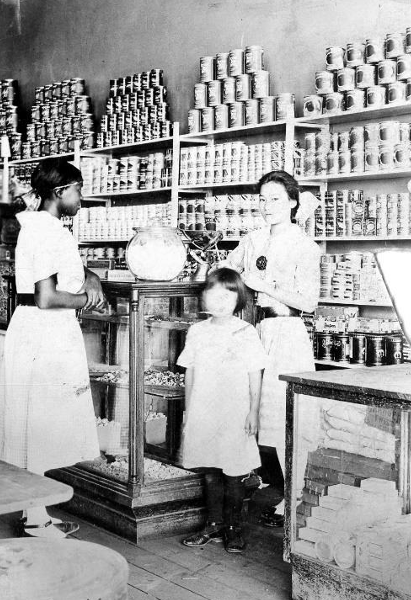
The Yamauchi family of Pasco did not go into farming like most Japanese Americans in the region. Originally, Harry Yamauchi and his wife Chika met in Hawaii before moving to the mainland. The plan was to work on the railroad in Washington, but they arrived in San Francisco around the time of the Great San Francisco earthquake in 1906. The couple quickly made their way up to Washington, and by the end of 1907, had settled in Pasco.
Japanese immigration reached its peak in 1907 with the end of the Russo-Japanese War and before the restrictive Gentleman’s Agreement came into effect. The Gentleman’s Agreement restricted the immigration of Japanese citizens into the United States. This did not prevent families from staying together, and allowed for wives, children, and other family members to enter the country. However, this policy incentivized women to marry men without having met them, and led to a practice known as ‘picture brides’.
Picture brides were often tricked into marriage and trafficked into the U.S. for the purpose of creating a family with a bachelor. There are many tales of women receiving an image of a man who looked young and handsome, only to arrive in the U.S. to find that the picture was of their husband’s good-looking younger friend. Going back was not an option for most of these women. Their families often shamed them for any desire to return, and divorce was looked down on.
Japanese Americans faced stigmatization and oppression from their fellow Americans, and the pathway to become U.S. citizens was unclear, even for children who were born in the U.S, until the landmark court case of The United States v Wong Kim Ark in 1898. Wong Kim Ark was born in San Francisco to Chinese parents who were carrying out business in San Francisco and were not part of any delegation from China. Wong Kim Ark’s parents would later return to China, but he did not. In 1895, Wong Kim Ark visited his parents in China and was denied re-entry to the U.S. because he was not a citizen, a right guaranteed to all non-diplomatic children born in the U.S. until the 14th Amendment. Wong Kim Ark won his court case, which promised citizenship to all children born in the U.S. to Asian parents. This did not protect the Japanese American community from other forms of discrimination, however. Anti-Chinese and Japanese movements were commonplace in the Pacific Northwest, with race riots against Chinese Americans in Tacoma in 1885 and again the next year in Seattle.
The largest community of Japanese Americans in Eastern Washington was in the Yakima Valley, which was concentrated around Wapato. Most of the Japanese Americans in this area were employed as domestic workers and farmers in Wapato and the lower valley. When Japanese Americans first immigrated to the Yakima Valley is one of great debate, but most consider the Ishikawas, who settled in 1891, to be the first family to establish a farm site in the region. (When we say establishing a farm site, it’s important to note that Japanese Americans were not allowed to own land, and many families instead leased land from others or found ways around the laws.)
In 1910, the census recorded 6127 Japanese Americans in Seattle, 1018 in Tacoma, and 352 in Spokane. The whole of Washington's Japanese population recorded in the 1910 census was 12,929 of the 1,1414,990 residents of the state.
In 1920, when the Gentleman’s Agreement and Japanese immigration became a hot debate, a committee was formed in Seattle to discuss the topic. Many anti-Japanese speakers opposed immigration, saying that immigrants would steal their jobs, were not up to par with Christian values, did not keep the Sabbath day holy, were spies, and took all the good farming land. In reality, Japanese Americans only leased a small percentage of farmable land in the Yakima Valley, and Seattle was heavily dependent on the work of Japanese laborers. In the Yakima Valley and Twin Cities (the former nickname of the Tri-Cities), Japanese Americans were an important part of the community, often donating money for the civic good.
The Japanese American community fought back against racism, sending court appeals, buying war bonds, and continuing to participate in the community. Kennewick farmer Frank Yoshino, for example, was an assistant basketball coach at Kennewick High School in the 1930s. His two oldest surviving children, Elmer and Louise, both helped out in school clubs and with the football team.
After years of oppression, the Japanese American community was subjected to heightened anti-Japanese sentiment during the Second World War. When Japan attacked Pearl Harbor, the backlash against the Japanese American community was swift and violent. The FBI had a prepared list of ‘dangerous’ individuals in the Japanese American community who were targeted for arrest, and the arrests quickly grew into the mass incarceration of all Japanese Americans on the West Coast. The dividing line in Washington State was the Columbia River. Those on the Kennewick side needed to leave, while those on the Pasco side watched their families leave. If a family was lucky, they had a friend or family member who could care for their home while they were gone. Most were not; they had to sell most of their possessions, their homes, and face an uncertain future.
Six families that we know of were forced to leave Kennewick. The Matsumura, Minatoya, Moteki, Teramoto, Yamagami, and Yoshino families each have their own unique story. We can only touch on these briefly here, but I encourage you to read some of the stories cited at the end of this essay, and listen to ‘RACHEL MADDOW PRESENTS: BURN ORDER’: https://www.ms.now/rachel-maddow-presents-burn-order.
In Pasco, Harry Yamauchi and his wife were incarcerated, and all those of Japanese ancestry in the Yakima Valley (1061 people in total) were arrested as well, regardless of citizenship status. People in the Yakima Valley were taken to Puyallup or Portland, where they were made to live in horse stables, then were sent to the concentration camps in Minidoka, Idaho or Heart Mountain, Wyoming. Those in Benton County were forced to go to Portland before most of them were sent to Heart Mountain, Wyoming. Some families that did not live in the county before 1940 were sent to a different camp. In the case of the Moteki family, they were sent to Gila River, Arizona.
Heart Mountain was known as the ‘rebel’ camp, so nicknamed for several reasons, including the community uprisings and the activists who came out of the camp at the end of the war. We don’t know what happened to any families from Benton County during their time at Heart Mountain. From the brief mentions in the camp newspaper, it’s clear that they suffered greatly.
George Yamauchi, son of Harry Yamauchi, joined the U.S. army as an interpreter. It’s largely through him that we get a look at the life of Japanese families during World War II. The Yamauchis were a fairly successful family, and were able to open a variety of businesses over the years, but things changed when the war started. They faced discrimination on a level they had not seen before. When Mary Yamauchi went to renew her family’s business license, she was refused.
By this time, at a point where the Tri-Cities were changing with the beginning of the Hanford buildup, their parents were incarcerated in Minidoka, while another sister and her family were imprisoned in Heart Mountain, Wyoming. George Yamauchi wrote a letter to the editor of a local newspaper. He pointed out that the people around them had changed, and questioned why neighbors who had known the Yamauchis for years suddenly believed they were enemies. He questioned why his family faced issues like license renewals when they were following the law.
Of the families that left Kennewick, only three that we know of ever came back to Washington: the Minatoyas, the Yoshinos, and the Yamagamis. Frank Yoshino and his sons (with the help of Harry Yamagami) started an agricultural business in Moses Lake. Several of the Yoshino children spent time living in the Tri-Cities.
The mass incarceration of Japanese Americans shattered the communities they had built on the West Coast. There were a few families like the Yamauchis who returned, but the lives they had built couldn’t be fully recovered. George Yamauchi wrote about the injustices his family faced during this period. Linda Yamauchi Atkinson volunteered with the Franklin County Historical Society until her death in 2024. Professor Noriko Ryder of CBC continues to teach students the language of her home country while recognizing the horrors from both countries during the war. The legacy of the Japanese American community only ends if we forget.
References:
- Ancestry.com. https://www.ancestry.com
- Bauman, Robert. “Past as Prologue: ‘What Is an American?’ Asks a Soldier from Pasco Whose Family Was Interned.” Northwest Public Broadcasting, January 1, 2021. https://www.nwpb.org/2021/01/01/past-as-prologue-what-is-an-american-asks-a-soldier-from-pasco-whose-family-was-interned
- Densho, National Park Service. “Densho Digital Repository.” https://ddr.densho.org
- East Benton County Historical Society. Kennewick, WA.
- “Gentlemen’s Agreement of 1907.” Wikipedia. wikipedia.org/wiki/Gentlemen%27s_Agreement_of_1907
- Hanford Oral History Project at WSU Tri-Cities. “Interview with Evelyn Walkley.” Hanford History Project. hanfordhistory.com/items/show/188
- Hanford Oral History Project at WSU Tri-Cities. “Interview with Yamauchi Family.” Hanford History Project. hanfordhistory.com/items/show/2431
- Heuterman, Thomas H. The Burning Horse: Japanese-American Experience in the Yakima Valley, 1920–1942. Cheney, WA: Eastern Washington University Press, 1995.
- Idaho Public Television. “Internment of Japanese Americans in the Inland Northwest.” idahoptv.pbslearningmedia.org/collection/internment-of-japanese-americans-in-the-inland-northwest
- Japanese American Citizens League. “When Did America Start Building WWII Concentration Camps?” Densho Catalyst. densho.org/catalyst/when-did-america-start-building-wwii-concentration-camps
- Lange, Dorothea Collection. “Japanese Americans in Spokane, 1916–1945.” Spokane Public Library. lange.spokanelibrary.org/exhibits/show/asian-american-footprints/japanese-americans-in-spokane/1916to1945
- Oral History Center, University of California. “Guide to Archival Collection.” oac.cdlib.org/findaid/ark:/13030/c8tf04gc
- National Council on Public History. “Housing and the WWII Home Front.” ncph.org/wp-content/uploads/2025/09/Housing-and-the-WWII-Home-Front_pdfversion.pdf
- Seattle Civil Rights & Labor History Project. University of Washington. “Nikkei in the Pacific Northwest.” guides.lib.uw.edu/research/nikkei
- Spokane Historical Society. “Japanese American History Tour.” spokanehistorical.org/tours/show/19
- The Kennewick Courier-Reporter. Kennewick, WA.
- United States v. Wong Kim Ark (1898). National Constitution Center. constitutioncenter.org/the-constitution/supreme-court-case-library/united-states-v-wong-kim-ark-1898
- Washington State University Libraries. “Japanese American Collection Overview.” content.libraries.wsu.edu/digital/collection/cchm/custom/ja-overview
- Yakima Valley Museum. Yakima, WA.
- Yamauchi, George. “Letter to the Editor.” The Pasco Herald, December 16, 1943.
- Yamauchi, George K. E. Growing Up in Pasco. SmashedWords, 1984.
ALSO LISTEN TO ‘RACHEL MADDOW PRESENTS: BURN ORDER’: https://www.ms.now/rachel-maddow-presents-burn-order
Ashleigh Malin is a historian, folklorist, and cosplayer, living her best life.
