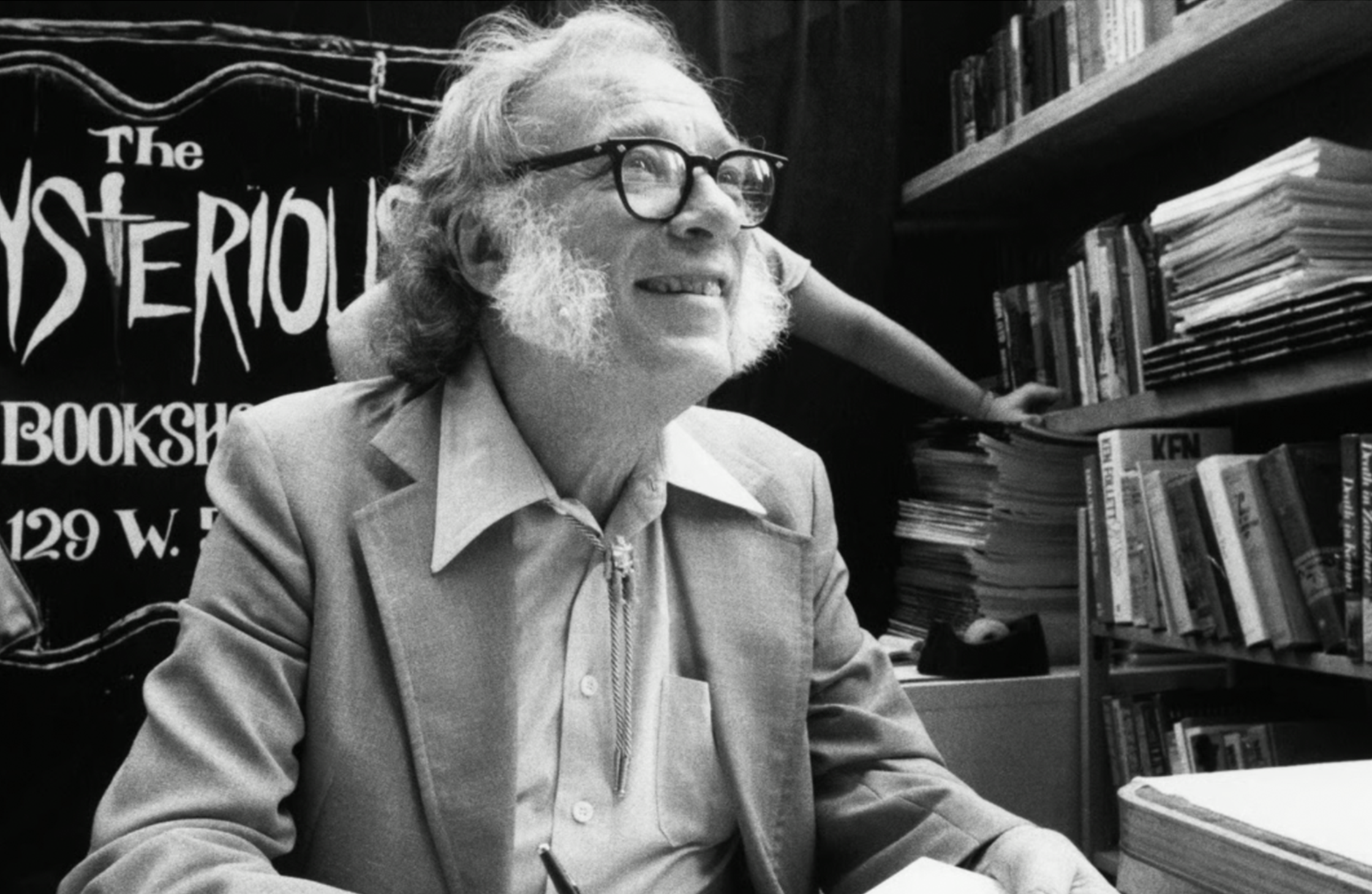
Isaac Asimov is one of the three big names in science fiction, alongside Arthur C. Clarke and Robert A. Heinlein.
Asimov emigrated to the U.S. as a child in the twenties, working in all of his family’s successive candy stores. Alongside their candy, the stores also sold newspapers and magazines with which Asimov taught himself to read. He later credited these as a major influence in his lifelong love of the written word. Presented with an unending supply of new reading material, he began reading science fiction at age nine; and at age eighteen, he joined a science fiction fan club.
Asimov attended a branch of Columbia College in Brooklyn, majoring in chemistry. After being accepted on a probationary basis to the graduate chemistry program at Columbia, he obtained a Master’s in 1941. During World War II, he worked at the Philadelphia Naval Shipyards with Robert Heinlein, which began a lifelong friendship. At the conclusion of the war, he was drafted into the army. He was supposed to have participated in Operation Crossroads at Bikini Atoll, but was excluded because of a clerical error. In 1946, he received an honorable discharge and returned to school, earning his PhD in 1948. The following year, he was hired as a professor of biochemistry at Boston University School of Medicine.
In 1977, Asimov had a heart attack, and in December 1983, he underwent triple bypass surgery. During the procedure, he contracted HIV, of which he died on April 6, 1992.
Although Asimov published books and essays in other genres and on many other topics, he is chiefly remembered for his science fiction. He began writing at age eleven and published his first story in Boys High School’s literary journal in 1934. His first professional writing was in May 1937, when he submitted the science fiction story “Cosmic Corkscrew” (which is now lost to history). In May 1938, puzzled by a change in the schedule of Astounding Science Fiction, Asimov went to see its publisher, Street & Smith Publications. Inspired by the visit, he quickly finished a story and personally submitted it to the Astounding editor, John W. Campbell. Campbell met with Asimov for more than an hour and promised to read the story himself, and two days later he sent Asimov a detailed rejection letter. This was the beginning of a long friendship as well as an important professional connection. Campbell had a strong formative influence on Asimov, and while Asimov lived in New York, they met almost every week.
Campbell also rejected Asimov’s next story, “Stowaway,” but not long thereafter, Amazing Stories accepted “Marooned Off Vesta,” Asimov’s first published story, and printed it in its March 1939 issue. Amazing published two more of Asimov’s stories in 1939; and in 1940, Asimov published seven stories in four different pulps, including, finally, a story in Astounding Science Fiction. By July 1940, Asimov had written twenty-two stories, of which thirteen were published, and after that, he never received another rejection (except, he wrote later in his book In Joy Still Felt, in two “special cases”).
In 1942, Astounding published “Nightfall,” which the Science Fiction Writers of America voted the best science fiction story ever written at its 1968 meeting. Afterwards, Asimov stopped writing for a year, expecting teaching to be his primary source of income in the future. However, his friend and fellow author Heinlein encouraged him to continue writing.
In 1940, Asimov published the first of his robot stories, “Strange Playfellow.” In 1941, he introduced the famous Three Laws of Robotics in the story “Liar!” which were later codified in “Runaround.” These laws are widely known in the science fiction community:
- A robot may not injure a human being or, through inaction, allow a human being to come to harm.
- A robot must obey the orders given it by human beings except where such orders would conflict with the First Law.
- A robot must protect its own existence as long as such protection does not conflict with the First or Second Law.
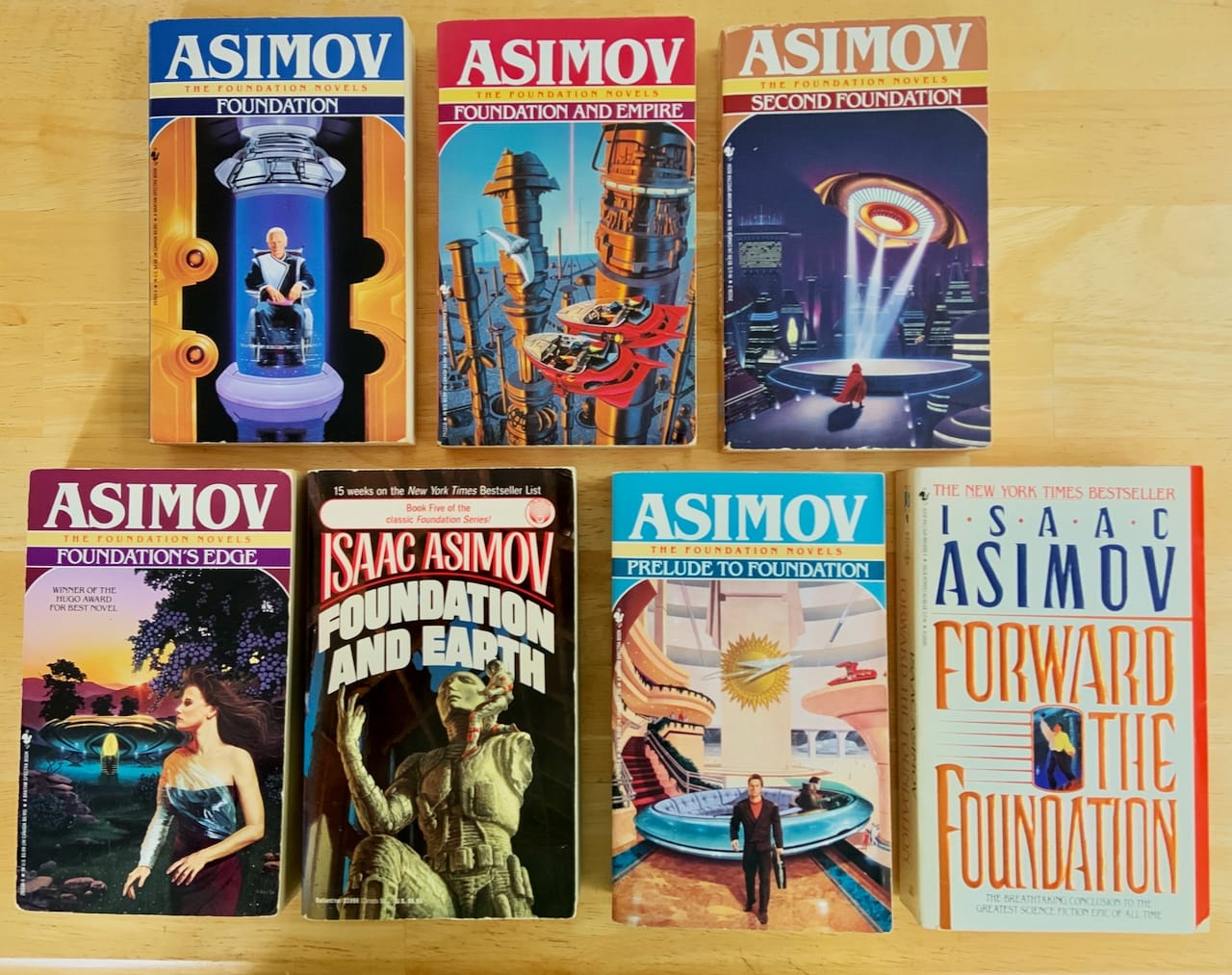
At the beginning of the 1950s, Asimov published the Foundation Trilogy, which won the Hugo Award for the best science fiction series ever published in 1966. The Foundation Trilogy and I, Robot are true science fiction classics, seminal works that have inspired many other writers, including Greg Bear, Gregory Benford, and David Brin, all of whom collaborated to produce a Second Foundation Trilogy with the blessing of Asimov’s widow.
In 1972, Asimov published his first full-length science fiction novel in fifteen years, The Gods Themselves. It won best novel in the Hugo, Nebula, and Locus Awards. In the same year, Kent State University Press published a bibliography of his works to date, Asimov: A Checklist, to which Asimov responded with charming humility:
Looking over the manuscript of the bibliography of my works … fills me with a sense of guilt and … a small bit of fright. I had no intention, ever, of presenting the insuperable problem to bibliographers that I have apparently succeeded in doing…. I would have run from my typewriter screaming and never approached it again.
Nevertheless, Asimov returned to science fiction full-time in 1982, and in his last ten years, produced eight full-length novels, four in the Foundation series.
During Asimov’s 53-year writing career, he published 40 novels, 383 short stories, and over 280 nonfiction books, and also edited or co-edited nearly 150 additional books. His published works span the entire Dewey Decimal system, except for the 100s (philosophy and psychology). He published two mystery novels and eleven collections of mystery stories, eleven books on literature and the Bible, four autobiographies, eighteen books on history, nine books of humor, and six other nonfiction books.
Based on his publications, interviews, articles, television and video appearances, and other nonfiction work, Asimov became known as the Great Explainer. Much of his nonfiction output was concerned with explicating and popularizing science. He produced at least 82 books in this area, and was widely recognized as an authority on science and technology.
He also received a number of science awards both during his life and after his death. In 1981, an asteroid was named after him; in 2009, a crater on the planet Mars was named in his honor; and in 2010, Congress designated the second week in April as National Robotics Week to recognize his accomplishments.
Asimov was an acknowledged atheist, and he made a point of rejecting all superstitious and pseudoscientific beliefs. “There is no belief, however foolish,” he once wrote, “that will not gather its faithful adherents who will defend it to the death.” He was one of the signers of the Humanist Manifesto; and in 1984, the American Humanist Association (AHA) named him Humanist of the Year. From 1985 until he died in 1992, he served as honorary president of the AHA, and was succeeded by his friend and fellow writer Kurt Vonnegut.
What Asimov will be remembered for most are his science fiction and cross-genre works. The Foundation novels and the Robot books are essential reading for everyone interested in science fiction, and the Laws of Robotics should be committed to memory by everyone concerned with the future of artificial intelligence.
Steven Woolfolk is the owner of Xenophile Bibliopole & Armorer, Chronopolis, a bookstore specializing in rare books, located in Richland, Washington, and online at Xenophilebooks.com.
Sources:
- Asimov, Isaac. Asimov on Science Fiction. Doubleday, 1981.
- Asimov, Isaac. In Memory Yet Green, the Autobiography of Isaac Asimov, 1920-1954. Doubleday, 1979.
- Asimov, Isaac. In Joy Still Felt, the Autobiography of Isaac Asimov, 1954-1978. Avon, 1981.
- Asimov, Isaac. I. Asimov: A Memoir. Doubleday, 1994.
- Asimov, Isaac. It's Been a Good Life. Prometheus Books, 2002.
- Miller, Marjorie M. Isaac Asimov; A Checklist of Works Published in the United States, March 1939-May 1972. Kent State University Press, 1972.
- Woolfolk, Steven. “The Birth of Science Fiction.” Tumbleweird, June 20, 2025.
- https://atlantipedia.ie/samples/isaac-asimov
