
In the first three segments of this series, we showed how the amount of the greenhouse gases in the atmosphere can be reduced more easily than was previously assumed. This is largely due to the development and deployment of low-carbon and carbon-free clean energy technologies that reduce anthropogenic emissions of carbon dioxide (CO2). Reducing emissions in this manner, combined with the continued removal of large quantities of CO2 by natural carbon sinks, leads to falling CO2 concentrations.
Anthropogenic additions of CO2 to the atmosphere have increased almost every year until recently, as the world has relied on fossil fuels to meet growing energy needs. However, the growth in anthropogenic CO2 emissions has slowed substantially since about 2012, as energy growth has been met by improved economics for advanced, clean energy alternatives.
This has prompted some parties to conclude that we now have all the clean energy options that we need. This is not correct, but we are certainly in better shape than we were at the start of the century. In fact, we’re at the point where we can now project reductions in annual emissions and, following that, reductions in atmospheric levels of CO2.
We’ve made great progress in driving down the cost of solar and wind technologies but we don’t have everything that we need.
Additional efforts are needed to get the full complement of 21st century clean energy technologies ready for an affordable, sustainable energy future.
The architecture of the electrical power system
This month, we’ll discuss how the electrical power sector will change as we add economically-preferable 21st century clean energy technologies and continue to decommission 20th century power systems.
Remember high school economics courses where we were taught about supply and demand in the marketplace? Let’s start by discussing the architecture of electrical supply in the context of the following three classes of electricity generators: baseload power generators, load-following power generators, and renewable power generators.
Baseload power generators
These are electrical generation technologies that are able to reliably produce power pretty much all the time: around the clock and in all seasons. They are typically efficient facilities that are expensive to build, but despite that they produce electricity at relatively low costs because they run 24/7 at high capacity. As a result, they are preferred generators and operate at high utilization rates (i.e, ‘capacity factors’ — the ratio of power produced to their maximum capacity). Producing many kilowatt-hours of electricity allows the capital cost to be amortized across many kilowatt-hours, yielding low electricity production costs.
During the 20th century, large coal-fired power plants produced most of the U.S.’ baseload power. In the latter half of the century, the power industry added nuclear power reactors (even more expensive than the coal-fired units), and succeeded in increasing nuclear plant availability such that capacity factors rose by a remarkable amount, from around 60% in 1980 to over 90% by the end of the century. This accomplishment by the nuclear power industry means that nuclear units now produce about 50% more electricity than expected, and that nuclear power is both more reliable and more affordable than expected.
Nuclear power is also an important part of why the U.S. has steadily reduced its annual CO2 emissions by 35% to 40% since we hit peak CO2 emissions in about 2006. The additional electricity provided by nuclear reactors, combined with plentiful, low-cost natural gas from advanced fracking, has enabled our electrical industry to shut down several hundred coal-fired power plants over the last 20 years. Fortuitously, the combustion of natural gas produces roughly half the CO2 of coal, and of course nuclear power plants don’t produce CO2 at all.
Load-following power generators
Sometimes called ‘dispatchable power’, load-following electric generators have lower capital costs than baseload systems, but have substantially greater operating costs due to producing electric power at lower efficiencies. Examples include older coal-fired power plants that weren’t as efficient as later units, and small, modular gas-turbine powerplants.
Because of their higher operating costs, dominated by the cost of their fuel, load-following power units are typically operated for fewer hours and are turned on and off frequently. They often operate with capacity factors less than 15%.
During the 20th century, the electric power industry became adept at operating blends of baseload and load-following power generators to produce electricity at low costs. Too much of either would have driven electricity prices higher.
Renewable power generators
With the exception of hydro, which we’ve had for over 100 years, this class can be thought of as mostly newer technologies that produce electricity from renewable energy sources — solar, wind, bio-mass, geothermal, and hydro. Because the basic energy that is being used is essentially free, the costs associated with converting and providing energy from these sources are typically dominated by the cost of building renewable energy facilities. To get the most economic use of these assets, you want to operate them as much as possible, but they’re limited by the intermittency of their resources. Typical capacity factors for solar and wind, for example, are between 20% and 30%. They might not be available during peak electrical demand hours.
In the past twenty years, the electric power industry has been successful at applying solar photovoltaics and wind turbines as modular systems that exploit the economics of hardware mass production, therefore achieving low capital costs. As a result, solar and wind power are very inexpensive when deployed at ‘utility scales’ (i.e, in megawatt quantities) without energy storage. However, because wind and solar energy resources are highly variable, they would require massive over-building of generation capacity and substantial energy storage capabilities (e.g, batteries) in order to produce a substantial fraction of society’s electricity demand.
Getting to an appropriate future blend of power generators
In this section, we’ll use ‘trinary diagrams’ to illustrate the mixture of the U.S.’ electrical power production. In doing so, we’ll briefly illustrate where we’ve been, where we are today, and where we need to go.
The first set of two trinary diagrams give us an appreciation of the blend of technologies and energy sources that provided our electricity in the years 2000 and 2025. The three vertices of the triangles are where all electricity is produced by one of the three types of power generators (baseload, load-following, and renewable). At any point on these diagrams, the sum of percentages for baseload power generators, load-following power generators, and renewable power generators is 100%. For the years 2000 and 2025, the actual blend proportions are represented by the placement of the blue circle.
We also show proportions within each class of generators. In particular, we note that in the year 2000, coal provided 45% of baseload electricity production in the U.S, and natural gas 9%; By 2025, the industry has reduced coal consumption to just 3.5%. Natural gas use increased to 32%, and solar and wind power increased from 0.2% in 2000 to 17% in 2025.
The increase in solar and wind were made possible through improved economics for each. However, it would be incorrect to assume that going to very high percentages would lower the cost of electricity. Rather, given the low-capacity factors for solar and wind, getting to very high percentages of variable renewable energy, where baseload and load-following systems are low in percentages, would require overbuilding solar and wind plus the construction of large banks of batteries (or other energy storage systems). The argument can be made that in some regions of the country, over-building wind and solar has increased electricity prices.
Anyone that says we’ve known about climate change for decades but nobody has done anything about it is simply wrong.
In the U.S, we’ve reduced the consumption of coal for electrical power generation by two thirds during the first quarter of the 20th century. Continued development and deployment of affordable, low-carbon and carbon-free energy technologies — as we are already proving — is a key element in getting the greenhouse gas content of the atmosphere under control.
Likewise, because of seasonal and hourly variability in electricity demand, going to very high percentages in nuclear power would also increase the cost for nuclear (in cents per kilowatt-hour), since overbuilding nuclear power would force capacity factors to fall.
Collectively, our electrical sector’s carbon emissions have decreased by about 800 million metric tonnes of CO2 over the 20 year period from 2005 to 2025. This remarkable 33% decline was made possible (and affordable) through the development and commercialization of advanced technologies.
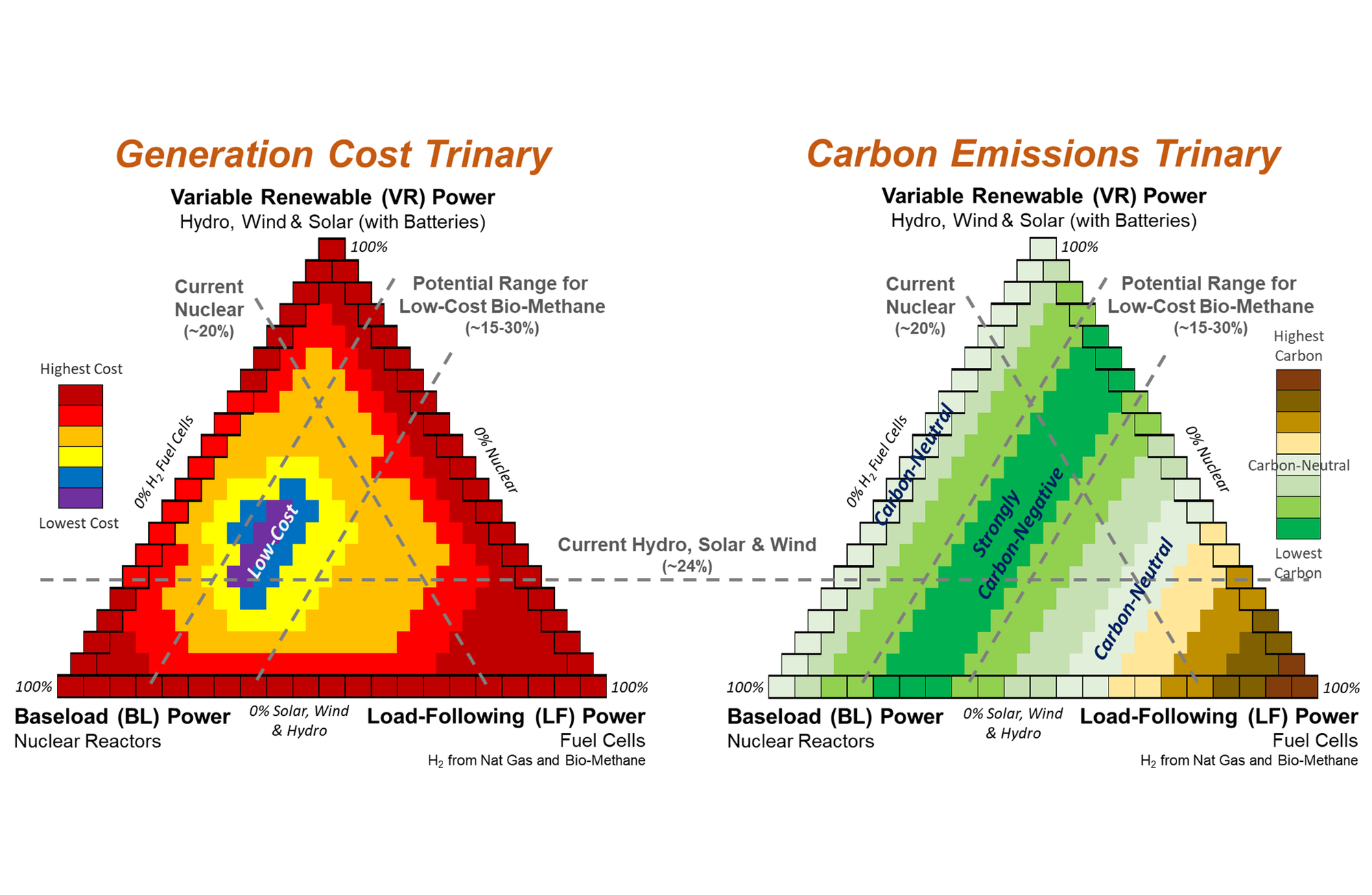
The second set of trinary diagrams point to where we need to go. The Generation Cost Trinary shows that, to have the cheapest electricity, we need a mixture of baseload power, load-following power, and renewable power, and not too much of any one class of power generators. According to the Carbon Emissions Trinary, the cheapest mixture of power production can overlap the ‘sweet spot' for low carbon emissions, if baseload power is produced with nuclear reactors and dispatchable power is produced with natural gas, bio-methane, and high-efficiency fuel cells.
As we’ve said before, Economic Gravity Always Wins. The approach to getting the greenhouse gas content under control includes the development and commercial deployment of affordable, clean energy technologies that are economically-competitive and preferable to fossil energy technologies. Next month, we’ll continue this discussion with more information on specific technology choices that match this approach.
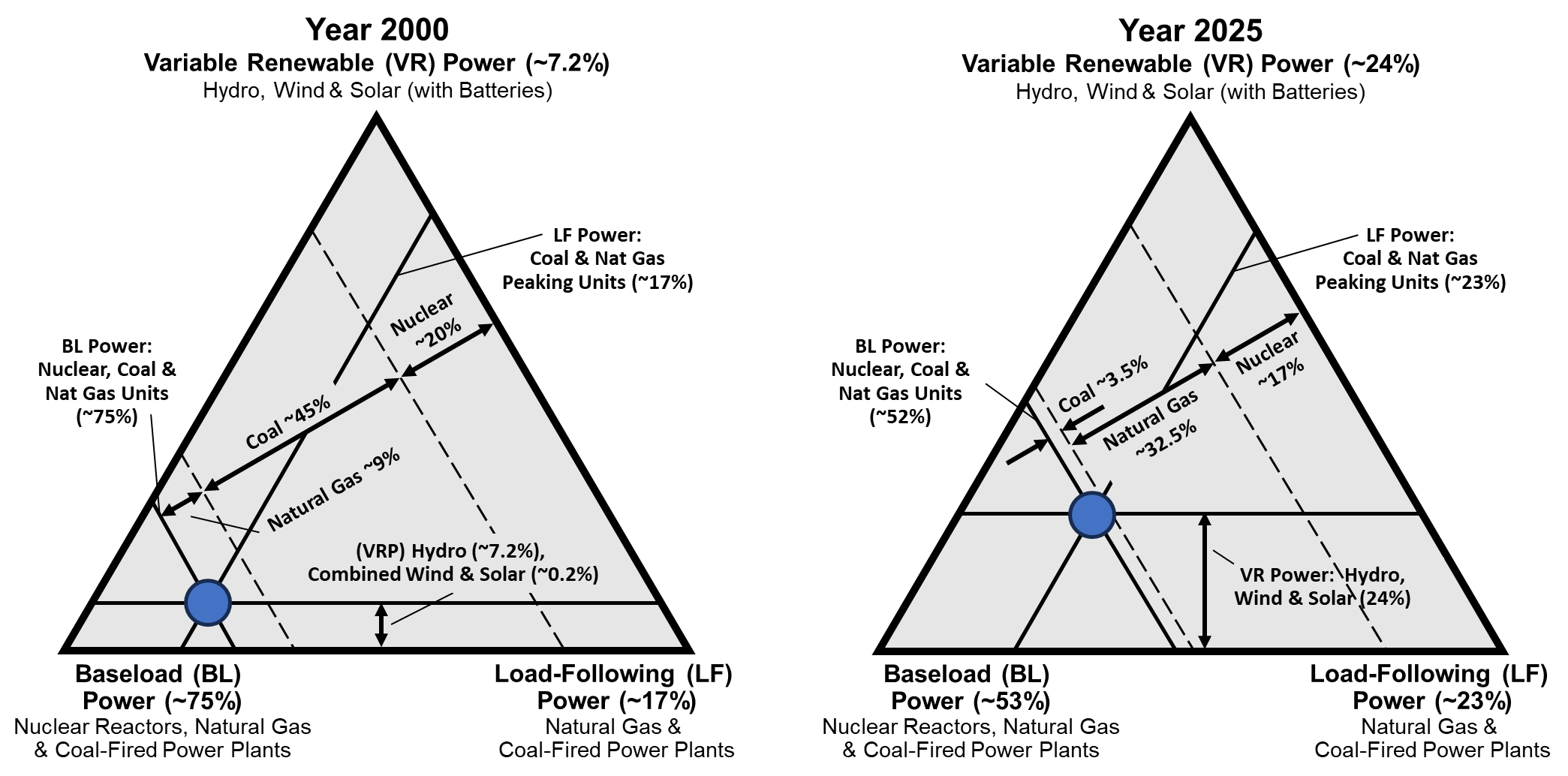
The U.S.’ Electrical Power Industry has substantially reduced CO2 emissions during the first quarter of the 21st century through the use and build-out of advanced technologies. Generation trinary diagrams illustrate the U.S.’ blend of electrical power generation units in the years 2000 and 2025, and show the extensive changes over that 25-year period. For example, in the year 2000, combining baseload power and load-following power, coal provided the largest share of electrical power generation — about 52% of the nation’s electricity. Of course, coal is also the fossil fuel with the greatest carbon intensity. Also of interest: in the year 2000, solar and wind power systems were still extremely expensive. By 2025, however, coal was in decline with hundreds of coal-fired power plants having been shut down in favor of cleaner natural gas and new wind and solar generators. In addition, although it is not on the diagrams, we are starting to see the build-out of advanced, high-efficiency fuel cells running on natural gas.
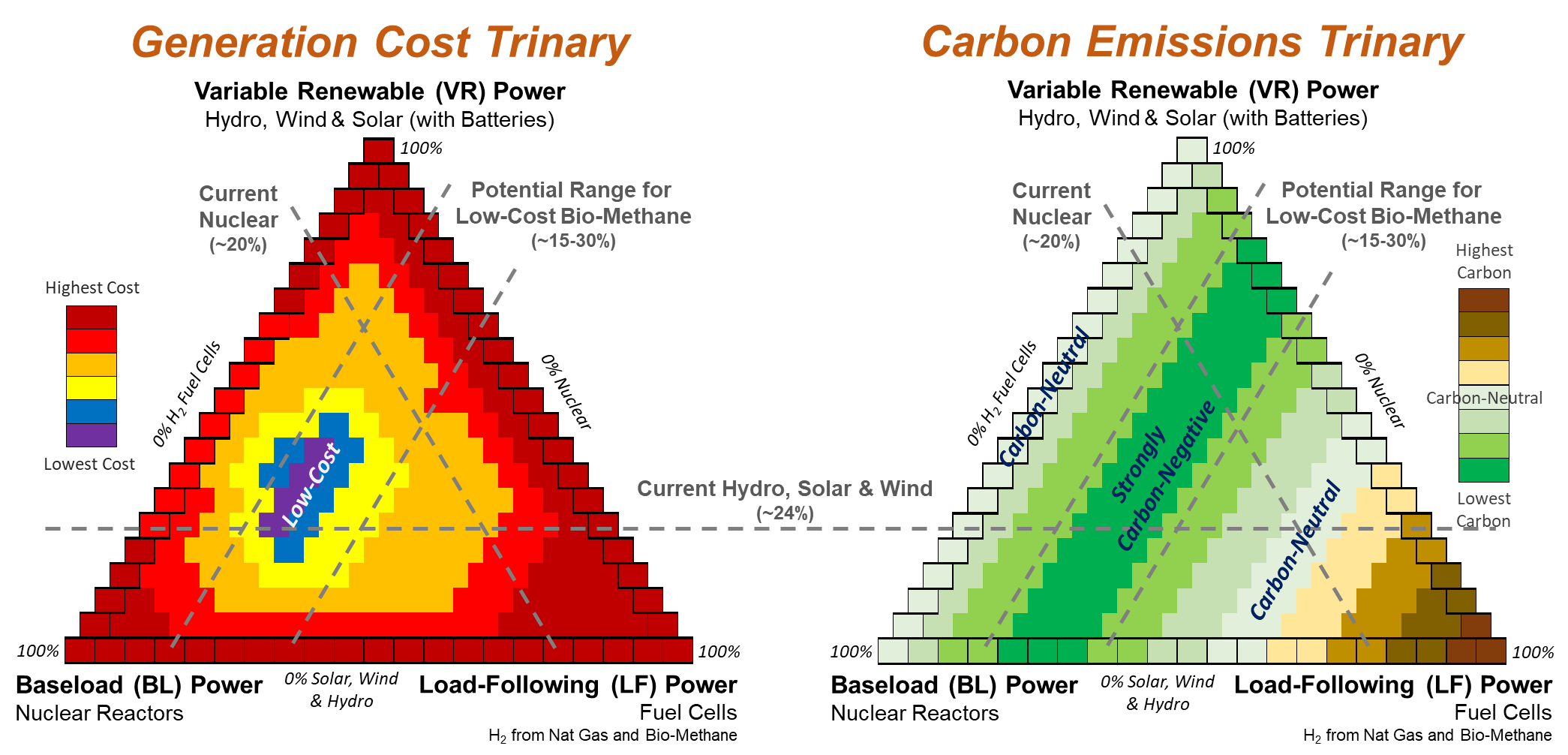
These cost and carbon emissions trinary diagrams show where we should point the future electrical supply in order to attain an affordable, sustainable energy future. Notably, small modular nuclear reactors and high-efficiency hydrogen fuel cells, with renewable natural gas, allow a blend of power generation units that get us to a set of ‘sweet spots’ where we have a future that includes affordable and potentially carbon-negative electrical power.
The advent of current events
We are suddenly and inadvertently at an unplanned inflection point.
The war in Iran has temporarily cut the worldwide distribution of oil and gas by 20%, and has created what some have called ‘a new energy crisis’. While some of that reduction will be restored when the Strait of Hormuz is reopened, a substantial fraction of the energy infrastructure in that region has been destroyed. The reliability of fossil fuel has proven to be not so reliable.
We can therefore expect that billions, perhaps trillions, of dollars will be spent over the next several years to build out new energy infrastructure.
But which way will the world go? Will we rebuild more 20th century fossil energy infrastructure, or will we emphasize the build-out of 21st century clean energy infrastructure? Many countries are reconsidering their reliance on fossil fuels and will have a high bias for affordable, reliable alternatives.
We can choose an affordable, low-carbon future NOW.
Climate scientist Steve Ghan leads the Tri-Cities chapter of Citizens Climate Lobby.
Bob Wegeng, an engineer who worked in the energy industry before joining the Pacific Northwest National Laboratory as a technology developer, is the co-holder of three R&D 100 awards and is now the president of a startup company in the Tri-Cities.
