
Targeting atmospheric carbon dioxide at 350 ppm will help us get control of the Earth’s greenhouse gas effect.
In our last two columns, we showed that the natural removal of carbon from the atmosphere can help us reverse the accumulation of carbon dioxide (CO2) if emissions from human activity decrease by just a few percent per year. Although global emissions have not yet started to decline, annual worldwide emissions of CO2 are no longer growing at an exponential rate.
In fact, as we showed in a graph last month, annual CO2 emissions have mostly stagnated over the last dozen or so years. In addition, the U.S. and Europe have succeeded in reducing annual emissions at a rate of at least 1% per year. This initial progress in the early 21st century has been enabled due to improved fuel efficiency of transportation and heating systems, the replacement of coal with fracked natural gas for electricity production, decreased costs for renewable electricity and batteries, and the use of renewable natural gas (e.g, biogas). Each of these emission reduction solutions was enabled by improvements that allow these new technologies to compete with fossil energy technologies.
We don’t mean to disparage 20th-century fossil energy technologies. In fact, they are responsible for substantial advances in human living conditions, including decreased poverty and longer lifetimes. They produced large increases in living standards and wealth. And they will continue to be used for multiple decades.
The most successful approach to emission reductions is the development and deployment of advanced, 21st-century energy technologies that are economically preferable to previous, 20th-century fossil energy technologies.
Atmospheric concentration goal
Primarily through the combustion of fossil fuels, humans have raised the atmospheric level of CO2 from about 280 parts per million (ppm), the concentration two hundred fifty years ago, by slightly more than 50%. It’s now at about 430 ppm.
Simply put, we need to reverse this trend.
In this month’s article, we suggest an intermediate target of getting atmospheric levels back down to under 400 ppm early during the second half of this century, and a more ambitious target of under 350 ppm by the end of this century.
As technologist Vaclav Smil makes clear, this won’t be easy because of the massive amount of material involved in the decarbonization transformation.1
We selected these concentration targets — in particular, the 350 ppm target — through consideration of the climate science literature, our own calculations, and recommendations from a pre-eminent climate scientist, Dr. James Hansen. In a landmark paper in 2008, Dr. Hansen and his collaborators recommended 350 ppm as the target for CO2 based on projected future temperatures plus additional climate concerns. These included:
- Declining Arctic sea ice, which was already shrinking faster than climate models had predicted;
- Disappearing mountain glaciers, which feed rivers that deliver fresh water to communities;
- The melting of Greenland and West Antarctic ice sheets, leading to increases in sea level;
- The poleward expansion of subtropical regions, rendering areas less hospitable to humans and many species; and
- Stresses on the world’s coral reefs, which shelter a large percentage of marine species.
These concerns caused Dr. Hansen’s team to “suggest an initial objective of reducing atmospheric CO2 to 350 ppm, with the target to be adjusted as scientific understanding and empirical evidence of climate effects accumulate.”
We find both the rationale and concerns about climate-induced harms to be compelling, and we consider the recommendation of 350 ppm CO2 to be appropriate at the present time; hence, we call it a provisional goal.
So, while we say that this won’t be easy, we also assess that it won’t be as hard as it was previously thought to be. The natural carbon sinks are helping, and we’ll demonstrate in subsequent columns that we can develop and deploy affordable, advanced technologies that don’t produce as much CO2.
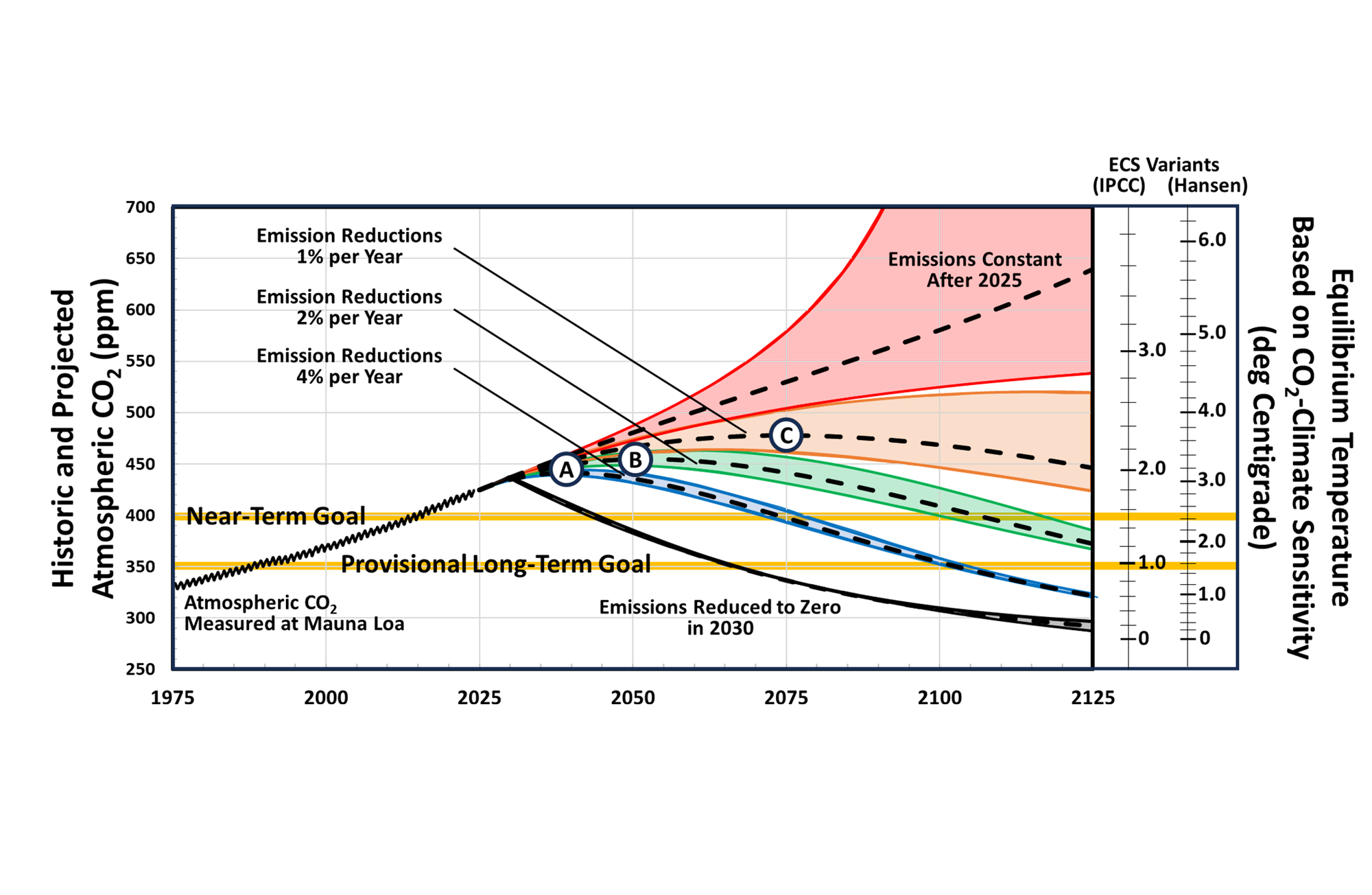
In the following figure, we have extended the graph from last month, where we laid out how CO2 concentrations might fall under various emission reduction scenarios. This figure shows that CO2 concentrations can be reduced to the target concentration without so-called net zero emissions. The 2% per year emissions reduction scenario, which approaches the 350 ppm target concentration, is substantially more attainable than the highly aggressive ‘net zero by 2050’ goal that has previously been proposed by others.
We’ll talk more about emission reduction trajectories next month, including more specific discussions on solutions.
Stay tuned!
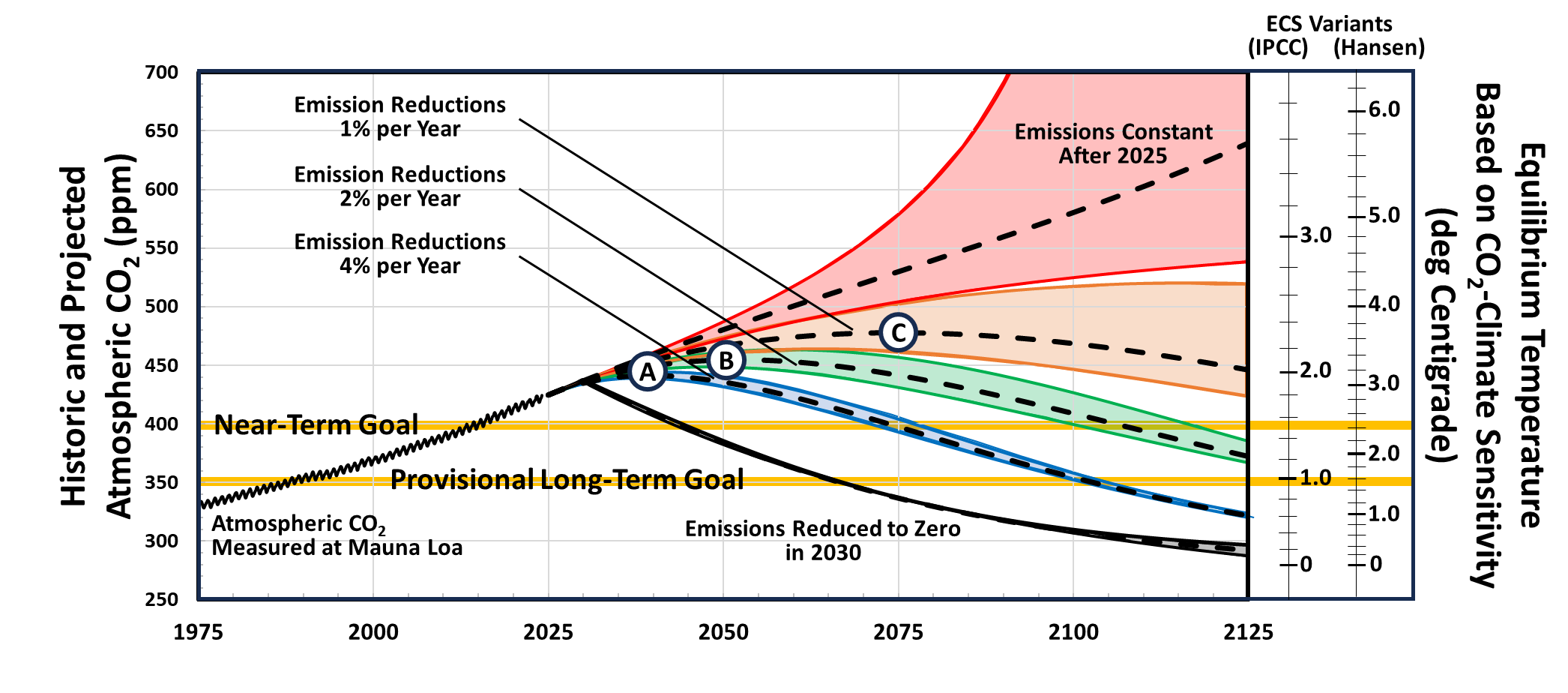
In this graph, we present additional information on various scenarios for reducing worldwide CO2 emissions and bringing down the overall CO2 concentration in our atmosphere. As with the graph last month, we present five scenarios: constant CO2 emissions, gradual emission reduction scenarios (1% per year, 2% per year, and 4% per year), and the hypothetical case where emissions are zeroed overnight. The concentration decreases by 2100 for all scenarios except constant emissions, as the natural carbon sinks continue to remove CO2 at rates that are directly proportional to the atmospheric concentration. The concentration reaches the long-term target concentration (350 ppm) for the 4% per year emissions reduction scenario by 2100, and approaches that target for the 2% per year scenario by 2125. For the 1% per year scenario, the concentration decreases after 2075, but too slowly to even approach the near-term target (400 ppm) by 2125.
This graph also highlights three points, marked A, B, and C. The location of Point A corresponds to the year, in the 4% per year emission reduction trajectory, when the CO2 concentration peaks and then begins to fall. In this trajectory, the peak year is projected to be 2040, when the CO2 concentration is projected to be 441 ppm, just slightly higher than its present concentration, 429 ppm. Points B and C are for the 2% and 1% per year emissions reduction scenarios, respectively. These points show that the faster emissions are reduced, the sooner the peak concentration is reached, and the lower the maximum concentration is.
Another addition to the graph is the section on its right-hand side, where we connect CO2 concentrations to long-term, eventual global temperatures, using what climate scientists refer to as the Equilibrium Climate Sensitivity (ECS). This is essentially scientists’ best estimate of the ‘equilibrium temperature’ that would eventually be reached at a given CO2 concentration, within a few centuries of attaining (and maintaining) that particular CO2 concentration. The United Nations Intergovernmental Panel on Climate Change (IPCC) estimates that, for every doubling of atmospheric concentration, the equilibrium temperature would rise by about 3 degrees Celsius,2 while another group, led by James Hansen, estimates a greater warming (about 4.8 degrees Celsius) for each doubling in atmospheric CO2 concentrations.3 The two vertical scales provide this connection for the two groups. For example, reaching 560 ppm CO2 would be a doubling from the 280 ppm that was present in Earth’s atmosphere before the industrial period, and the vertical scales show the 3.0 degrees Celsius and 4.8 degrees Celsius values from the IPCC correlation and the Hansen group correlation.
We have also added two gold, horizontal bars to represent the near-term and the provisional, long-term CO2 targets (400 ppm and 350 ppm, respectively). The equilibrium temperatures for the near-term target, from the IPCC and the Hansen estimates of climate sensitivity, are 1.5 degrees Celsius and 2.5 degrees Celsius, respectively; the values for the provisional long-term target are 1.0 and 1.6 deg Celsius, respectively.
Note again that the equilibrium temperatures are values that may require centuries to achieve, so passing through a particular atmospheric concentration does not mean the warming will reach the equilibrium temperature values, particularly if the CO2 concentration decreases within decades.
Climate scientist Steve Ghan leads the Tri-Cities chapter of Citizens Climate Lobby.
Bob Wegeng, an engineer who worked in the energy industry before joining the Pacific Northwest National Laboratory as a technology developer, is the co-holder of three R&D 100 awards and is now the president of a startup company in the Tri-Cities.
Sources
- Smil, Vaclav. How the World Really Works
- The Intergovernmental Panel on Climate Change: ipcc.ch/reports
- Hansen, J.E. et al. ‘Global Warming Has Accelerated: Are the United Nations and the Public Well-Informed?’: tandfonline.com/doi/full/10.1080/00139157.2025.2434494#d1e912
