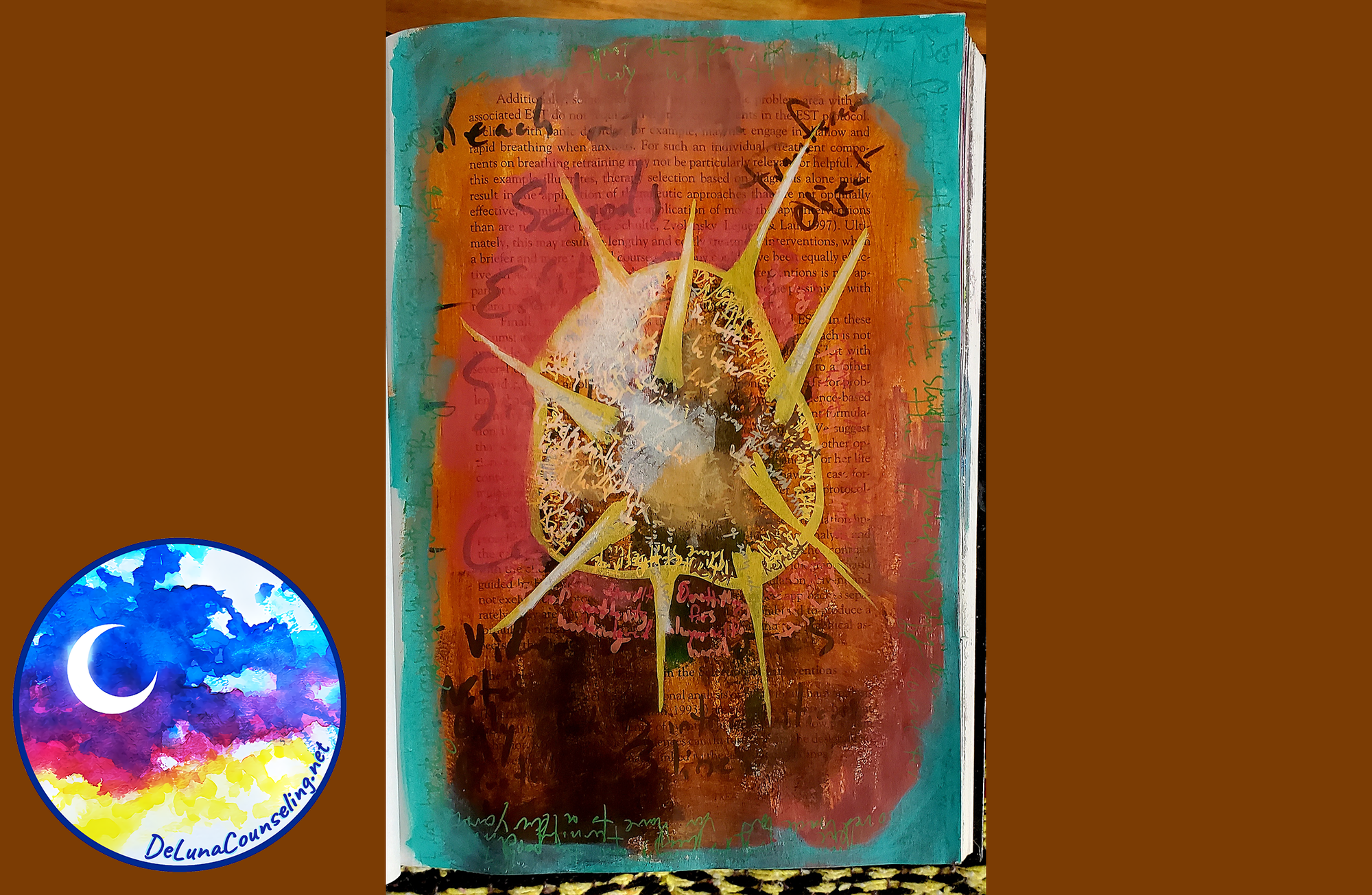
Art and art therapy are useful tools for understanding ourselves and the world around us. Expressive therapies are presently used by many therapists to facilitate growth and change, while not having to rely on talk therapy exclusively.
The goal of this column is to present a topic from a place of vulnerability, followed by an art exercise that might facilitate curiosity and insight. It is not a guide for how to make a specific type of art, nor is it a replacement for therapy. (Editor’s note: Check out Ashleigh Rogers’ “Acts of Art” for some additional art making ideas: tumbleweird.org/topic/acts-of-art)
This column is written by counselors familiar with creative and expressive therapies, and we welcome questions or comments. If you would like to engage in the act of making or sharing your art from this column, feel free to contact DeLuna Counseling, or join us in person at our monthly gathering at Earth Spirit in Kennewick. Information for the event and how to contact us can be found at http://delunacounseling.net.
“Trust your gut.”
“Follow your intuition.”
“You have the inner wisdom you need.”
The language of following our innate understanding feels omnipresent these days, especially as a therapist. Sometimes it’s good advice — advice I, myself, have given out to clients over the years as we worked to understand how their intuition contains untold wisdom and the promise of deeper emotional intelligence. So then, why is it that our intuition can seemingly lead us astray or be difficult to hear?
My own intuition seems riddled with voices that I sometimes have to sort through before giving them credence or space. There have been so many times in my life where my gut has given me the green light to get closer to people who later turned out to be unsafe. Not to mention that sometimes my inner voice tells me I’m not even fucking close to being ‘good enough’. My first gut reaction to looking at my art or writing is usually a desire to toss it in the trash, to say that it isn’t worth the effort, or to remind me that there are many people who have done it better, have said it clearer, or just generally deserve to be heard more than I do.
You may be thinking that those negative inner voices should not be called intuition; that instead, they are trauma narratives, or imposter syndrome. But I have yet to see a study where those are differentiated, and making those kinds of distinctions isn’t always helpful to me or to my clients. I know that some people find value in parsing out trauma and wisdom; but if I’m honest, I am just not sure that can be done effectively. I also think it can be a setback to divorce your intuition from its place of birth — your emotional intelligence and insight about your past experiences and how they shape you.
So what do we do about this imperfect understanding of wisdom and intuition?
When gardening this year, it has been on my mind that the potential for a beautiful tomato plant exists in a tiny seed the size of a grain of sand. When you plant and water this tiny seed, it catalyzes tens of thousands of years of evolutionary information, along with thousands of years of human tinkering and selection. The seed interacts with its environment based on this innate knowledge and wisdom, growing (or stagnating) based on what it encounters in its life cycle. To me, this is our inner wisdom — a seed forged by generations of love, trauma, pain, desire, joy, creativity, and alienation — that germinates through many cycles in our own lifetime.
I like this metaphor, as it gives me more access to what my own inner voice feels and sounds like. Intuition can be confusing for me because my intuition seeds contain a childhood full of shame, anger, alienation, and confusion. I grew up being noticeably queer and gender non-conforming in the outskirts of a rural town to immigrant parents who had their own trauma histories.
The resulting inner wisdom seeds I cultivated resembled goat heads or a prickly cactus, sharp points and self protection at every turn. I was quick to be unkind with my words when I felt someone may be attempting to hurt me. Eventually, I learned that being alone was often better than pretending to be close to people who would reject or hurt me. I began to relish solitude, as there was far less conflict if there were simply less people involved.
Being ‘prickly’ and ‘distant’ is what I needed to protect myself and survive the environment I grew up in. And while a part of me wishes I had been able to find more belonging in my youth, my continued longing for connection made me intensely curious about other people’s relationships, and their responses to each other and to myself. Eventually, this curiosity, along with my love of art, eventually led me to where I am now!
Some days I do feel I have managed to beat back the loneliness and disconnection of my childhood. Yet at times, even after years of therapy and becoming a therapist myself, I still have mean and aggressive thoughts that just fly into my head at the slightest provocation (especially if I happen to be tired and cranky). I hate seeing people impale themselves on the goat head thorns I have left unattended. For me, I find it helpful to give myself space to disconnect. Stepping back from situations that trigger a ‘thorny’ response gives me the distance I need to allow my inner wisdom to take shape into something else.
I hope that one day I can see myself as more of a rose bush. Still not the funnest thing to cuddle up to, but my god, can they bring joy and beauty into the world! I will continue to create fertile ground for my wisdom and intuition to germinate and grow in that direction. Through my interactions with others, I attempt to move the fruit of that cycle towards a future where I can be proud of what flows from me into the world, and better appreciate what flows back to me.
Art therapy exercise: Create a seed
Please note: Try not to do this exercise in isolation, and make sure you have space to receive comfort and compassion. Healing is often about having the right people around — people who support you, and who can help you continue on your path towards understanding. Allow yourself to use any creative outlets that you are familiar with while engaging in the exercise, such as writing, painting, collage, drawing, sculpting, or movement. If you don’t have access to art supplies or have physical limitations, you can use your imagination to visualize the steps below.
Start by taking a few nice deep breaths. With whatever materials you have handy, create a large seed. Within the seed, begin to write words or create symbols representing core pieces of your wisdom. What are the lessons that your ancestors gave your family? What are the lessons that your caregivers offered you? What are the lessons that you have picked up during your own lifetime? Give yourself an opportunity to really be honest and compassionate with how this wisdom might have come into existence.
Take a few deep breaths after doing this, and check in with how you are feeling and what you are experiencing. Review what you have created, and ask yourself: What bits of wisdom do you wish to harvest and nurture the most? Are there any that you will have to keep an eye on, or that may no longer serve you?
When you’re ready to continue, around your seed, draw, write, or sculpt a few things to represent the types of nourishment and resources you need to cultivate the parts of your wisdom that are the most important to you. What are some people/things that are influencing your seed’s growth? How can you nurture the parts of you that are the most aligned with, how you see yourself and who you wish to be? Are there people, places, or activities that offer you space to access your inner wisdom in a way that feels balanced? Conversely, what are some things in your life that might be accidentally feeding the parts of yourself that you wish to minimize? Are there experiences that make you lean on those intuitive responses in a way that recreates painful patterns from your past?
To finish this exercise, think of a mantra to enclose the whole object — the seed itself as well as the surrounding influences. The mantra can be an affirmation of what you have learned about yourself, or it can focus on what you wish to see in the future. For me, the mantra that made the most sense during this exercise was: “I will have many iterations of this seed in my lifetime; I don’t have to get it right, I just have to keep trying.”
Whatever message you decide to give yourself that might offer you comfort and hope, inscribe and wrap the piece in this information, literally or metaphorically. You might choose to mentally visualize your seed and its surrounding influences being surrounded by the mantra you created, or you might choose to physically add it to the artwork you just made (as before, it can be represented using words, symbols, or anything else that feels right to you).
Once you have completed your piece, give yourself a moment to sit with what you have created or imagined. What emotions are present for you? Can you foster compassion for the lessons you carry and the intuition and wisdom that has shaped your survival?
If you would like to create a ritual around continuing your journey with your intuition seed, make a space where you can return to this art piece on a regular basis. This will serve as a reminder of how you wish to nourish and grow your intuition. Rituals and reminders of our journey can help us slow down and be more thoughtful about our actions and our choices.
DeLuna is an art therapist based out of Richland. They are interested in the connection between healing, art, and community.
References:
- Schott BH, Henson RN, Richardson-Klavehn A, Becker C, Thoma V, Heinze HJ, Düzel E. “Redefining implicit and explicit memory: the functional neuroanatomy of priming, remembering, and control of retrieval.” Proc Natl Acad Sci U S A. 2005 Jan 25;102(4):1257-62. doi: 10.1073/pnas.0409070102. Epub 2005 Jan 18. PMID: 15657126; PMCID: PMC545864.
- Stanton, Sarah Dyanne, "Intuition: A Silver Lining for Clinicians with Complex Trauma" (2016). Dissertations - ALL. 615. https://surface.syr.edu/etd/615
