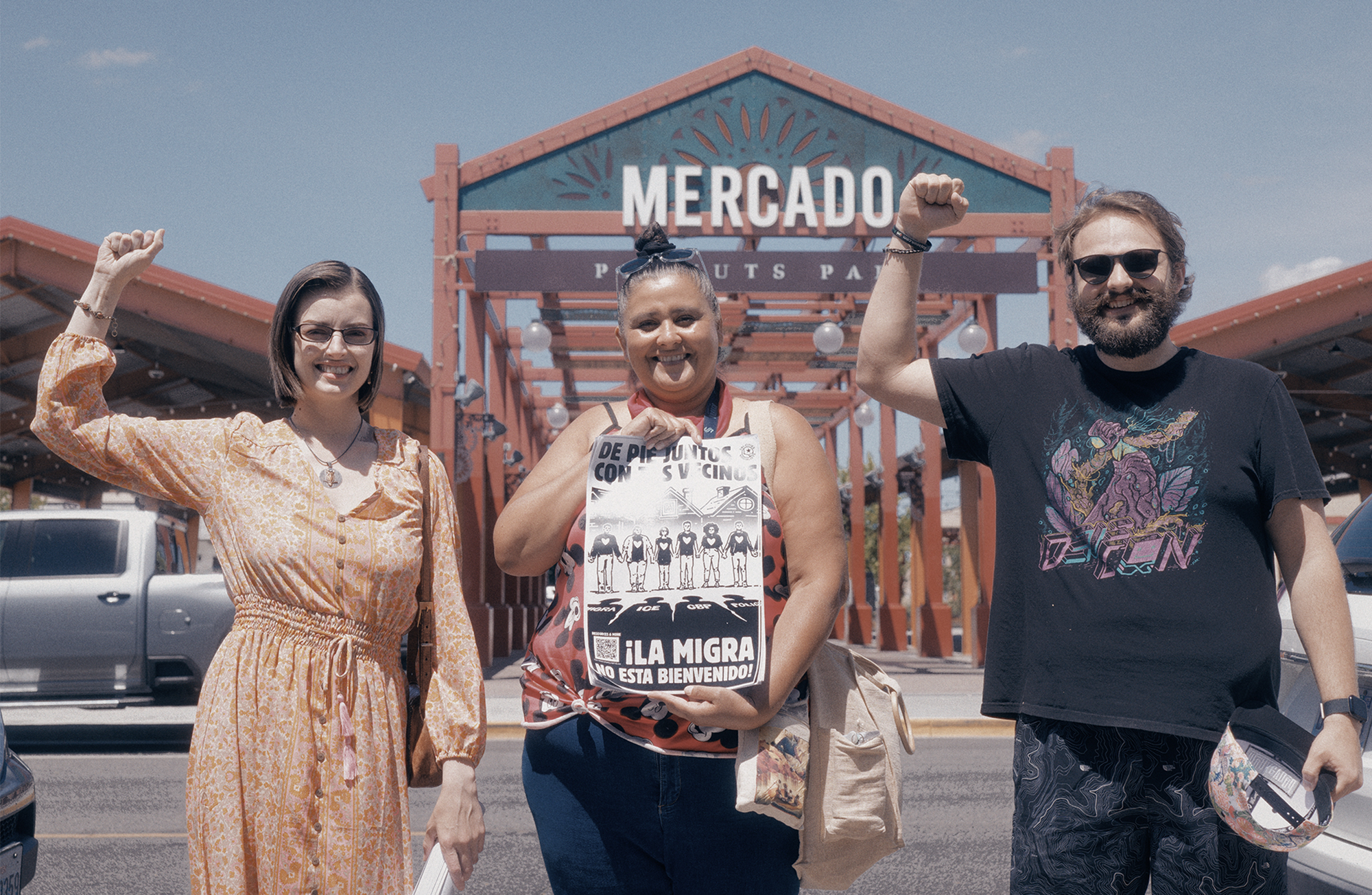
TCS volunteers and member-organizers distribute flyers, community resources, and Know Your Rights information to individuals and businesses as part of the ‘ICE Out of Tri’ campaign. (Pictured from left to right: Moe, Ali Alvarez, and Ryan Cunningham.)
On Thursday, March 26th, Franklin County officials held a conference at the HAPO center for the regional Federal Partners Coalition (FPC). The Benton-Franklin Council of Governments describes this coalition as a “new collaborative effort to serve rural and tribal communities across Idaho, Oregon, and Washington,” though Pasco City Manager Harold Stewart later noted the conference hosted partners as far south as Northern California and as far east as Montana. The priority of the FPC is to serve rural families and businesses for the purposes of rural development, with a particular focus on meeting community-specific priorities.
March’s conference aimed to help local government and private partners access federal assistance programs, enabling direct lines from the local to the federal government, which are typically difficult for rural communities to access. The federal side of the conference included USDA Rural Development, the Economic Development Administration, the Environmental Protection Agency, the Department of Health and Human Services, and the Department of Housing and Urban Development. The attendees, which included local and Tribal governments alongside various community groups, sought much-needed funding for critical infrastructure and economic development in crumbling rural communities.
As helpful as this project seems on its face, the FPC convention exposes many of the problems with the U.S.’ approach to so-called ‘rural development’. The federal roster, in addition to general service and development departments, featured some of the more reactionary elements of the federal government — namely the Drug Enforcement Agency (famous for uplifting rural communities!) and the Small Business Administration — alongside “many high-ranking officials from the Trump administration,” according to Franklin County Administrator Brian Damsel. Whether these high-ranking officials are unnamed because Damsel inflated their status or because they are broadly unpopular and would draw negative attention is unclear, though neither answer is a ringing endorsement of the FPC’s stature as a bold new regional-federal partnership.
The FPC, despite being officially framed as having a Pacific Northwest focus, includes a regional who’s-who for some of the most die-hard loyalists to the Trump regime. Montana, Northern California, Eastern Oregon, and Eastern Washington all leaned clearly to the right in the last election and are home to long-standing reactionary political movements, including secessionists and far-right paramilitary groups. Idaho, in particular, is a major right-wing holdout for Trump, being one of only four states whose population maintains a favorable outlook on Trump, according to The Economist’s ‘Tracking the presidency’ approval tracker. Among 2024 voters, Idaho maintains the third highest overall loyalty to Trump.
It is also noteworthy that Franklin County was chosen to host this summit in the months following the passing of Resolution 2025_0173, wherein the county commissioners expressed their support for the Trump regime’s massively unpopular Immigration and Customs Enforcement (ICE) raids. The resolution declared Franklin County to not be a “sanctuary jurisdiction,” opening the county up to racist ICE raids, in violation of the Keep Washington Working Act. While there is no direct evidence that this resolution is why Franklin County was chosen, it would not be out of character, given Trump’s emphasis on punishing jurisdictions that stand against him, and his habit of rewarding compliant jurisdictions. Of course, it is also possible that the county’s act of fidelity to Trump’s fascist program was entirely incidental to the meeting location. Whatever the connection, it is clear that Franklin County commissioners are all too comfortable sacrificing the region’s working people to advance Trump’s billionaire agenda.
Trump’s programs devastate rural communities
The Trump administration is no friend to rural people. As outlined in the Center for American Progress (CAP) report, ‘10 Ways the Trump Administration Has Failed Rural America (and 10 Ways To Overcome It)’, the administration went to great lengths in its first term to side with agribusiness, gut rural development investment, and “sacrifice small and medium farms in [Trump’s] trade war.” (Willingham, 2020) Trump’s first administration also “revoked rules that would prohibit meatpackers from paying different prices to farmers with similar products, and banned them from retaliating against growers who organized collectively.” (Willingham, 2020)
The Trump regime is only the latest and most reactionary in a long history of ‘rural development’ doing more to hurt rural communities than to build them. For decades, rural communities have been hollowed out by programs which favor agribusiness, drain local communities of their wealth, and re-concentrate wealth into urban areas. Even some of the more innocuous programs, like building roads and railways, or energy and broadband infrastructure, are often carried out with a specific pattern of serving small communities only insofar as they advance the development of capital. Quoting Phil Neel in his book Hinterland: America’s New Landscape of Class and Conflict (2018):
[R]ural regions are simply abandoned, becoming wastelands for global production. At best, they can hope to be transformed into recreation zones, military and prison complexes, or massive sites for primary production — swaths of countryside converted to mines, oil fields, or farms, or simply flooded to make way for reservoirs and hydropower projects serving the cities. Though sometimes geographically distant, most non-urban areas function as subsidiary zones for global capital and for the particular cities that happen to be closest to them — they are by no means outside the economy, and they therefore no longer constitute ‘peripheries’ that are not yet fully subsumed into world capitalism.
Much of rural development involves corporations setting up new enterprises in rural areas based on tax incentives. These incentives — generally exemptions and credits — are given by states, counties, or towns as a means of attracting businesses to economically disadvantaged rural regions. However, these incentives snatch money from the hands of the community. Rather than reinvesting locally, tax exemptions offer a way for capitalists to dodge making contributions to critical services in the communities where they operate. Those untaxed funds end up concentrated in the hands of wealthy owners, overwhelmingly centered outside the rural communities meant to be ‘developed’. This pattern functions as a means of extracting wealth from rural communities, hollowing them out and leaving them destitute.
The dominant narrative on the right is that this arrangement is a fair trade, since these capitalists are providing a valuable service to rural communities by bringing their companies there. But why should Amazon be enriched while the people who work for them are broke? Jeff Bezos could not deliver every Amazon package in a single city himself; much less pack the boxes, maintain the website, sweep the factory floor, balance the books, and sort the orders. It’s the vast army of laborers who do these tasks and more; and for their labors, their boss gets paid.
The liberal cure for the problem of rural underdevelopment is almost worse than the disease. The rallying cry of rural Democrats is the raising of property taxes, a proposal that only squeezes the working class on two fronts. Rather than making capitalists pay their fair share, Democrats frequently ask already-hard-hit workers to front the additional costs of infrastructure and education. Property tax policies can have a positive progress impact where there is wealth to spare, but there is nothing to spare in rural areas already made lean by expropriation and exploitation; they are made up of primary residences, not lavish estates and vacation homes. Democrats transplant property tax policy to rural areas thoughtlessly at best — projecting urban dynamics onto rural areas without understanding either. Is it any wonder, then, that they keep losing political ground in rural communities, based on the proposal to double bind workers with increased property taxes?
The role of big agribusiness in rural underdevelopment
Franklin County commissioners know that Trump’s policies are hurting our rural areas. While updating the commission on matters facing farmers during the commissioners meeting on March 25, 2026, Commissioner Didier stated, “Farmers are hurting terribly out there right now. Fuel prices are through the roof because of the war, the tariffs are raising our costs of parts that we put on our circles, equipment — everybody is looking to try to just hang on and survive.” These problems are not only affecting farmers, but the entire working class. Fuel prices and the increased cost of everyday items are crushing workers across the country, and low income areas are often hit the hardest.
Of course, farmers are not a uniform bloc; they can run anywhere from small family farms to large agricultural corporations like Monsanto. And big agribusiness is only one more element exacerbating the dire conditions of rural working people, exploiting workers and small farms in any way it can. For instance, Monsanto’s use and abuse of patent law to dismantle their competition is well documented. And while many small farms rely on migrant labor, large agribusinesses tend to wield ICE as a cudgel against farm laborers who demand better pay and conditions.
In March of 2025, farmworker and community leader Alfredo ‘Lelo’ Juarez of Whatcom County, Washington was violently detained by ICE. According to the Food Chain Workers Alliance, “Farmworker organizations on the ground believe that ICE targeted Lelo for his leadership in standing up for farmworkers and immigrants in his community.” (FCWA, 2025) Closer to Tri-Cities, there is an ongoing struggle with big agribusiness. In Sunnyside, workers at Windmill Farms have been fighting for two years for union recognition. According to Jocelyn Sherman, workers attempting to organize their workplace have “faced adverse actions, including terminations and conditions that have pressured them to leave their jobs.” (Sherman, 2024) Despite not being a household brand name, Windmill Farms is owned by multi-billion dollar private equity firm Instar.
The USDA, one of the agencies attending the Federal Partners Coalition conference, overwhelmingly subsidizes big agribusiness through their grants program. According to a 2025 article in Fanalytics, “Less than a third of all farms benefit from agricultural subsidies, and the ones that do tend to not be the little guys trying to compete — they’re almost always already-established farms operating at a significant scale.” The corporations who “already have the most money receive these grants most often,” making it “hard for the individual farmers and small sustainable farms who most need the money to get enough of a foothold to compete with already established giants.” (Roseman, 2025)
Aligning with Trump’s economic policies means further investment in big agribusiness, and the worsening of these conditions for workers. This kind of ‘rural development’ does not enrich the lives of the working class, it simply props up existing monopolies and further enables their exploitation of labor.
Rural data centers destroy rural communities
Lately, ‘rural development’ across the country has been hyper-focused on building massive data centers in rural areas to serve the looming AI bubble, exploiting the natural resources and cheaper labor of those regions. This focus was recently clarified in a statement from Jason Smith, Chairman of the Ways and Means Committee, following the passing of Trump’s so-called ‘Big Beautiful Bill’: “The new law’s enhancements for RQOFs (Rural Qualified Opportunity Funds) may significantly lower barriers for large-scale, capital-intensive projects in rural areas — most notably hyperscale data centers.” (Smith, 2026)
Rapid data center development has led to the contamination of local water supplies, artificial droughts, massive emissions from diesel generators, and the prolonged use of hydroelectric dams, causing major environmental impacts. In addition to these environmental and social catastrophes, data centers lead to increased energy costs getting pushed onto residents, putting further strain on working people to subsidize wealthy tech executives. Aminu Abdullahi in his article ‘AI Data Centers Boom is Draining Water From Drought-Prone Areas — Sustainability Tipping Point?’ reports: “A single 100-megawatt data center can use up to 2 million liters of water per day, roughly equal to the daily water use of 6500 households. Yet tech companies keep building in hot, dry areas.” (Abdullahi, 2026)
The water crisis driven by data centers has had an acute impact already on the Columbia Basin. In Morrow County, Oregon, nitrate levels in the groundwater have reached toxic levels as a result of Amazon’s data center complex there. Portland News reports that residents of Boardman, Oregon, are experiencing illnesses stemming from the lack of clean water and that “the financial burden is also significant, as many families are forced to pay for expensive filtration systems, or new, deeper wells that can cost upwards of $24,000.” (Portland News Staff, 2026)
The lie used to buy workers off on accepting these facilities is that they will create jobs, bringing much-needed income to hard-hit rural communities. It is only much later that the trade-off becomes clear, with workers fielding the ecological, health, and economic costs of these projects. However, even the promise of jobs is a sham. The proposed data center project in Richland would span over 150 acres, yet only employ around 100 people. (Culverwell, 2026) This massive use of land serves only to accelerate the process of extraction from already-encumbered rural hinterlands.
While the Federal Partners Coalition is not specifically focused on data center construction, it’s important to note that many of the subsidy programs offered by the organizations in attendance have gone to data center projects. A July 2025 Executive Order fast-tracked the permitting process for data centers, strengthening bias towards these projects. There are also numerous tax subsidies and credits made available to large consumers of electricity, of which data centers are one of the most notoriously greedy. And the Department of Energy (DOE) frequently funds or contributes to grid modernization explicitly to absorb the infrastructural burdens on grids created by AI data centers. In Richland, Washington, the DOE is currently exploring proposals to bring their own data center to a 295-acre site on former Hanford Site land which was transferred to the DOE. The site could be operational as soon as 2028. (Cary, 2026)
How does ICE terror ‘develop’ rural communities?
The most recent and most severe crisis facing rural communities is the blitz of fascist terror experienced by the working class at the hands of ICE. Since his inauguration in 2025, this domestic terror force has been utilized by Trump to inflict as much pain, suffering, and fear on the working class as possible. According to the agency’s own numbers, 33 people died in ICE custody in 2025, breaking the prior record of 32 deaths in 2004, and making it the deadliest year for those held in ICE custody. ICE terror has always been a bipartisan program; under the Biden administration, eleven people died in ICE custody in 2024. The rapid acceleration of deaths, armed occupation of cities, and intensity of crackdowns nationwide under Trump’s second administration signal his escalating war against the working class.
The primary form of this war on workers has been the widespread urban assaults and militarized sweeps that look like they were ripped straight out of the height of street terror in Nazi Germany. ICE agents have been seen on video intentionally ramming cars of legal observers, killing observers as they struggle to obey conflicting orders, and executing protesters in the street. Activists resisting the surge have had their rights suppressed by the Department of Homeland Security (DHS), the parent department to ICE. For example, there was the detainment and attempted deportation of legal resident Mahmoud Khalil for his activism bringing attention to Israel's genocide of Palestinians. Working people in impacted communities have had to shelter in their homes out of fear of ICE attacks. With raids on schools, parents have been preventing their children from attending school, holding back their education and leaving schools empty. Workers afraid of raids on job sites have been unable to collect the money needed for survival, plunging families into financial crisis.
The goal of the Trump regime’s terror campaign is to intimidate the working class and keep them compliant while conditions around the country deteriorate, whether from cuts to critical social programs people depend on to survive, or from increased costs caused by wide-sweeping tariffs and imperialist wars. By pitting white workers against Black and Brown workers, the right hopes to play off longstanding racism to win one section of workers to its other regressive economic and political positions.
These policies have not only been carried out in cities, but in rural areas also. According to the Transactional Records Access Clearinghouse (TRAC), 59% of the counties with the highest proportion of residents being removed by ICE came from rural areas. The ten counties with the highest proportion of residents in deportation proceedings were all rural. Many detention centers are also centered in rural communities, taking advantage of the abundant land and federal subsidies (many detention centers are privately owned), as data centers seek to do.
In our region, rural counties are also hit disproportionately. While in absolute terms, urban areas like Multnomah and Washington Counties in Oregon, and King County, Washington, have seen the largest total number of ICE arrests per-county, Washington’s rural communities have seen a significant jump in per-capita arrests. In Washington, Yakima County is by far the highest county for arrests-per-capita at 180 arrests per 100,000 residents, with Franklin County in second place at 66 per 100,000. The rural populations of Whatcom, Mason, and Chelan counties all help fill out the top band of per-capita arrests. (University of Washington, 2025)
By expressing support for the Trump regime's immigration crackdown, Franklin County’s commissioners have openly stated their allegiance to the ruling class.
It is in this political context that Franklin County’s triumvirate of reactionary county commissioners — Stephen Bauman, Rocky Mullen, and Clint Didier — were more than happy to get the chance to rub elbows with “high-ranking” Trump officials and gain access to federal funds. Their vision of rural development is clearly one muddled by their attachment to corporate interests and the racist political project of the right. Regardless of the benefits many attendees may have gotten out of the FPC conference, what’s clear is that these institutions overwhelmingly act against the interests of workers, which is exactly what Bauman, Mullen, and Didier want.
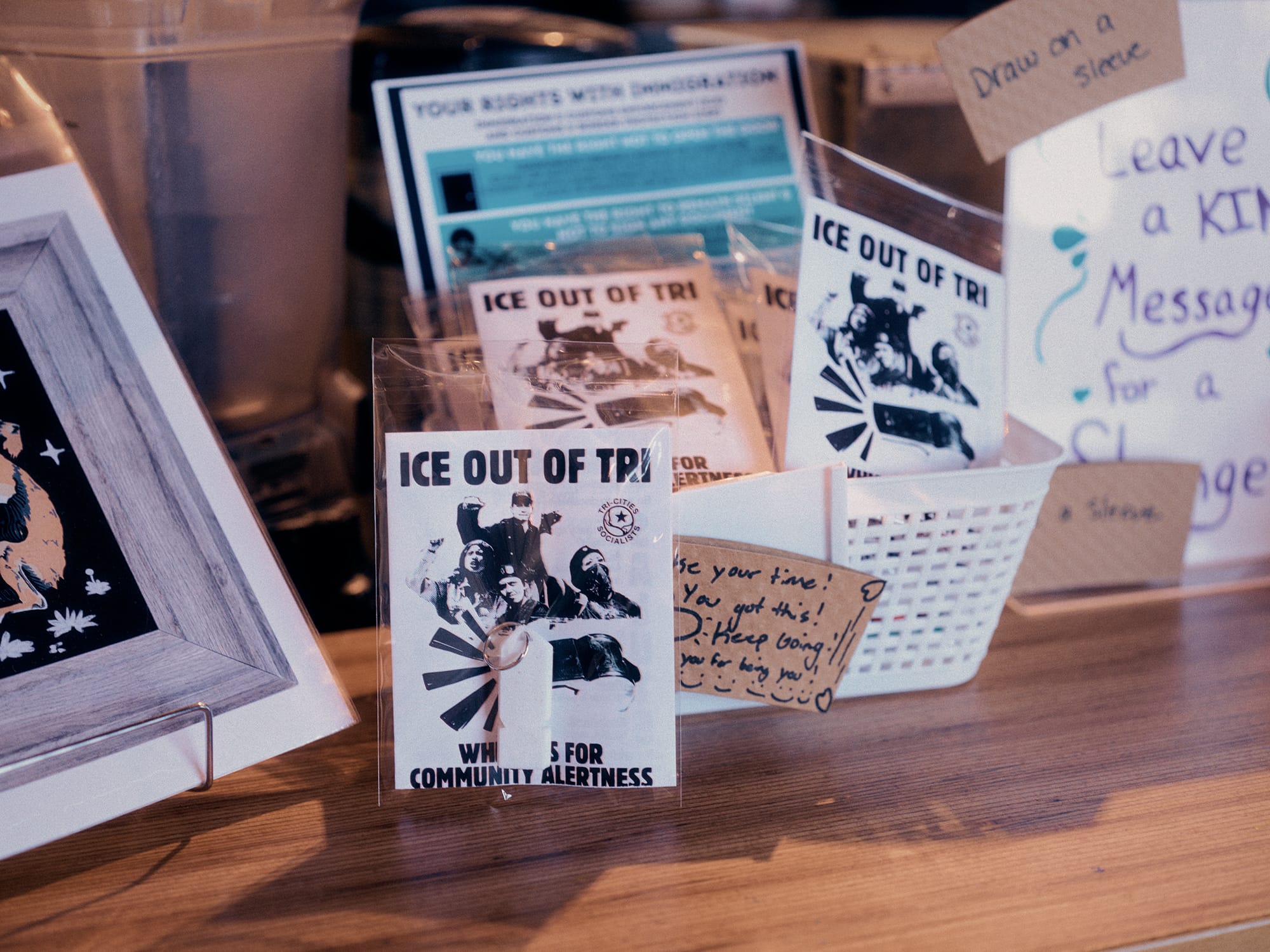
Tri-Cities Socialists: Real development, real solutions
It is impossible to develop a rural area while kidnapping and terrorizing its residents. It is impossible to develop a rural area while starving it of its own wealth. It is impossible to develop a rural area while pricing out its residents and poisoning their water. It is impossible to develop a rural area without a working class political project with a clear program.
Our ‘leaders’ need to be held accountable for selling out the working class to corporate interests, exploiting our labor and natural resources, terrorizing our communities, and driving up prices. Rural development should be focused on improving the lives of rural people — expanding access to education, healthcare, and other services.
It is the local residents and the environment which should be the main consideration for any and all forms of rural development.
What rural areas need is a political program that works for them. The Tri-Cities Socialists are an organization dedicated to fighting for rural people in our region. Our program seeks to not only force capitalists to put their money back into the communities they extract it from, but to free workers from the parasitic capitalist class entirely. A socialist government can redirect funds and infrastructure directly to where they are actually needed, directing the economy along rational, humane lines rather than capitalist extraction and accumulation.
Our primary work right now is through our ICE Out of Tri campaign, fighting ICE terror and building community organizations that can weather attacks on our communities. We need volunteers willing to help organize their neighborhoods for defense. If you are interested in getting involved, email iceoutoftri@gmail.com and schedule a meeting with an organizer to learn more.
Tri-Cities Socialists is an organization of everyday working people committed to fighting for a system where the government and economy are controlled by the poor and oppressed, not billionaires and their cronies. We are activists, leaders, workers, students, and organizers committed to the cause not just of fighting back, but winning a whole new system — socialism.
https://www.instagram.com/tcsocialists
References:
- Abdullahi, A. (2025) ‘AI Data Centers Boom is Draining Water From Drought-Prone Areas – Sustainability Tipping Point?’ Tech Republic: https://www.techrepublic.com/article/news-ai-data-centers-drought/
- Cary, A. and Culverwell, W. (2026) ‘AI data center with a different mission being considered in Tri-Cities’ The Tri-City Herald: https://www.tri-cityherald.com/news/local/pacific-northwest-national-lab/article315513483.html
- Culverwell, W. (2026) ‘It’s official. Amazon is $5B mystery data center developer near Tri-Cities’ Tri-City Herald: tri-cityherald.com/news/business/article314662893.html
- Smith, J. and Culverwell, W. (2026) ‘$500M data center proposed in Richland. It could employ 100 workers’ Tri-City Herald: tri-cityherald.com/news/politics-government/article312541413.html
- Day, M. (2023) ‘Pain, exhaustion rampant among Amazon warehouse workers, study says’ Los Angeles Times: latimes.com/business/story/2023-10-25/pain-exhaustion-rampant-among-amazon-warehouse-workers-study-says
- The Economist Staff (2026) ‘Tracking the presidency’ The Economist: economist.com/interactive/trump-approval-tracker
- FCWA (2025) ‘We Demand the Release of Farmworker Leader Alfredo “Lelo” Juarez from ICE Detention’ Food Chain Workers Alliance: foodchainworkers.org/2025/03/we-demand-the-release-of-farmworker-leader-alfredo-lelo-juarez-from-ice-detention/
- Portland News Staff (2026) ‘Oregon Town’s Water Crisis Deepens as Data Centers Expand’ Portland News: www.youtube.com/watch?v=U8-2uGj2MNc
- Hanson, D. (2026) ‘Federal Partners Coalition Summit connects Northwest leaders with federal agencies in Pasco’ Apple Valley News: instagram.com/p/DWXhlV9j00O/
- Roseman, A. (2025) ‘Big Ag, Big Bucks: How USDA Subsidies Feed Market Inequality And Political Influence’ Faunalytics: faunalytics.org/usda-grant-analysis/
- Smith, J. (2025) ‘Big, Beautiful Success Story: Rural America Rebound on the Horizon with New Opportunity Zone Incentives’ Ways and Means Committee: waysandmeans.house.gov/2025/08/27/big-beautiful-success-story-rural-america-rebound-on-the-horizon-with-new-opportunity-zone-incentives/
- University of Washington (2026) ‘New Data on PNW Immigration Enforcement Reveal Powerful Surge in Late 2025’ Center for Human Rights, University of Washington: jsis.washington.edu/humanrights/2026/03/11/new-data-on-pnw-immigration-enforcement-reveal-powerful-surge-in-late-2025/
- Willingham, C. (2020) ‘10 Ways the Trump Administration Has Failed Rural America (and 10 Ways To Overcome It)’ Center for American Progress: americanprogress.org/article/10-ways-trump-administration-failed-rural-america-10-ways-overcome/
