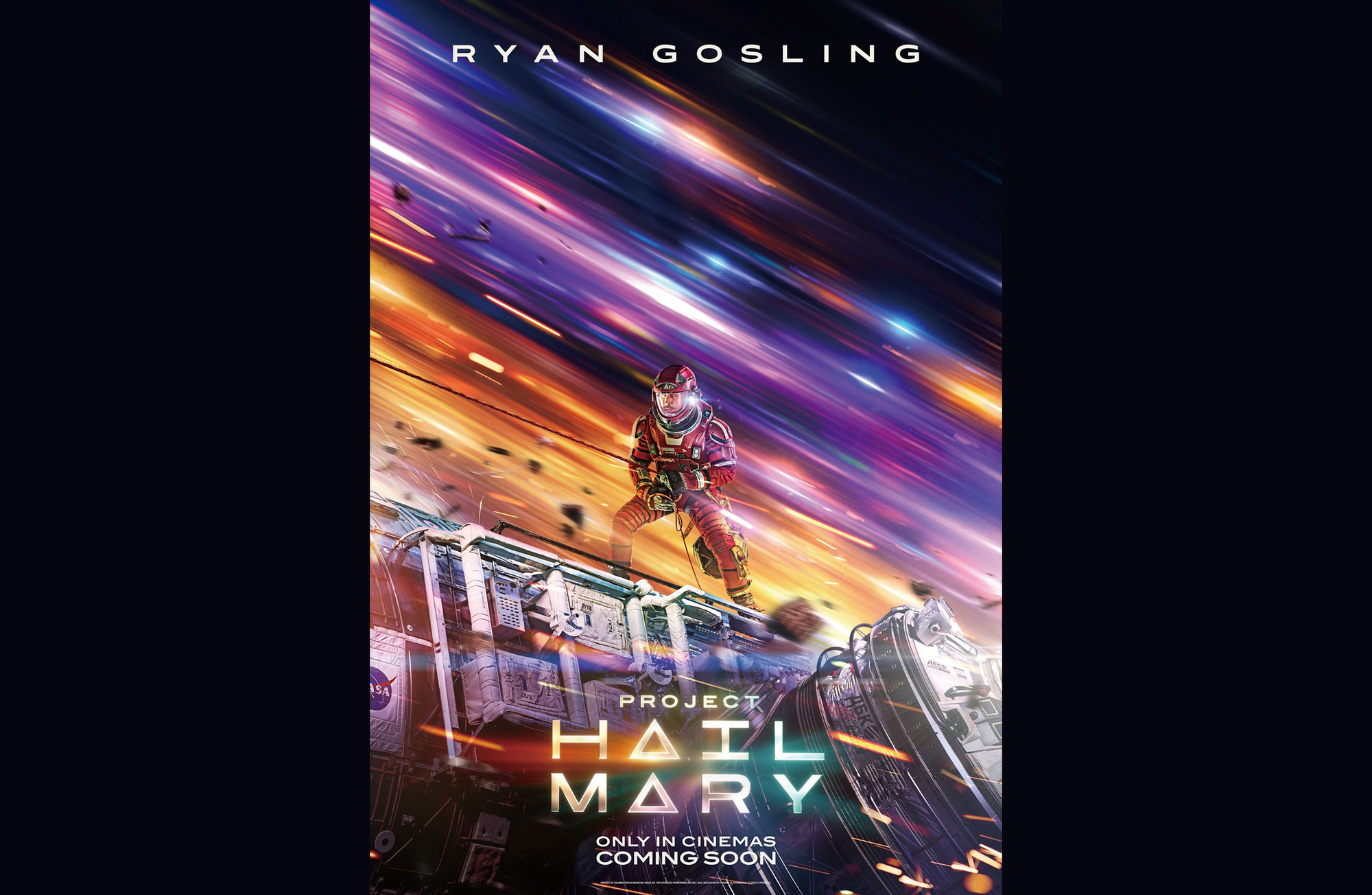
If there’s one movie genre which is a hard sell in 2026, it’s dystopian science fiction. The film industry never tires of recycling apocalyptic visions of the future; but the digitally overloaded audiences of today have only to turn to the news to be faced with the creeping horror we’re already living inside: a nightmarish hybrid of Fahrenheit 451, The Hunger Games, and Idiocracy.
It’s hardly surprising, therefore, that author Andy Weir is having a bit of a ‘Hollywood moment’. His blend of optimistic hard science fiction and light, breezy narrative panache gave veteran director Ridley Scott a resounding hit in 2015 with his adaptation of Weir’s The Martian. Filmmakers Phil Lord and Christopher Miller are hoping to emulate this success with their interpretation of Weir’s latest novel, Project Hail Mary.
Dr. Ryland Grace (Ryan Gosling) considers himself a failure. After an early, stellar career as a molecular biologist, he found himself cast out by the scientific community for daring to suggest that elements other than carbon, hydrogen, and oxygen could form the molecular basis for extraterrestrial life. One day, Grace awakens from a coma to find himself in deep space, with two other crew-members deceased, and no memory of how he got onto the spacecraft.
As his memories slowly return, Grace’s tale unfolds in flashbacks. He had been ‘slumming it’ as a middle-school science teacher when astronomers made a shocking discovery: the sun was dying — being eaten by an alien microorganism dubbed the ‘astrophage’.
Government agent Eva Stratt (Sandra Hüller) recruited Grace to study the astrophage, and he discovered that it reproduces by using carbon dioxide from the dense atmosphere of Venus, drawing energy from the sun to power the process. Stratt revealed to Grace that not only is our sun dying, every other nearby star is suffering the same fate, with the exception of Tau Ceti. The governments of the world resolved to pool their resources in a desperate mission to Tau Ceti, attempting to find a way to stop the astrophage. This mission was dubbed ‘Project Hail Mary’ — a last chance to save humanity from extinction.
When he arrives in the Tau Ceti system, Grace discovers that he is not alone. Another ship, clearly alien, is already there, and attempting to make contact. Grace, much to his own astonishment, finds himself not only tasked with saving humankind, but also serving as Earth’s first ambassador to an extraterrestrial intelligence: a small, spider-like alien from the Eridani system whom Grace nicknames ‘Rocky’.
Without giving away any more of the plot, what follows is equal parts hard sci-fi and feel-good buddy movie, at times verging on straight-up comedy. Gosling is saddled with the herculean task of carrying the brunt of the movie’s emotional heft and, reading Weir’s narrative style perfectly, he just about pulls it off.
Directors Lord and Miller try just a little too hard to convince us we’re watching a landmark sci-fi masterpiece in the vein of 2001 or Interstellar, and, in so doing, draw attention to the fact that this is not a fundamentally original picture, but a carefully-assembled mosaic of previously-trodden tropes. That said, their obvious love of the source material renders Project Hail Mary an homage rather than plagiarism. In today’s atavistic climate of science denialism and rejection of expert knowledge, this film is a refreshing, lovingly crafted celebration of intelligent, educated people saving the world by being intelligent and educated, albeit with a Spielberg-level scoop of sentimentality to smooth its edges. I found it to be slightly over-long, but nevertheless highly entertaining.
Recently arrived in the Tri-Cities from Scotland, Damian Beagan is a former freelancer who wrote movie and music reviews for a variety of UK websites.
