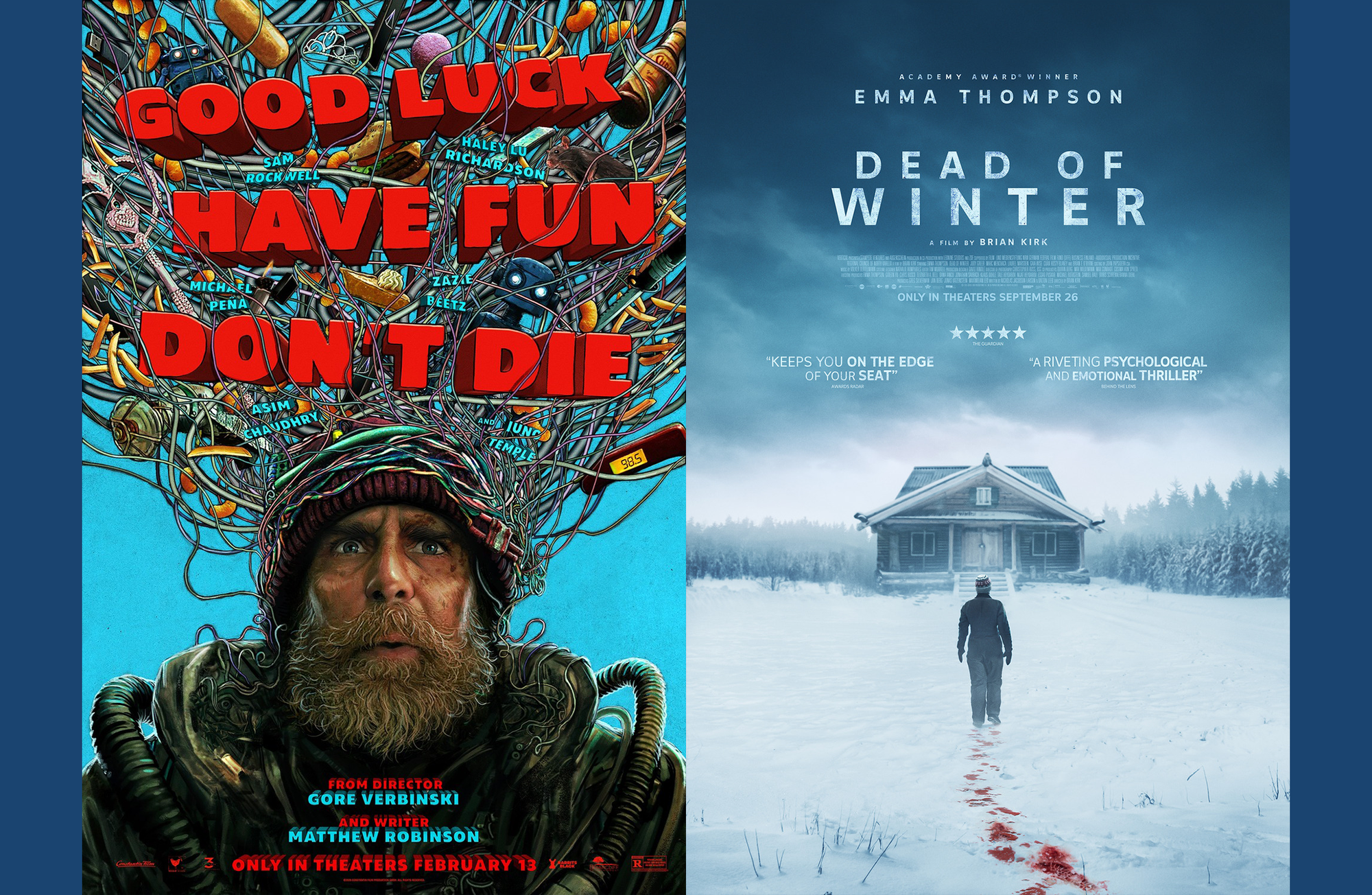
Dead Of Winter
It gets cold in northern Minnesota. So cold that the brutal Minnesotan winter develops a glowering, brooding presence in its own right. The Coen Brothers’ 1996 classic Fargo starred the Minnesotan winter as much as any of its human co-stars: a dark, sullen undercurrent of menace suffusing the entire film with a subconscious shiver. Winters in Minnesota are a whole mood.
Thirty years later, that mood returns to star in another dark, blood-soaked suspense thriller — Dead of Winter, with Emma Thompson taking Frances McDormand’s place as a good-natured local woman unwittingly entangled in grisly events which unfold in the remote backwoods of rural Minnesota. Thompson’s character, Barb, is a world away from the spiky, irascible, savagely smart, thunderously sarcastic, and fresh-out-of-f*cks women who have become her stock-in-trade in recent years. Barb, the living embodiment of ‘Minnesota nice’, recently lost her beloved husband of over forty years. She sets out from her trailer behind the rural bait-and-tackle shop they ran together to take her husband’s ashes on their final journey: to be scattered at the remote lake where they went ice fishing on their first date.
Unfortunately, winter makes its presence known before Barb reaches her destination. She finds herself lost in a blizzard, miles from any cell service. Happening upon a nearby cabin in search of directions, Barb meets a suspiciously uncommunicative bearded man (who she thinks of as ‘Camo Jacket’). He gruffly provides her with some bare-bones directions, just as she notices a large patch of fresh blood in the snow in front of his cabin. Nice as she undoubtedly is, Barb is nobody’s fool; she soon discovers that the blood is not that of a deer (as claimed by Camo Jacket), but belongs to a kidnapped teenage girl being held prisoner in the basement of the cabin.
Thus begins a deadly game of cat-and-mouse, as Barb resolves to rescue the ill-fated teenager, and finds herself hunted not only by Camo Jacket, but also by his infinitely scarier, rifle-wielding wife, ‘Purple Lady’ (played against type by Judy Greer). It’s not until her arrival that the couple’s horrific, desperate motive for kidnapping the girl is revealed as the film builds towards a fiery conclusion.
In contrast to the deadly events unfolding on the ice, the film also tells, via flashbacks, the sweet, poignant story of Barb’s marriage to her late husband, Karl — from their first date, through the heartbreaking loss of their only child, to Karl’s tragic death from Alzheimer’s disease. Young Barb’s story is made even more touching by the inspired casting of Emma Thompson’s real-life daughter Gaia Wise as Barb in her younger days.
The film’s regular flashbacks occasionally slow down the pace, but the two storylines eventually converge in an ending which, though tragic, makes perfect sense. Standing in for Minnesota, the wintry landscapes of Finland and northern Germany are captured in eerie, glowering hues by director Brian Kirk. In the hands of a lesser actor, Emma Thompson’s Barb could easily have become a one-note exercise in sentimentality; but her innate steeliness and depth lend the character complexity and genuine emotional heft. It’s also worth mentioning that Judy Greer’s truly nasty, delusional, entitled Purple Lady is one of the most terrifying antagonists of recent years, right up to her final frame on film. Dead of Winter is a chilly, unsettling journey, elevated to something greater than the sum of its parts by two outstanding performances.
Good Luck, Have Fun, Don’t Die
On the face of it, the premise of Good Luck, Have Fun, Don’t Die doesn’t appear terribly original: dystopian ‘artificial intelligence gone rogue’ movies have become so ubiquitous over the last 35 years or so that they can almost be considered a sub-genre of science fiction in their own right. While modern classics like Terminator 2: Judgment Day and The Matrix have speculated in a multitude of different ways about the much-hyped ‘moment of singularity’ when AI achieves consciousness and out-evolves its human creators, these doomsday scenarios are invariably set in an imagined future where a technology-obsessed human race has succumbed to its own hubris and failed to heed the warnings. The premise of Good Luck, Have Fun, Don’t Die, however, takes the horror to a different level by asking, “What if it’s already too late?”
At 10:10pm on a rainy night in Los Angeles, a time-traveler from the future bursts into Norm’s Diner and announces to the patrons that he has traveled back in time to save the world from an AI — currently being created in a nearby house by a nine-year-old boy — which is about to become self-aware. He must recruit a team of assistants from the diners currently in the restaurant. Explaining that this is his 117th attempt, he informs them that he can only succeed by assembling exactly the right combination of people, but his trial-and-error process of selection has led to 116 failures so far.
What follows is a satirically vicious two hours of jet-black, gonzo sci-fi comedy which almost plays as if Terry Gilliam directed Black Mirror: The Movie. As the nameless man from the future (Sam Rockwell) sets about selecting his team, the movie fleshes out the backstories of several key characters via a series of self-contained vignettes, each illustrating different ways they have recently encountered the horribly plausible effects of our technology-addled modern world. One woman loses her beloved son in a school shooting, and her grief leads her to replace him with a corporate-sponsored clone which speaks in a robotic, Midwich-Cuckoo-like monotone and spouts commercials for fruit drinks instead of conversation. Another flashback involves a stressed-out substitute high school teacher, whose cellphone-addicted students become connected to an AI hive mind. By touching the screen of a student’s phone, he accidentally triggers a TikTok zombie apocalypse and has to flee for his life from a horde of mind-wiped high-schoolers.
Directed with frenetic Everything Everywhere All At Once energy by Pirates Of The Caribbean veteran Gore Verbinski from a script by The Invention Of Lying writer Matthew Robinson, the movie is propelled by a full-throttle performance by Sam Rockwell (in full Zaphod Beeblebrox mode) as the unnamed man from the future. In a less frenetic setting, Rockwell’s untamed ‘rizz’ would be more than enough to drown out everything else on screen, but by letting him off the leash, Verbinski gives the whole ensemble an urgency which might otherwise be lacking, particularly when the narrative pace is frequently broken up by flashbacks. In fact, it’s fair to say that the film is structurally something of a mess, but its sheer manic energy more than compensates. Other highlights include outstanding performances from Juno Temple and Haley Lu Richardson, whose emotional depth provides a counterpoint to Rockwell’s manic energy. Refusing to serve up an easy happy ending, this is one of those rare, high-concept movies that succeeds in being riotously funny while also remaining thoughtful and deeply unsettling. Yes, it’s a big, noisy mess, but so is the world in 2026. Go see it, have popcorn, don’t die.
Recently arrived in the Tri-Cities from Scotland, Damian Beagan is a former freelancer who wrote movie and music reviews for a variety of UK websites.
