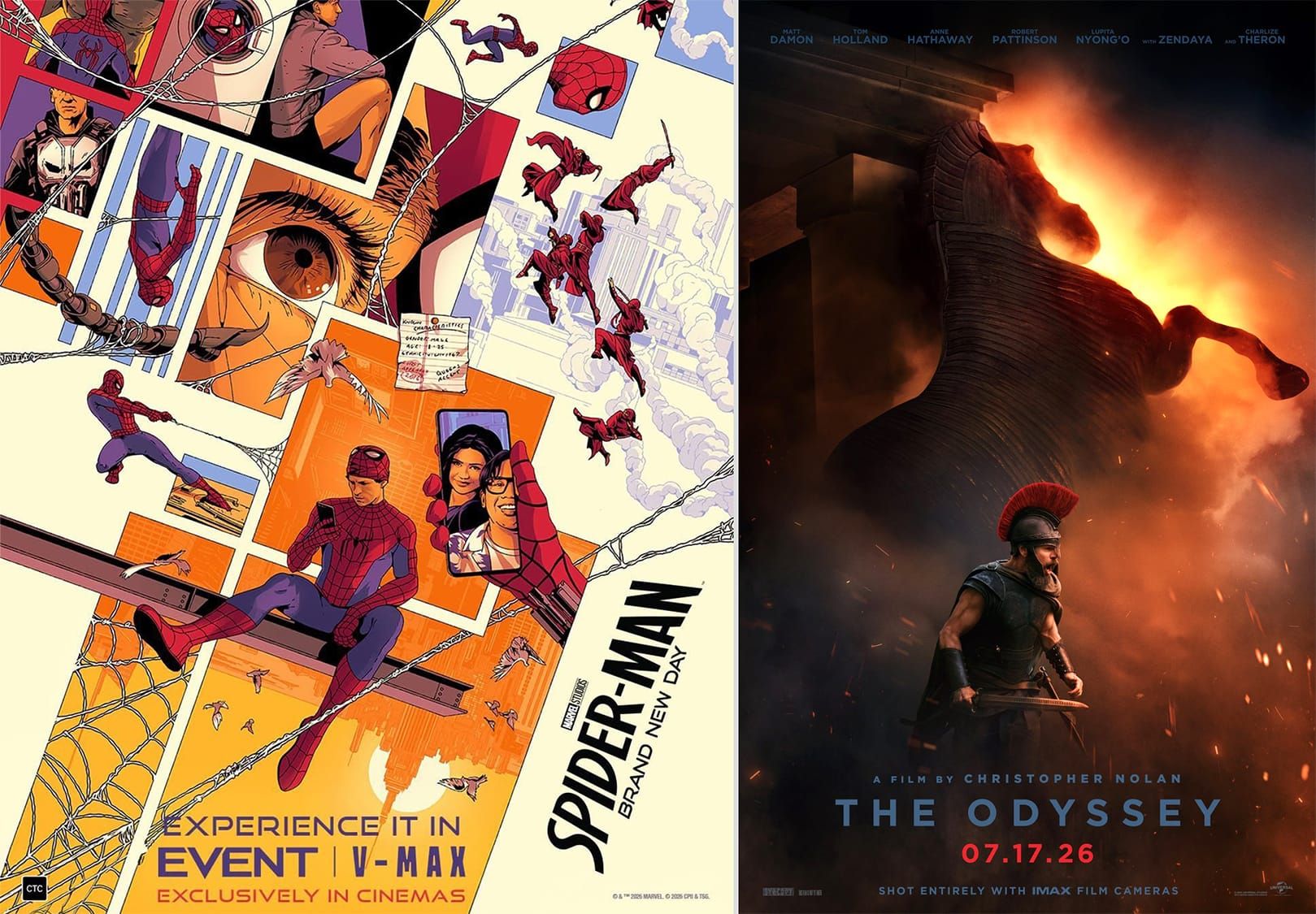
Spider-Man: Brand New Day
Waiting for the lights to dim and the titles to roll on this, the 38th film in the Marvel Cinematic Universe, the question which springs to mind is: Does the world really need another Spider-Man movie?
Well, the world probably doesn’t, but Marvel certainly does. In the seven years since the apocalyptic, climactic, ‘everything-and-the-kitchen-sink’ extravaganza that was Avengers: Endgame, the MCU has felt rudderless and adrift, its assorted superheroes continuing to be appropriately super, but in a vague, aimless atmosphere, like… Umm. Okay. What now? There’s a distinct sense that everything is being thrown at the wall of Marvel HQ, but not much is sticking. The studio seems painfully aware of this; last year’s Thunderbolts* was stuffed with self-deprecating references to its own shortcomings, its C-list superheroes cheerfully acknowledging their status as the ‘Temu Avengers’.
Where, then, for the Marvel bigwigs to turn but back to their one guaranteed money-spinner: good ol’ Spidey? Spider-Man: Brand New Day is the fourth entry in the series since the character was fully incorporated into the MCU in his current incarnation, portrayed by Tom Holland. Four years have passed since Dr. Stephen Strange cast a magic spell to make the entire world forget Peter Parker at the end of Spider-Man: No Way Home, during which Peter has had to get used to being only Spider-Man.
After throwing himself into his work as a means of coping with the death of his Aunt May, as well as the loss of his friends and his beloved girlfriend M.J. (Zendaya), Peter has become something of a recluse. He inhabits a grubby, low-rent former storage space, and is suffering from burnout, despite his stellar performance as a crime-fighter. He begins suffering some strange symptoms — unexplained headaches and wrist-cramps. When he realizes that his spider DNA is making his body undergo some sort of metamorphosis, Peter seeks the advice of Dr. Bruce Banner (Mark Ruffalo), who uses a genetic inhibitor to suppress his own alter-ego, The Hulk.
Of course, just as Peter is attempting to navigate this difficult phase of his life, along comes a sinister entity capable of possessing and controlling minds. This mysterious, non-corporeal foe seems hell-bent on locating something called V-Max, which it claims is deep in the bowels of the Department Of Damage Control, a government agency Peter has previously assisted. Enlisting the help of Frank ‘The Punisher’ Castle (Jon Bernthal), and gleaning intel from the New Avengers’ Black Widow (an entertaining cameo from Florence Pugh), Spidey sets out to contain this new threat. Without giving too much away, Brand New Day is also a crossover into the X-Men universe, with Sadie Sink essentially reprising her Stranger Things persona in a new franchise.
Despite his insistence that he was reluctant to continue playing Spider-Man past the age of 30, Tom Holland has now passed that personal milestone and still seems quite at ease in the role. He inhabits Peter Parker with an endearing balance of teenage gaucheness and superhero pluck, bringing immense charm to the franchise as a whole. Holland’s real-life partner Zendaya adds another layer of poignancy to Peter’s lost love with M.J, and Jon Bernthal plays Frank Castle with a gruff empathy which serves as a warning to the reclusive Peter: Careful, kid, or this could be you.
Ultimately, Brand New Day succeeds where other recent Marvel entries have floundered by keeping its characters grounded. Over and above the usual flashy action set-pieces is a small, moving tale about the importance of friendship and human connection.
The Odyssey
“Tell me about a complicated man.”
Thus begins the 2017 translation of Homer’s Odyssey by University of Philadelphia professor of classical studies Emily Watson, a line cited by director Christopher Nolan as the spark which ignited his quest to bring this 2800-year-old epic poem to the very biggest of big screens. It’s striking that it has taken until 2026 for Hollywood to produce a big budget adaptation of this ancient masterpiece; there’s visual splendor, dramatic action, and even terrifying monsters found in abundance in the text, yet the only direct reading of the poem to make it to cinemas (until now) is a 1954 Italian production starring Kirk Douglas in the title role.
Nolan’s inspiration (reminiscent of Laurence Olivier’s psychoanalytic re-reading of Shakespeare’s Hamlet) has been to approach The Odyssey not just as an epic adventure, but as a character study. In Nolan’s vision, Odysseus, King of Ithaca, is no one-dimensional, chisel-jawed hero, but a battle-weary, haunted war veteran played against type by a grizzled, wiry Matt Damon. Twenty years have passed since the end of the Trojan Wars, and King Odysseus is missing, but not presumed dead — at least not by his wife Penelope (Anne Hathaway), who has ruled Ithaca in his stead since his disappearance, forced to entertain an endless stream of suitors seeking to inherit the kingdom by marrying the ‘widowed’ queen.
As the tale unfolds in a dream-like, non-linear tapestry of flashbacks, we learn of the increasingly desperate struggle of Odysseus and his soldiers to find their way home after winning the war; a hollow victory for Odysseus, who finds himself wracked by guilt over the treachery he employed to triumph. Nolan’s Odysseus, rendered amnesiac by the lotus flowers fed to him by his captor, the nymph Calypso, is a notoriously unreliable narrator — an echo of Leonard Shelby, the amnesiac protagonist of Nolan’s breakthrough feature, Memento.
Odysseus, pressed by the goddess Athena to return home after years in a stupor on Calypso’s island, recalls his travails on the perilous voyage which led him there: the island where he and his men were captured by the giant Polyphemus; the loss of two ships and most crew at the hands of the giant cannibal Laestrygonians; his encounter with the treacherous witch Circe, who transforms his crew into pigs; his voyage into Hades to confront the shades of his fallen comrades; the perilous navigation of the narrow route between the sea monsters Scylla and Charybdis, his crew almost lured to their deaths by the song of the deadly Sirens; and, ultimately, reflecting on the horror he has spent years refusing to confront – his shame and self-hatred at his pivotal role in winning the Trojan War by means of a monstrous deception, that of the infamous Wooden Horse Of Troy.
It’s impossible to fully explore here the complexities and subtleties of Nolan’s breathtaking epic. In its grandiose execution, shot entirely in IMAX 70mm, using custom-made cameras, and with a reported budget of a quarter of a billion dollars, The Odyssey uses a monumental canvas to tell the very personal story of a guilty man developing a conscience. Odysseus’ ultimate redemption isn’t borne of any of his heroic escapades, but arrives in the quiet, still moment in which he is finally able to forgive himself.
Unquestionably, this is Christopher Nolan’s magnum opus — a paradoxical blockbuster using the biggest screen possible to deconstruct an antihero’s inner journey.
Recently arrived in the Tri-Cities from Scotland, Damien Beagan is a former freelancer who has written film and music reviews for a variety of UK websites.
