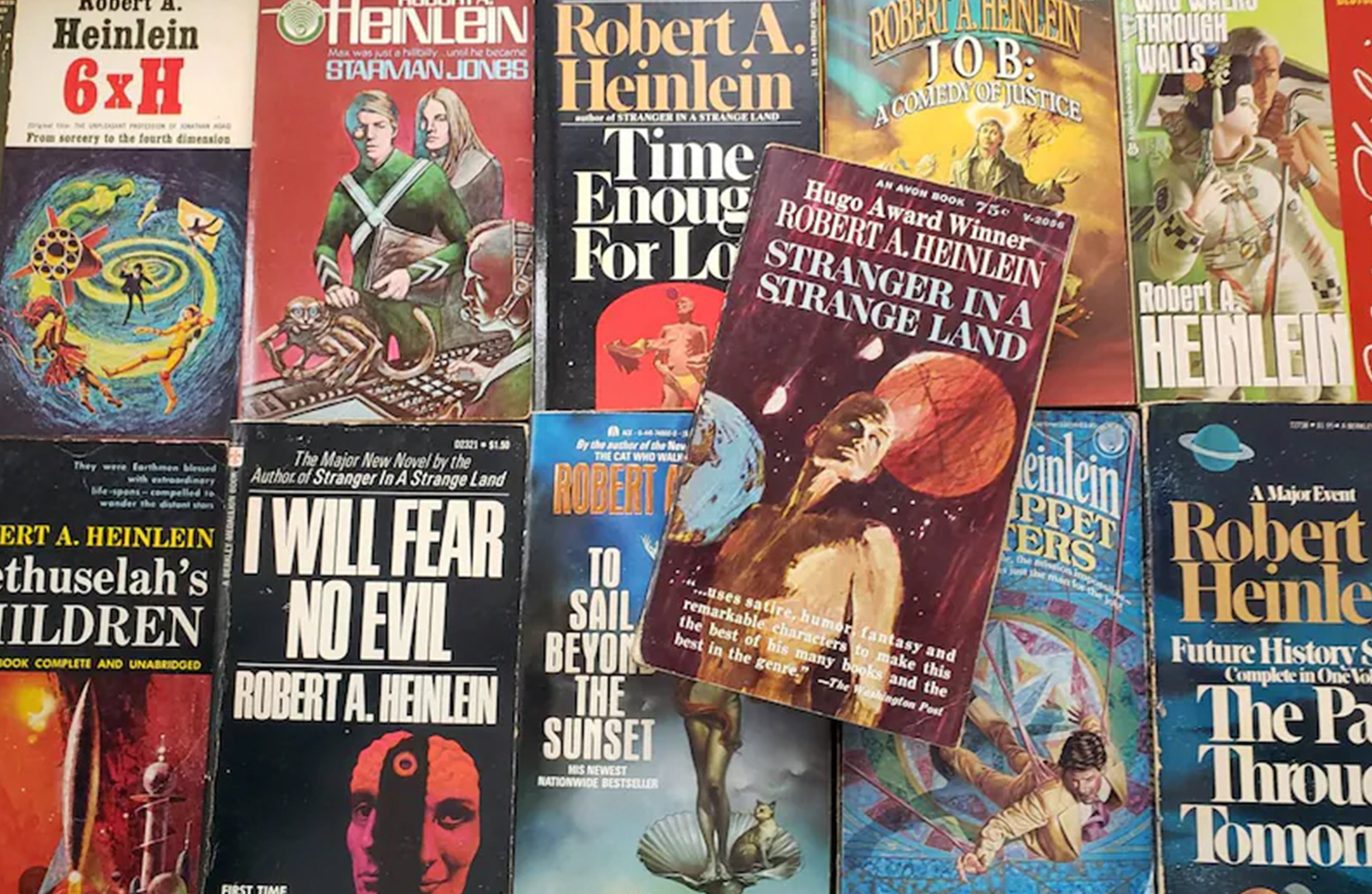
Of all the science fiction writers who began their careers writing for the pulps, three stand out: Isaac Asimov, Arthur C. Clarke, and Robert A. Heinlein. Alongside John W. Campbell, the editor of Astounding Science Fiction, they helped create the Golden Age of Science Fiction.1 All three continued to publish almost exclusively science fiction into the 1980s and beyond, and all three are major influences on science fiction today.
Heinlein has many well known works, but two of his most beloved titles are Stranger in a Strange Land and Starship Troopers.
Heinlein was born on July 7, 1907, and died on May 5, 1988. At age sixteen, he lied about his age to join the Missouri National Guard, later studying engineering at the United States Naval Academy. However, his academic standing of fifth in his class fell to twentieth after he received demerits for his “rebellious and bohemian spirit.”2 After contracting pulmonary tuberculosis in 1934, he was discharged from the Navy, and while he recovered, he studied graduate physics and mathematics at UCLA. During the 1930s, he worked in Upton Sinclair’s socialist ‘End Poverty’ movement in California.
With his background in engineering and mathematics, Heinlein was also an important figure in the development of ‘hard’ — rigorously scientific — science fiction. His changing philosophical views were also reflected in his writing. As a young man, Heinlein was heavily influenced by the visionary writers and philosophers of his day, including the social concepts of writers such as H.G. Wells and Upton Sinclair. By 1930, after spending time in the sexually permissive climate of the jazz-age Greenwich Village, he had become a progressive liberal.3 Heinlein believed that some level of socialism was inevitable and, in the United States, had already arrived. In later years, however, he became increasingly conservative and believed that a strong world government was the only way to avoid mutual nuclear annihilation.4
Heinlein began writing professionally in 1938. His first published story was ‘Life-Line’, which appeared in Astounding Science Fiction in August 1939. It was followed by another, ‘Misfit’, in the November Astounding, and Heinlein was quickly recognized as a major author in a new ‘social science fiction’ genre.
In 1942, he put his writing career on hold to serve as an engineer in support of the war effort, recruiting Isaac Asimov and L. Sprague de Camp to assist him in his work. Heinlein returned to writing in 1947, producing new stories for Astounding and, with Rocket Ship Galileo, beginning a series of books for Charles Scribner’s sons. At the same time, he also started to write nonfiction, much of it focused on political topics — in particular, the Cold War and the implications of the atomic age.
Like most science fiction writers of the 1940s and 1950s, Heinlein tended to ignore sex, although his 1952 novel The Puppet Masters toyed with the notion of contract marriage, marrying for a specified number of years instead of for life. But his attitude toward sex was fairly consistent: a tempered, nonromantic version of free love with a contradictory emphasis on an adolescent view of romantic love and the importance of marriage.
Heinlein’s successful writing career continued, and in 1974, he received the first Grand Master Award from the Science Fiction Writers of America.
Heinlein’s work can be broken down into four phases:
- Period of Influence: the pre-World War II period, when Heinlein started writing short stories in Astounding professionally.
- Period of Success: Heinlein began selling books and working on book series, including Between Planets, The Black Pits of Luna, Columbus Was a Dope, Destination Moon, The Door into Summer, and The Man Who Sold the Moon.
- Period of Alienation: After Sputnik, Heinlein began with his political manifesto ‘Who Are the Heirs of Patrick Henry?’ and the solipsistic short story ‘All You Zombies’. He switched publishers (from Doubleday and Scribner to Putnam) and began to write edgier, more contentious books, such as the Hugo winners Starship Troopers and Stranger in a Strange Land. According to Alexei Panshin, “This could [also] be characterized as … the Period of Professionalism,” when Heinlein paid increasing attention to “sex, religion, war and politics.”5
- Period of Metaphysics: He opened with the first of his humongous, introverted, metaphysical novels, I Will Fear No Evil in 1970. During this period, Heinlein explored themes and ideas that were more abstract than those that had informed his earlier stories.
Robert A. Heinlein wrote 32 science fiction novels, 59 science fiction stories, nine poems (only two of which were published during his lifetime), five nonfiction essays, and the screenplay for the movie Destination Moon. His stories were the basis for four films, two television series, two songs, and a board game, and he edited sixteen science fiction collections. Four of his novels won Hugo Awards, and seven of his novels and stories were awarded Retro Hugos (given for works that were published prior to 1953).3
Heinlein did as much as, and perhaps more than, any other writer to define the science fiction genre, and his work continues to influence and inspire other writers in the field today. If you wish to become more familiar with Heinlein’s work, the best way to approach it is to select a phase that interests you and read stories and novels from that phase; then branch out. Although most of what he wrote was published fifty or more years ago, it holds up remarkably well.
Steven Woolfolk is the owner of Xenophile Bibliopole & Armorer, Chronopolis, a bookstore specializing in rare books, located in Richland, Washington, and online at Xenophilebooks.com.
References:
- Canavan, Gerry, and Eric Carl Link. The Cambridge History of Science Fiction, Cambridge University Press, 2019.
- ‘The Few, the Proud, the Rule-Breakers’. The Washington Post: washingtonpost.com/archive/local/2002/10/31/the-few-the-proud-the-rule-breakers/4519fa85-9c3b-4069-9803-991e1e2ef889
- Patterson, William H., Jr. Robert A. Heinlein: In Dialogue with His Century, Volume 1, Tor Publishing Group, 2011.
- wikipedia.org/wiki/Robert_A._Heinlein
- Panshin, Alexei. Heinlein in Dimension, Advent, 1968.
