If your drinking water comes from a private well, there’s one question worth asking: When was the last time you had it tested?
If your answer is “Uhhh…” or “I’m supposed to do that?” — you’re probably not alone.
When water comes out of the faucet clear, cold, and tasting like… well… water, it’s easy to assume everything is fine. But private wells are a little different from public water systems. The responsibility for keeping an eye on your water largely falls to you.
And unfortunately, your water can’t exactly tell you when something is up.
One thing worth checking for is nitrate. While nitrate can be found naturally in soil, it can also make its way into groundwater from several sources common in our area, including agriculture, irrigation, septic systems, and livestock. The tricky part? You can’t reliably see, smell, or taste it.
That’s why the Benton-Franklin Health District (BFHD) is making it a little easier to answer the “What’s actually in my water?” question.
The best part is... (drum roll please): the test is free!
Yes, you read it here. Testing is free for those who qualify.
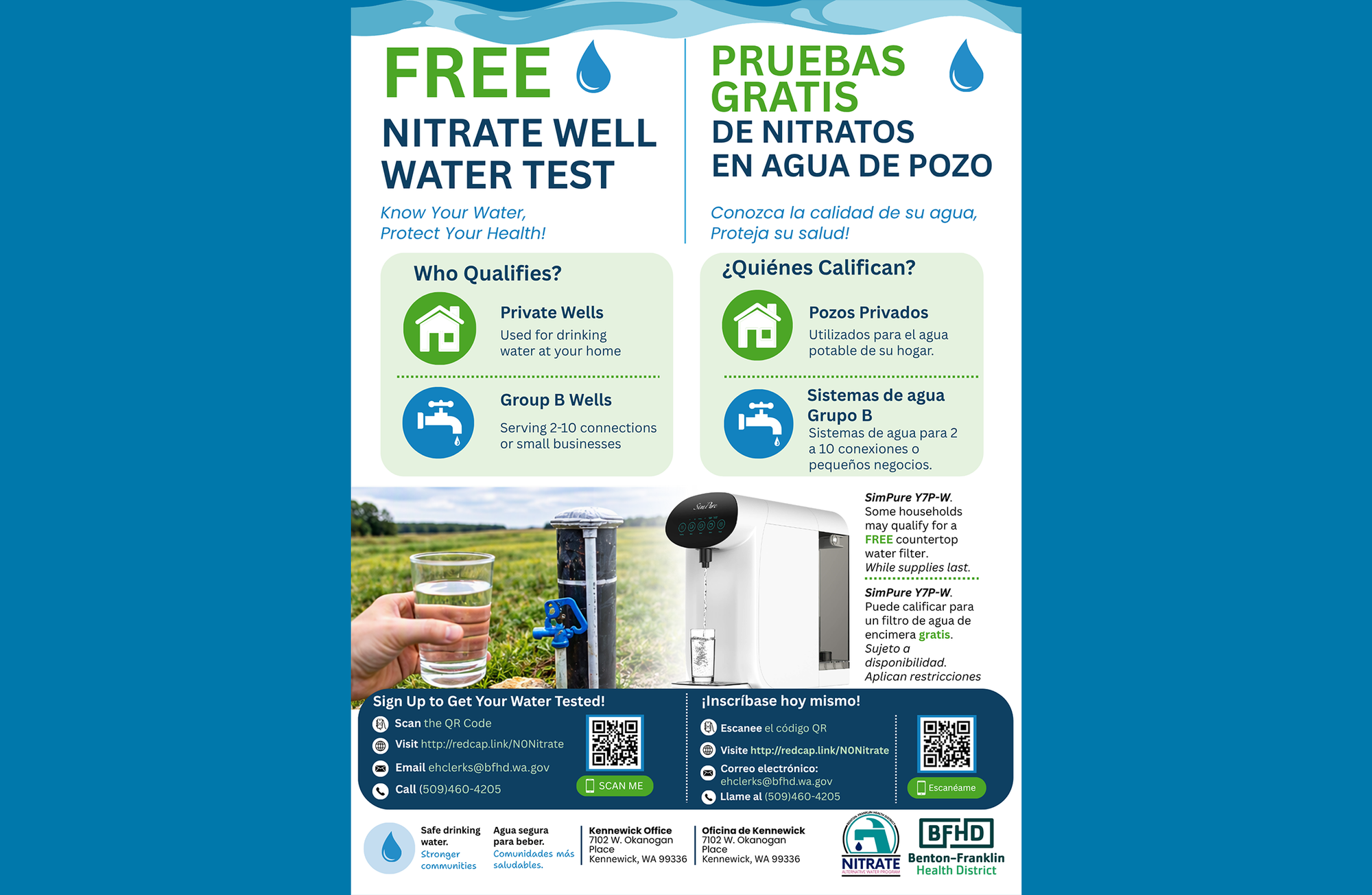
Through BFHD’s Alternative Water Program, eligible residents in Benton and Franklin counties who use private wells or Group B water systems can have their drinking water tested for nitrate at no cost.
Once your water is tested, you’ll receive your results and information to help you understand what those numbers mean. If elevated nitrate is found, BFHD can also connect you with information about reducing exposure and available resources.
Some people use general filters like water softeners to deal with hard water, iron, or other water issues. But nitrate is very great at mixing with water and can sneak right through most filters. A treatment designed to remove nitrates, such as reverse osmosis, is needed to pull it from your drinking water. Through available programs, eligible residents whose nitrate result is above 10 mg/L may qualify for a free countertop reverse osmosis unit to help solve the problem.
Your little bottle of water can also tell us a bigger story.
Every sample gives us another piece of information about groundwater in Benton and Franklin counties.
Think of it as a giant community puzzle. One test tells us about one well. Put many of those results together, and we can start to see where nitrate levels may be higher, how they change over time, and where additional outreach and resources could make the biggest difference.
Those results help BFHD build a local groundwater map and better understand what’s happening beneath our feet — literally.
So, if you’ve been drinking from the same well for five, ten, or twenty years and can’t remember the last time it was tested, consider this your friendly reminder.
Grab a sample. Get it tested. Learn a little more about the water you drink every day. What you can’t see still matters. Get your well water tested.
Learn more about free nitrate well water testing, eligibility, and available resources through the Benton-Franklin Health District’s Alternative Water Program at www.twqr.site/ADWP
