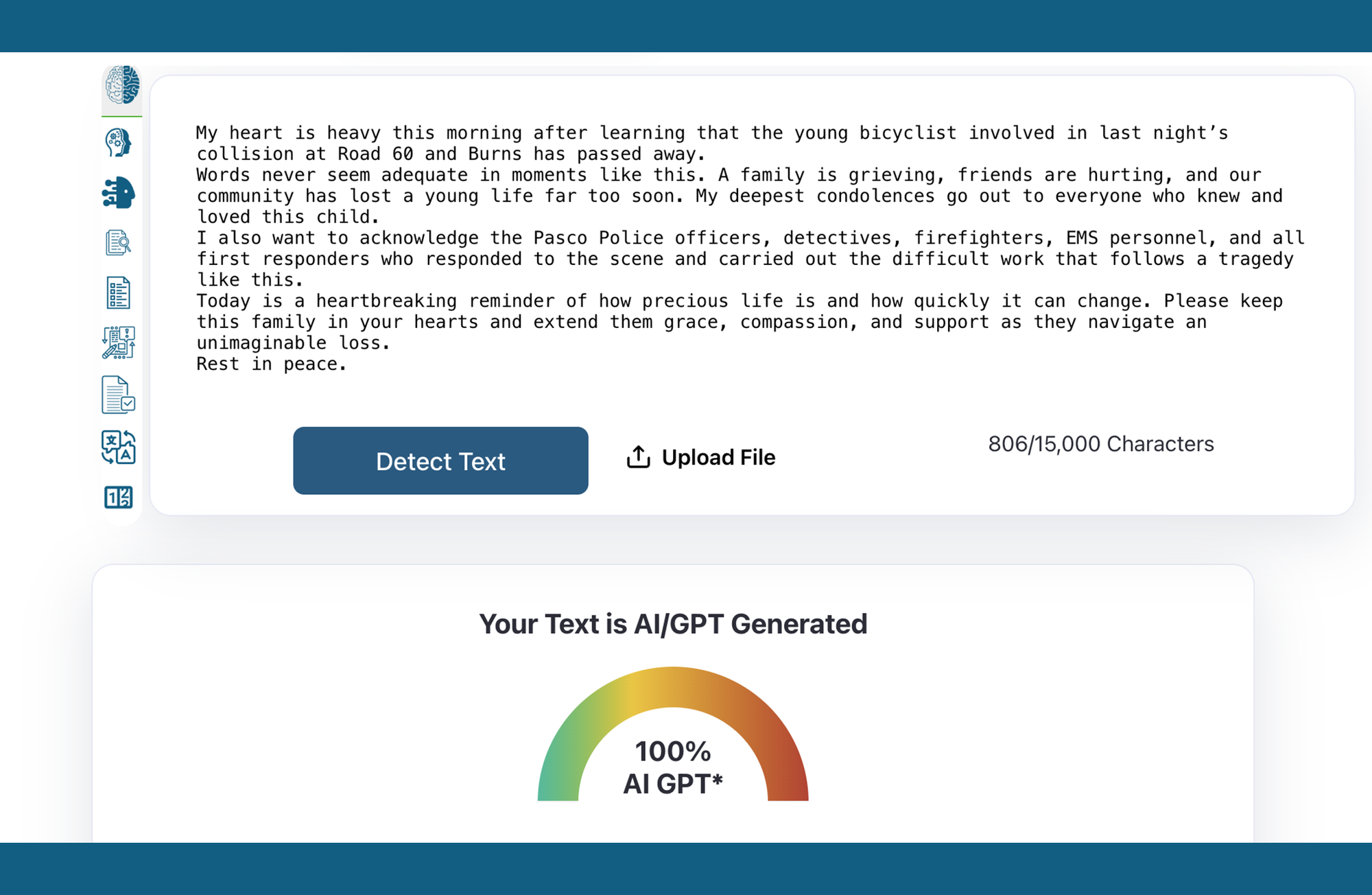
A May 2026 message of condolences on a Pasco City Council member’s Facebook page appears to be 100% AI-generated, as one commenter pointed out.
Editor’s note: This article was edited for Tumbleweird by Zero. The original version can be read at https://waitbackup.substack.com/p/wait-back-up-pascos-social-media.
The speed of the technological advances within my lifetime is astonishing. I’m what they call an ‘elder millennial’, and I remember getting our first home computer as a big event! I even remember watching my folks do their taxes on paper forms spread over the kitchen table. Kids born today are swiping on screens before they can form full sentences, and will never know the sound of a modem dialing up, or need to ‘wait their turn’ for the internet. (I promise this was real; if someone needed to make a phone call, you had to get off the internet.)
Many things (like wine, and good cheese, and me) age well. Social media policies are not one of them. Alas, the City of Pasco, Washington, has a councilmember social media policy in place that still makes mention of MySpace — and that’s not in anticipation of the promised relaunch, it’s about the old platform that has been out of popular use since 2011. While it is a great nostalgia hit for this old guy, it is not a great look for the City. The policy says nothing about AI, an emerging technology with a great deal of power and risk, instead listing a plethora of seldom-used or outdated platforms: MySpace, Flickr, Twitter, and RSS feeds, to name a few.
Some would argue that the names of the websites do not matter; the content of the policy and its enforcement mechanisms are what matter. And I agree. So I looked at the current policy (Resolution No. 3821 can be found on the City’s website), and it can be summarized as follows:
- It applies to councilmembers acting in their official capacities.
- It states a preference for official communication through City-owned accounts.
- It strongly discourages conducting official business through private accounts.
- It covers public records, confidential information, campaigns, and open-meeting concerns.
- It says online communication should reflect the professionalism expected at council meetings.
Take note of the language; there is a lot of suggestion, and not a lot that is enforceable or quantifiable. For example, during my time in Pasco, I have seen several councilmembers operate private social media pages with their elected titles in the name. This is not inherently a problem; a person does not lose their qualification just because they’re not at the office. The problem begins when private pages are used for City updates, constituent complaints, or other official communication — the exact crossover the current policy discourages. It is important to note that discouraged is not the same as disallowed, and I consider it a major red flag when official city policies leave the door open for substantial ambiguity.
Another issue I found is that the policy fails to identify the line between acceptable and unacceptable social media communication by councilmembers. On one councilmember’s ‘unofficial page’ I saw citizen-shot videos calling out local builders for charging too much, showing a private person’s home with identifying features, and elevating a partisan argument based on information that was later proven false. That post remains on their page, despite the councilmember receiving a call informing them that they were sharing incorrect information.
There are many more examples like this, and I recognise I’m being vague on the details, but this post is not intended to be a deep dive. For that, you can see Apple Valley News’ coverage, or read countless essays about the responsibilities of public servants. Rather, I am making the point that problems with elected officials posting opinions on social media have happened, and are still happening; and if we do not make drastic changes, these problems will escalate.
What would these changes look like?
Step One: Drop the vague, suggestive language in the City of Pasco’s social media policy, and clearly prohibit undesirable conduct, with clear definitions of what that means. Without quantifiable, measurable metrics, accountability becomes nearly impossible. With so many differing opinions and personalities at play, trusting people to self-police — especially in such a polarized political environment — is a recipe for disaster.
Step Two: Define when online activity becomes official business. To be clear, I am not here to strip councilmembers of their First Amendment rights. Everyone has a right to their opinion, and to express that opinion online. However, in their official capacity, they must act civilly toward the people they serve; and may not expose people to harm through accident, misconduct, or intentional action; or amplify unverified claims and rumors.
To this end, I suggest that Pasco’s updated policy should treat the following as official business:
- Announcing or explaining City actions
- Addressing pending City policies on which the council has not yet voted
- Providing constituent services, or communicating about a constituent’s needs
- Accepting and following up on complaints
- Addressing City employees about City matters
- Using City information, staff, equipment, branding, or other City accounts
- Claiming to speak for the City or City Council
- Invoking the councilmember title to give a statement the weight or appearance of an official City communication
These rules would set a standard for the people of Pasco to measure and evaluate official communication by councilmembers. Councilmembers remain free to debate policy, state general positions, and express personal opinions on personal accounts; but if they are acting in their official capacity, communicating about City business, they must be held to a different standard.
Now, how do we deal with gen AI?
The Pasco municipality is not unique in having yet to finalize a comprehensive generative AI policy. Nor is it surprising — the technology has infiltrated every part of society faster than any that came before it, and government departments are scrambling to keep up against the kind of budgets most municipalities can never dream of commanding. From creating believable deepfake videos to writing full opinion pieces in seconds, AI has the power to start a genocide… or to help your email reply sound perfect.
I am no stranger to this technology. In fact, I use it in my business, and to help me research. It is an amazing tool when used correctly. It also makes a shocking number of errors; and in the hands of people who increasingly do not know how to check sources, it can very quickly become an excellent tool for spreading misinformation.
Using AI in a limited way, to improve productivity internally within City offices, has its place; but it has no place in outward communications. It is unreliable, and the ultimate ‘people-pleaser’ — always attempting to tell the user what it thinks they want to read, often by making assumptions and filling gaps incorrectly. It simply should not be used to communicate official business in any way. The citizens of Pasco deserve to know that factual claims posted by councilmembers have been verified, and that the information they receive can be trusted.
To this end, I am calling on the City Council to create and implement social media and AI policies that, at minimum, accomplish the following:
- Restrict the use of the Councilmember title so it cannot be used in the name of social media pages not controlled by the City.
- Create enforceable rules and an independent enforcement process, so that violating those rules has real consequences.
- Define official vs. personal business, and establish what can or cannot be shared without verification.
- Ban generative AI from being used to communicate with constituents.
- Require visible corrections when mistakes are made — not an acknowledgment buried in the comments, but a forward-facing correction stating what error was made and how it will be prevented in the future.
These rules should allow everyone to express their opinions, while keeping personal opinions separate from the City’s official positions. At the end of the day, everyone who lives in Pasco should be able to trust that communications from the City and its councilmembers are honest and helpful.
https://waitbackup.substack.com
References:
- https://docs.pasco-wa.gov/WebLink/DocView.aspx?id=750439&dbid=0&repo=CityofPasco&cr=1
- https://tumbleweird.org/black-and-white-thinking
- https://www.applevalleynewsnow.com/pasco-school-officials-dispute-viral-social-media-claims-about-transgender-student-bathroom-incident/article_bc910251-acaa-4474-a25c-4ea9c2083505.html
- https://tumbleweird.org/teacher-quotes-twain
