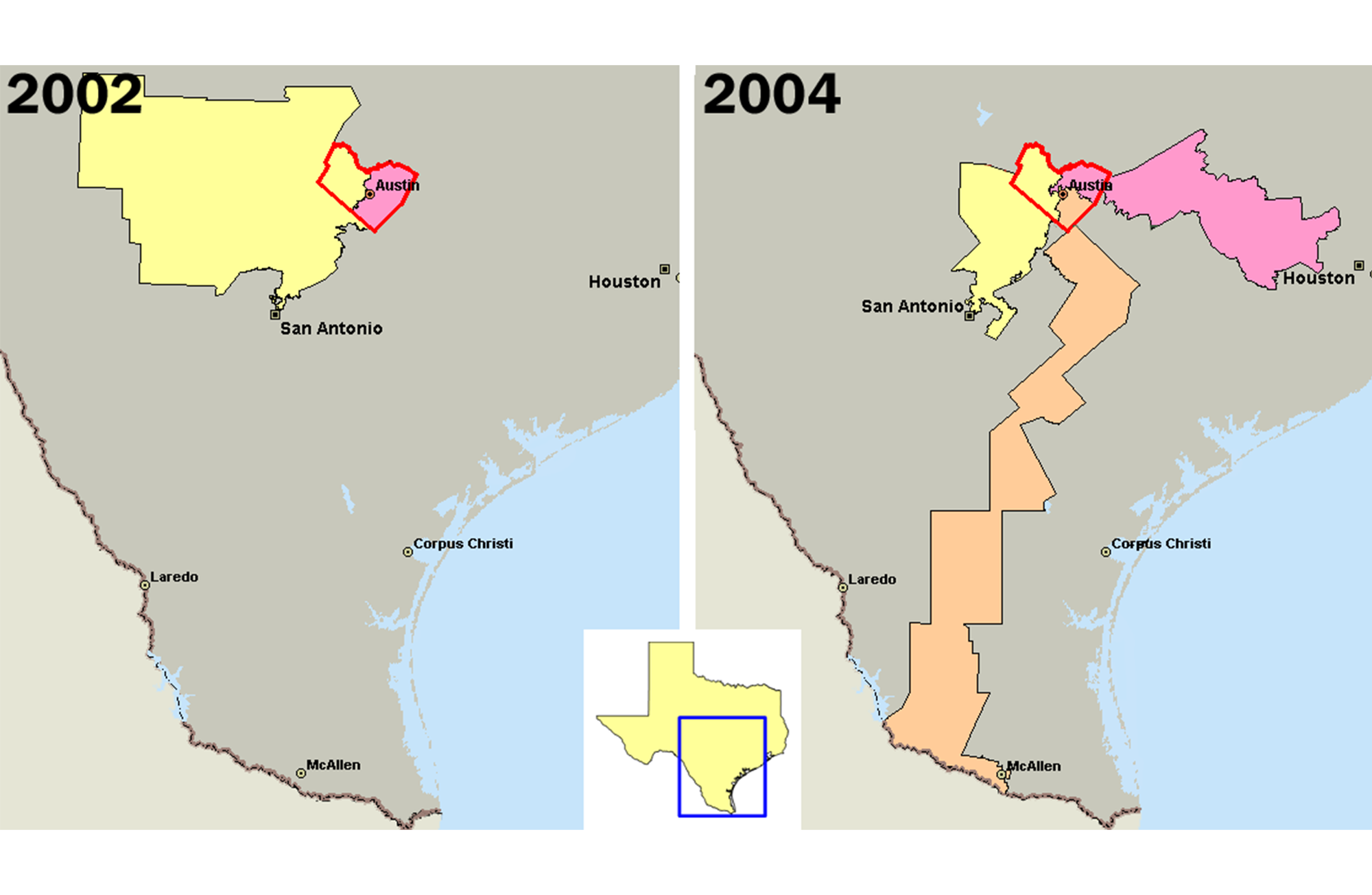
U.S. congressional districts covering Travis County, Texas (outlined in red), in 2002 (left), and 2004 (right). In 2003, the majority of Republicans in the Texas legislature redistricted the state, diluting the voting power of the heavily Democratic county by parceling its residents out to more Republican districts. In 2004, the orange district 25 was intended to elect a Democrat while the yellow and pink districts 21 and 10 were intended to elect Republicans. District 25 was redrawn as the result of a 2006 Supreme Court decision. In the 2011 redistricting, Republicans divided Travis County among five districts, only one of which, extending to San Antonio, elects a Democrat.
Narrated by Chad Fox
The American electorate is facing a structural crisis. For decades, the battle over congressional maps happened only once per decade, arriving strictly on the heels of the national census. Political parties fought tooth and nail to draw lines in their favor; but once the maps were set, voters had stability for the next ten years.
That stability is officially dead.
We have entered a dangerous new era of mid-cycle gerrymandering, where lines are being redrawn in the middle of a decade for the sole purpose of capturing partisan control. From California to Florida, political parties are manipulating the map to choose their voters before the voters can choose them.
This is not a minor blip on the radar; it is a systemic degradation of the democratic process reaching from national congressional power right down to local, down-ballot races.
This extreme partisan maneuvering exploits a fundamental flaw in how Americans vote and how leaders are elected. We see a version of this structural imbalance in the Electoral College, where an individual’s vote in a heavily contested swing state carries vastly more mathematical weight than a vote in a reliably stable state like Washington. Mid-cycle gerrymandering takes that inherent inequality and weaponizes it at the local level.
By shifting precincts and districts, parties engineer an intended outcome: they know exactly how a district will vote before a single ballot is cast. For the average citizen, this map-shifting causes confusion. Voters are left wondering who actually represents them today, which district they belong to in any given cycle, and whether their vote retains legal or practical efficacy. Under this framework, transparency is sacrificed for predictable partisan outcomes.
In traditional political science analysis, the ‘spoiler effect’ refers to a third-party candidate drawing votes away from a major party with similar ideologies. In this new era, the district lines themselves act as the ultimate spoiler. By shifting boundaries mid-cycle, the dominant party spoils the competitiveness of the opposition, rendering any third party or dissenting major party mathematically non-competitive before the campaign even begins.
Simply put, if a conservative voter is trapped in a newly engineered progressive district, or a progressive voter is packed into a deeply conservative district, the vote is watered down from one cycle to the next. The foundational principle of representative accountability is replaced by an artificial landscape designed to protect institutional power.
The acceleration of mid-cycle gerrymandering is not happening in a vacuum; it is being driven by monumental federal legal shifts. Historically, the Voting Rights Act protected minority voting power by requiring the creation of majority-minority districts to ensure equitable representation. However, the legal landscape shifted dramatically with the U.S. Supreme Court’s recent decision in Louisiana v. Callais (April 2026). By severely weakening Section 2 of the Voting Rights Act — signed into law in 1965 by President Lyndon Johnson to outlaw discriminatory voting practices adopted in many southern states after the Civil War — the Supreme Court dismantled federal guardrails against racial and partisan map manipulation.
The ruling has triggered a literal race to the bottom across state legislatures. Armed with this new precedent, a wave of states — including Texas, North Carolina, and Florida — have rushed to pass voluntary mid-decade maps, locking in structural advantages ahead of the 2026 midterm elections. This represents a systemic failure of institutional accountability across the political spectrum. Whether it is a conservative legislature in Florida aggressively cutting opposition seats, or liberal states like California maximizing their own advantages, both major parties are guilty of using the mechanism of power to protect the mechanism of power.
The fallout of decisions like Louisiana v. Callais does not stop at the congressional level — it trickles down to school boards, city councils, and county commissions. Local communities must fight for structural reforms at the municipal level, such as advocating for ranked-choice voting or proportional representation in local charters. By fixing and securing the integrity of how we vote locally, communities can construct a resilient framework capable of withstanding national partisan games.
If the courts refuse to protect the integrity of the ballot, and state legislatures are driving structural manipulation, the solution cannot come from the top down. It must come from the bottom up. Everyday citizens retain the capacity to reclaim control of the map. Historical precedent demonstrates that local, grassroots action remains the only tool sharp enough to cut through entrenched partisan gerrymandering.
When elected politicians refuse to surrender the map-making pen, citizens have the constitutional authority to seize it directly. Citizen-led ballot initiatives are powerful weapons. In Michigan and Ohio, door-to-door grassroots signature drives bypassed partisan legislatures, and established independent, citizen-led redistricting commissions. Local coalitions nationwide are leveraging these historical models to push similar referendums, aiming to outlaw mid-decade map adjustments altogether.
Partisan gerrymandering relies entirely on algorithmic predictability. Mapmakers analyze historical precinct voter data and assume traditional voting patterns will hold. Grassroots efforts that focus heavily on local precinct committee officers (PCOs), neighborhood organizers, and local municipal races disrupt these mathematics. When local groups organize block-by-block to drive voter turnout in artificially engineered districts, they break the cartographers' algorithms and render the gerrymandering obsolete.
If the American public does not demand a change to how districts are drawn, mid-cycle gerrymandering will solidify into the new norm. The nation will find itself in an inescapable structural crisis where elections are no longer a reflection of the people's will, but rather a reflection of a politician's map.
Power must belong to the voters, not the cartographers. To preserve it, citizens must stop looking to Washington D.C. for remedies and begin organizing in their own backyards.
Bryan Verhei graduated with a degree in Political Science from Eastern Washington University and is currently a small business owner in real estate. He has worked with FairVote Washington and other local nonprofits that share his passion for political literacy.
References:
- Brennan Center for Justice (May 14, 2026). ‘Gerrymandering Explained’: https://www.brennancenter.org/our-work/research-reports/gerrymandering-explained
- Louisiana v. Callais, No. 24-109, 608 U.S. (Decided April 29, 2026). Ruling regarding Section 2 of the Voting Rights Act and majority-minority district mandates
- National Conference of State Legislatures (NCSL). (2026). State Redistricting Statutes and Mid-Cycle Map Adjustments Report. Denver, CO
- Ballotpedia. (2026). 2025–2026 Redistricting Trackers and Congressional Map Enactments. Retrieved May 2026 from multi-state legislative database records (Texas, North Carolina, Ohio, California, and Florida)
