
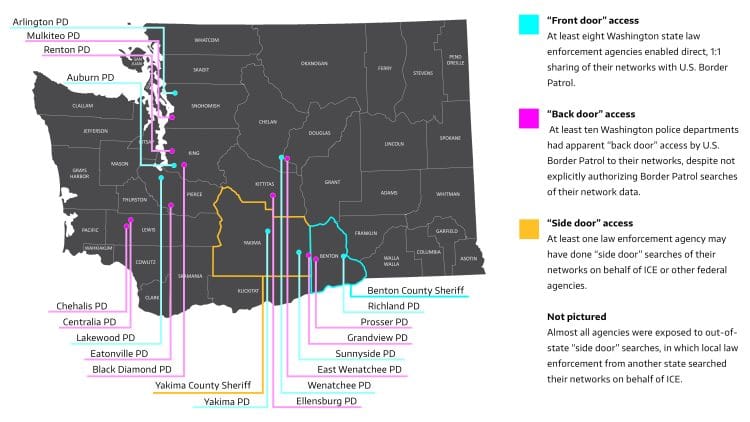
Local citizen concerns about the potential abuse of surveillance cameras photographing license plates along local roadways may have become a reality in Benton County.
Despite assurances that the Flock camera system would be closely monitored, both the Richland Police Department (RPD) and the Benton County Sheriff's Office (BCSO) appear to have violated their own policies — and state law — by allowing U.S. Border Patrol to access their data.
In a study published October 21 of this year titled ‘Leaving the Door Wide Open: Flock Surveillance Systems Expose Washington Data to Immigration Enforcement’ by the University of Washington Center for Human Rights, researchers found that many municipalities in Washington had their Flock systems accessed by federal law enforcement, including U.S. Border Patrol. At least seventeen Washington agencies with Flock systems were found to have been searched by Border Patrol. The study examined data obtained through public records searches and found that the Flock data was shared three ways: ‘front door’ access, ‘back door’ access, and ‘side door’ access.
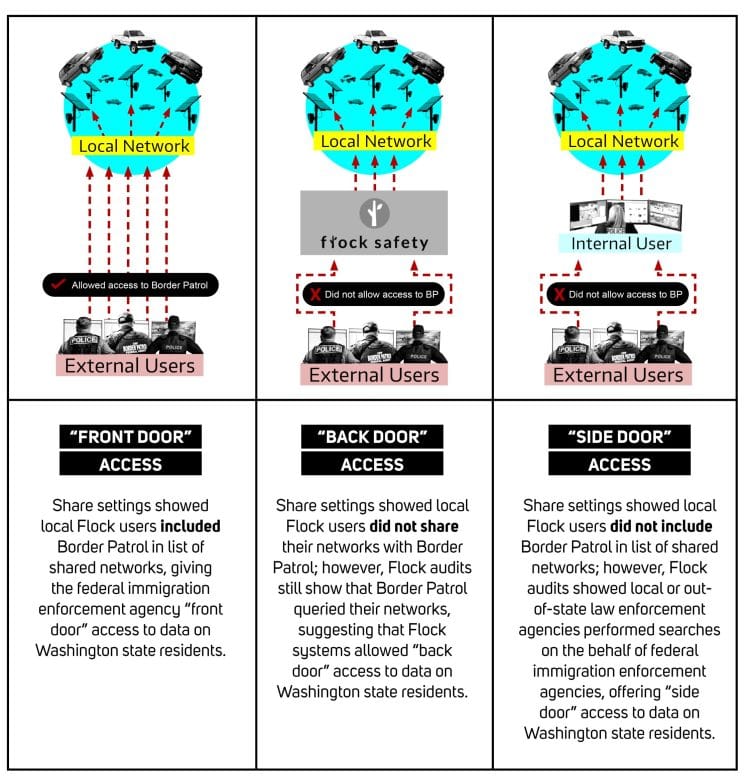
Front door access
The University of Washington study uncovered RPD and BCSO allowing ‘front door’ access to U.S. Border Patrol, meaning that they directly shared data with them by including Border Patrol in a list of Shared Networks.
On October 24, we reached out to the City of Richland regarding the federal government illegally accessing Flock camera systems after reading about the issue happening across the state. We asked what measures were being taken by the city to prevent federal agencies from accessing data that the city put in place by consent calendar (and without discussion) in 2023.
In response to these concerns, Mayor Theresa Richardson responded on October 27, saying: “Noted. Thank you for sharing your concerns.”
Deputy City Manager Joe Schiessl emailed a longer response two days later:
Thank you for your email to the Richland City Council regarding RPD’s use of the Flock camera system. ALPR is a powerful investigative tool that has demonstrated success in a number of significant criminal investigations in the Tri-Cities. The City of Richland is just now learning of troubling Flock camera usage by agencies at the state and federal level that RPD did not anticipate. For this reason, RPD has limited shared access to Richland’s Flock camera system to Washington agencies only at this time, and we will continue to evaluate options that strike the balance between effective law enforcement, state law, and recognized privacy interests.
In a phone interview on November 11, Tumbleweird asked Phil Neff, a research coordinator with UW, to explain in simple terms how access was allegedly given by RPD and BCSO to the U.S. Border Patrol.
Neff said:
My understanding of Flock’s technology is that administrators of a given local network that uses Flock make individual decisions about one-on-one sharing with different networks, and those are the ones that will be listed in the network sharing report as ‘Networks I'm sharing with’. That is our basis for asserting that a given agency allowed one-on-one sharing with U.S. Border Patrol. U.S. Border Patrol appears in that list of ‘Networks I'm sharing with’.... It has been surprising to hear from agencies that fall under that category that they didn't know that U.S. Border Patrol was included in the sharings list [based on] the extended evidence we have.
Neff explained that the Yakima Police Department, (Neff referred to them as Yakima) — another one of the agencies that the University requested information from for this study — provided a much more detailed report, including the identity of the user that was responsible for approving the ‘Sharing’ requests, and the date and time that sharing started. Neff was unable to posit a reason that RPD wouldn’t have the same level of detailed knowledge about shared access to Flock surveillance.
We made a public records request for that information — who granted access and what was shared — of both RPD and BCSO. Both reports will be available in December.
Neff sent Tumbleweird the Flock ‘Shared Networks’ reports they received from Richland and Benton County via public records requests during their research into Flock. Neff said in an email that both reports clearly indicate that data is being shared with ‘U.S. Border Patrol [Federal]’.
The reports can be viewed here:
https://drive.google.com/drive/folders/1LMeBrbLHCl2EdmJxyK_3j_WANOzF5M8j?usp=sharing
In the email, Neff also added: “In addition to the Shared Networks report, we received Organization Audits documenting searches by local users and Network Audits documenting searches by external users…”
Back door access
In addition to the ‘front door’ access allowed by RPD and BCSO, the University of Washington study also looked into ‘back door’ access.
“Our understanding is that there's a Flock setting called ‘Nationwide Lookup’, and that's enabled by just a single checkbox in the settings,” Neff explained. “And we believe that is the reason why some agencies that have not enabled one-on-one sharing [with] Border Patrol still have searches by Border Patrol of their networks.”
Neff said that the way the data is interpreted, some agencies that have been searched only via back door access may not be aware that it is happening.
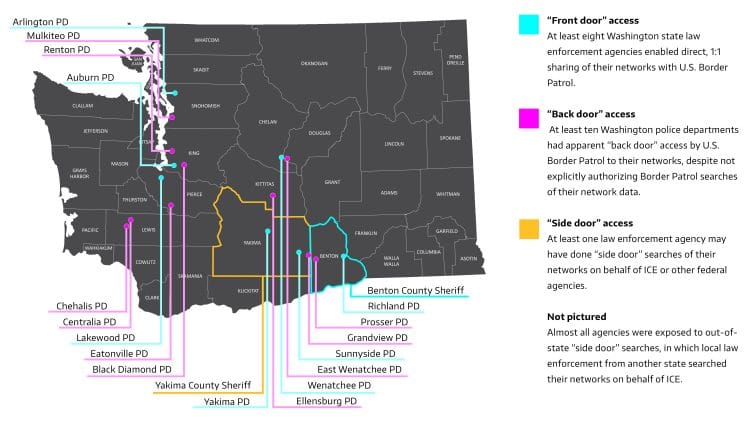
Numerous agencies in Washington cities had ‘back door’ access reports, meaning they were accessed by U.S. Border Patrol without authorization.
One such agency, the Sheriff's department in Mukilteo, Washington, released a statement regarding this unauthorized access on October 22, saying in part:
The Mukilteo Police Department recently became aware that the U.S. Border Patrol and U.S. Homeland Security accessed and utilized the Flock Camera System in the City of Mukilteo, and nationwide. This access was made without our permission and contravenes our department's policy. The Mukilteo Police Department has not engaged in immigration enforcement activities and has not provided access to federal agencies for immigration purposes.…
Flock’s National Lookup Feature allowed unintended access by federal agencies through a national shared network. The Mukilteo Police Department was never notified that Flock had entered a pilot program with the U.S. Customs and Border Patrol. The Mukilteo Police Department reviews all requests to access our cameras and only grants permission to agencies within Washington State that are subject to the Keep Washington Working Act. In an abundance of caution, we have disabled the National Lookup feature.
They also included a statement from Police Chief Illyn, who said:
The Mukilteo Police Department values its longstanding partnerships with federal agencies, including the U.S. Marshal Service, DEA, FBI, and U.S. Postal Inspectors. These relationships are built on trust, transparency, and mutual respect.
While we remain committed to collaboration on criminal investigations, trust and transparency are non-negotiable. When a partner circumvents local oversight and accesses systems without disclosure, it compromises the integrity of that relationship.
We have taken immediate steps to secure our systems and prevent any further unauthorized access. We have been in continuous contact with our Flock Representatives to ensure the safety of our systems.
The Mukilteo Police Policy on Automated License Plate Readers (Policy Number 339), states:
When using ALPR [Automated License Plate Readers] systems, officers will not target any person based on their actual or perceived race, color, religion, creed, sex, gender, gender identity, sexual orientation, age, national origin, ethnicity, disability, veteran status, marital status, partnership status, pregnancy status, political affiliation or beliefs, and, to the extent permitted by law, alienage or citizenship status.
The policy also states that “Information shall not be shared when the requesting agency is using the information for immigration investigations.”
The Mukilteo Police Department isn’t the only agency concerned about sharing data with federal law enforcement officers (with or without permission), as it could be a violation of the Keep Washington Working Act. This 2019 act specifically outlines what local law enforcement can and can’t do in relation to federal law enforcement. An excerpt:
KWW [Keep Washington Working] made numerous changes to state law for the stated purpose of “ensuring the state of Washington remains a place where the rights and dignity of all residents are maintained and protected in order to keep Washington working.” Among those changes, KWW restricts the extent to which local law enforcement agencies (LEAs) may participate in the enforcement of federal immigration laws. Because KWW is now in effect, LEAs have an immediate obligation to comply with KWW’s requirements.
Tumbleweird contacted the State Attorney General's office to inquire into whether they are investigating law enforcement in relation to these issues with Flock cameras. We received a response less than 24 hours later, on November 10, from Mike Faulk, Deputy Communications Director, indicating that the AG’s office is actively looking into the matter, but that they are “still learning more based on these reports.” We will update this story as it develops.
Flock Cameras in Richland
Flock Cameras were approved to be installed in the city of Richland three years ago, without discussion, by a resolution on the September 20, 2022 agenda. An interlocal agreement was made with the Kennewick Police Department, the Benton County Sheriff's Department, West Richland Police Department, and the Richland Police Department to collectively receive a one-time grant of $132,789 for the purchase of the Flock Safety System. The exact locations of the cameras aren't shared to the public, but there is a Flock Safety - Richland PD WA Transparency Portal that explains how the cameras are supposed to be used — and how they are not allowed to be used.
Under prohibited uses, RPD has a policy very similar to that of the Mukilteo Sheriff's Department:
Traffic enforcement, immigration enforcement, harassment or intimidation, usage based solely on a protected class (i.e. race, sex, religion), or personal use.
A story by the TriCities Observer on November 28, 2023 highlighted how data collected from the Flock cameras are controlled. From the article:
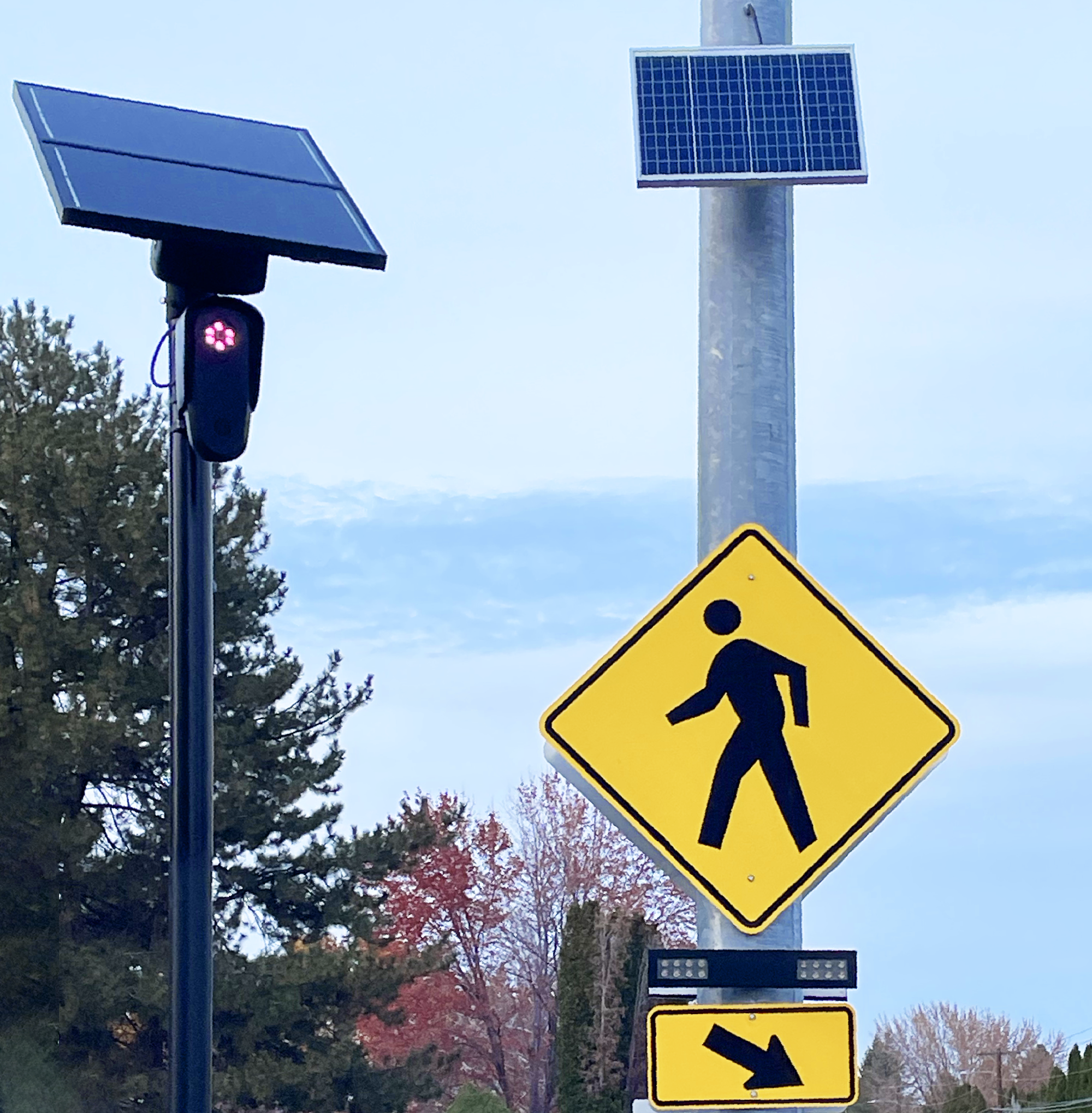
The cameras, made by Flock Safety, are mounted on a pole and powered by a solar panel. Each camera photographs the rear of every vehicle that passes it, including the license plate.
Flock owns and installs the cameras; the information they collect goes into a Flock-controlled database. Cities lease the cameras.
Flock cameras have been raising concerns across the country from organizations and individuals alike. First, anyone can purchase access to the monitoring software, including homeowner associations and individuals. This could put victims of stalking and domestic abuse in danger by giving their abusers access to tracking information about them.
Flock login information has also been stolen multiple times, allowing access to information on the system by foreign actors and hackers. In November, the cybersecurity company Hudson Rock showed that at least 35 Flock customer accounts had reportedly been stolen by hackers.
The ACLU published a story in February 2023, a few months after Richland passed their resolution to install the cameras, highlighting the issues with Flock systems. It says, in part:
Flock is building a giant camera network that records people’s comings and goings across the nation, and then makes that data available for search by any of its law enforcement customers. Such a system provides even small-town sheriffs access to a sweeping and powerful mass-surveillance tool, and allows big actors like federal agencies and large urban police departments to access the comings and goings of vehicles in even the smallest of towns.
Flock Cameras are everywhere. According to Flock Safety data, Flock is monitoring 5,000 communities across the U.S. in 49 states, clocking over 20 billion plate reads per month.
Among Flock Group Inc’s top investors are: Peter Thiel (Palantir), who sells intelligence tools to ICE, DHS, the Pentagon, and others; Trae Stephens (Anduril), who sells autonomous surveillance towers to the U.S. military; and Bedrock Capitol (Mach Industries), a major military contractor.
A table of the Flock systems audit — along with the entirety of the University of Washington’s findings — can be found on their website, at jsis.washington.edu/humanrights/2025/10/21/leaving-the-door-wide-open
A lifelong resident of Eastern Washington, Dori enjoys the outdoors, her family, and making good trouble. She has worked for many years in broadcasting and reporting and believes in the value of the 4th estate. She is a true community advocate that loves Washington.
References:
- https://jsis.washington.edu/humanrights/2025/10/21/leaving-the-door-wide-open/
- https://drive.google.com/drive/folders/1LMeBrbLHCl2EdmJxyK_3j_WANOzF5M8j?usp=sharing
- https://drive.google.com/file/d/1HkHObpAbk-2hsygQcZ2aGars-2-4U4CE/view?usp=sharing
- https://www.atg.wa.gov/keep-washington-working-act-faq-law-enforcement
- https://swagit-attachments.granicus.com/uploads/video/agenda_file/184804/9-20_RichlandWA_CC.pdf
- https://drive.google.com/file/d/1eomCRPiL8ZTaAHJLDSozPve9mkNqR_NT/view?usp=drive_link
- https://transparency.flocksafety.com/richland-pd-wa
- https://tricitiesobserver.com
- https://www.flocksafety.com/
- https://www.hudsonrock.com/search/domain/flocksafety.com
- https://www.aclu.org/news/privacy-technology/how-to-pump-the-brakes-on-your-police-departments-use-of-flocks-mass-surveillance-license-plate-readers
