Now teaching fourth grade at Wiley Elementary in Richland, Lindsay Gailey has entered her 21st year as an educator. We met several years ago at a teacher training put on by the Benton & Franklin Conservation Districts where I presented as a Teaching Artist. We bonded instantly through the rewarding endeavor of implementing routine student field studies.
What do you remember about your childhood and the origin of your nature connection?
My grandparents came here to work on the Manhattan Project, and I grew up in a North Richland alphabet house near the river. I spent a lot of time outside with my parents growing up, primarily my dad. He worked at the Hanford site, and through his job, he interacted with Fish & Wildlife and the Tribes, overseeing the flora and fauna of those 800 acres. An avid outdoorsman and hunter of upland game birds, we would regularly walk or ride bikes along the paths of the Columbia, typically heading north to Ferry Court, where we would eat a meal or a snack at a little wooden picnic table that used to be there.
My dad always paid attention to nature, primarily to the birds, teaching me how to use my senses to learn from them. What's that sound? Where do you think it's coming from? Where do you think it's going? What's happening? What else do you hear? What else do you see? I think that questions, observations, and appreciation are my earliest connections with nature. We discussed trees and seasonal changes. I grew up learning to connect those details to a larger interconnected system, of which I was a part.
Describe your ideal refuge.
Just being outside is ideal for me. I love my backyard. Similar to my dad, I enjoy my bird feeders, and like spending time seeing who's coming and going, thinking about where they're going and why. I enjoy the watching — how having more of a native plant landscape has changed the comings and goings in my yard, and the diversity it supports. That said, my true sanctuary is the water. I love being on the Columbia River where it's still for the most part, quiet and peaceful. Having the Columbia in our ‘backyard’ is a special gift.
In your education, did you pursue science?
I knew in third grade that I wanted to be a teacher, and this was due to the impact that my third-grade teacher had on me. I liked how it felt to be in her classroom. She made everyone feel seen and heard but still had very clear boundaries and expectations. In that environment, I knew that I could learn, not just find the right answer. That said, my pursuit of science didn’t come until I had a classroom of my own. Growing up, I wasn’t drawn to the sciences, like I am now. I think that I probably felt like math and science were areas for the ‘smart kids’ and my brain just didn’t think like that. Hence the power of hands-on learning and going outside!
This begs the question of how you've become a science-focused teacher.
I want my students to experience science in a way that I never did. I was lucky that 4th grade had incredible science kits when I first started teaching. I instantly fell in love with “Land and Water” — with its focus on streams and rivers, tributaries, erosion, dams, etc. — and quickly made cross curricular connections to our Washington State studies, which is where my passion took root. I have always felt that my students needed to have a deep understanding and connection to our local ecosystem and community.
I slowly started developing lessons and ideas. Getting the Salmon in the Classroom program into my 4th grade class became my goal. Around this time, Richland teacher Anne Autry conducted a World Water Day activity that brought 4th and 5th graders down to the river for field studies led capably by her older students. Everyone was engaged and empowered by the experience, and I knew this was how I wanted to teach. I wanted my students to learn about the river I loved, respected, and knew so well. I began taking classes with the conservation districts to learn how to implement routine field studies and conservation education in my classroom.
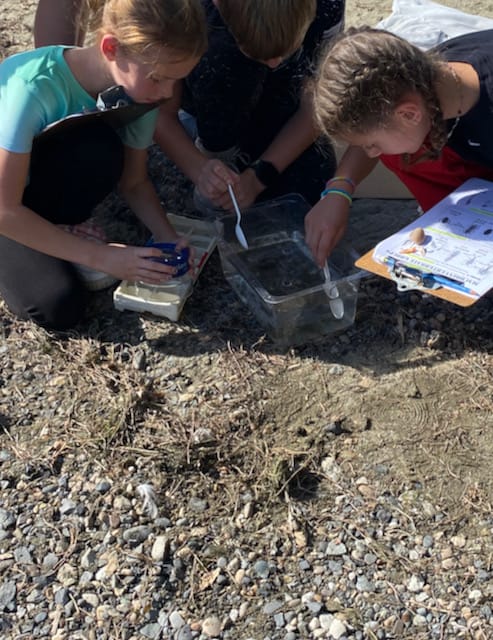
Eight years ago, I started building my pedagogy around outdoor hands-on learning, and made a Hail Mary phone call to (a then stranger) Debbie Berkowitz, and it all began. I am really proud to say the partnership has grown to something I never would have imagined, and it’s gotten better every year. Instead of relying on a textbook or a curriculum to seek the ‘right’ answer, I love that my students get to explore and experience a unit of study in a hands-on way. We aren’t looking for a right answer; we are learning to apply our background knowledge with our observations, learning to question and make conclusions. While doing so, it leads us down all sorts of different tangents, all powerful experiences.
Do you have a favorite activity that you anticipate doing with students, maybe for the first time?
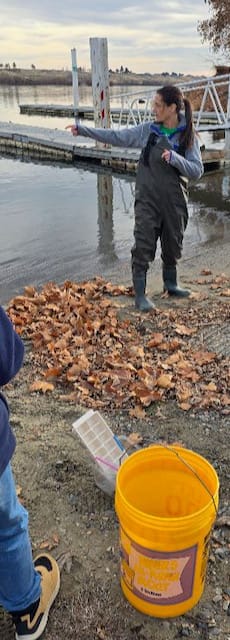
I love all of it. Although a bit stressful, preparing the students for the field studies is great fun. The first field trip, usually the first or second week of September, is a real wild card. The kids are still young, and that early in the year, we are still building our classroom community. They maybe haven’t been on many (if any) field trips, so there are a lot of variables at play. We do a lot of practicing at school on how to make observations and ask why, and begin building the courage to venture a guess. While an important life skill, it is one that really does take time to develop.
There is always a higher level of anxiety on that first trip, but it is a powerful springboard for our school year. The kids are always so excited to learn from our ‘Loraxes’ (community partners Debbie Berkowitz, Ernie Credford, and Kelsey Kelmel) and collect data; the time absolutely flies by.
All these life skills that you're teaching through hands-on science are potentially far-reaching. Are you able to collaborate with colleagues to ensure continuity in student learning?
I would love it if my students grew into future conservationists coming up with some way to eradicate cheat grass and cereal rye, or finding ways to rehabilitate salmon populations or pacific lamprey, but you can apply these skills in so many different areas of life. Different teachers possess different skill sets. We owe it to kids to be our best selves and expose the students to all the passions of learning that life has to offer, because we want them to grow and excel with the skill sets they were given.
While not all children will share my same passions, I hope that they will apply their questioning problem-solving skills to whatever they are passionate about. I hope that these life skills also encourage them to be informed citizen scientists, especially as they come into adulthood. I respect that not all educators feel passionate about field studies or hands-on science, just as I wouldn’t be a strong educator if I was asked to read directly from a curriculum or sit in a circle and sing. Field studies, hands-on science, and social studies experiences are where I can best connect with my students. Through partnerships with Kara Kaelber (Franklin Conservation District), and Rachel Little and Kristy Pentico (Benton Conservation District), I have been given the opportunity to connect with other science educators in our region — some who are just starting and looking for ideas, and others who have developed incredible programs of their own. It’s neat to see how people take their passion and run with it!
What you do is very valuable in the world. All these environmental organizations, like Tapteal Greenway, aim toward habitat conservation, preservation, restoration, mitigation, and education. Their members are mostly retired people who have time on their hands and passion. But sustainability depends on cultivating the pipeline of knowledgeable naturalists. We need young people who care, who seek a path to earth stewardship. Give an example of how you sparked a student’s interest in learning about the physical world.
Last year a student told me his mom assured him that sagebrush are tumbleweeds.
I took the inquiry approach: “Really? Well, that is something we will be looking into further this school year.”
After a few months of classroom research and getting out into the field, he declared, “I need to go and tell my mom she was wrong.”
I assured him that she just didn’t know, and it was a misconception. I also empowered him to educate her, because he is the expert and it is therefore his job to do so!
I love it when students finally realize that we don't live in a desert. We constantly compare shrub steppe to desert, and by the end of the year, they know it is now their duty to educate the people. That is so exciting, because they feel empowered to share what they've learned with somebody else — how and why they know.
Parent teacher conferences are always a special time for students to share with family what they’ve been studying. The science notebook provides ample talking points.
By the time our spring conferences come, we are really into a groove with our field study and salmon studies. The students lead this conference, sharing their journals and a few final products related to their work. Because of time, before conferences, the students are tasked with flagging the three journal entries that best show their learning.
I love listening to the students as they reflect on their work and the growth they have made over time. For example, their first salmon tank observations in January are a few simple sentences with a basic scientific illustration, and limited predictions, wonderings, or connections. As we progress through the spring, however, these become high-level observations that lead to connections to the outside world and even practical problem-solving wonderings. The quality of writing that my 4th graders produce through these opportunities always blows me away. I believe this is due to the connections they can make to the content and the power that it brings.
Field experiences give every child access to science. Everyone gets their hands dirty, feels the fresh air on their skin, observes the real world in real time, and makes entries in their notebook. Tell us about how this inclusive activity manifests in the school setting.
Discovering the Department of Fish & Wildlife (DFW) online lessons during COVID, I found a favorite one about sagebrush that I have modified over time and still use with my students today. It is really great. I use it as part of a school year culmination project to wrap up our study of the shrub steppe. It culminates in the creation and submission of a public service announcement promoting saving the shrub steppe.
A few years back, the DFW asked teachers to submit their students’ completed work as a competition, looking for PSAs they could run. Two of my students’ final products were chosen, one of whom was a child who had not historically found educational success, but had really taken off with our shrub steppe work. When I revealed the names of the chosen students, neither was expecting it, and both sat in shock as our classroom erupted into celebration. It still brings a smile to my face thinking about how proud this student was, and the growth that was made that year! It is quite common for my students — who may struggle to write or complete their work in class — to ask powerful questions, make high-level observations, and collect wonderful data and notes when we are in the field.
Who are your go-to sources? Who energizes your practice?
My original mentors in all of this were Kara Kaelber and Naomi Alhadeff with the Franklin Conservation District. They offered summer classes that were exactly what I needed and gave me such a powerful kickstart to becoming a conservation educator. This was back in the early 2000s, and a lot of what I do in my classroom today still has roots in the ideas and concepts I was able to learn from them.
Currently, Debbie Berkowitz, Kelsey Kelemel, Ernie Credford, and Dirk Peterson are the experts who I work the most closely with regarding the field study. They are true experts, and without their passion and partnership, none of this would be possible. They give their time and energy to helping my students (and me!) learn and grow. Rachel Little, Kristy Pentico, Alison Colotolo, and Ralph Lampman are consistent go-tos for the water and fish side of things. Although Rachel Little is no longer with the Benton Conservation District, her mentorship (and now friendship) is something I will be forever thankful for. She has truly helped me to develop into the educator I am today.
It's great to know I can call these professional scientists with my big ideas and questions. All of them will take the time to brainstorm and problem solve with me, and I am continually impressed with the way these highly intelligent folks bring it down to my level so I can thoroughly understand and then pass it on to my students. They’ve really helped me evolve my field study practice to what it is today. It is something that I am extremely proud of. All of these people have been integral in making it what it has evolved into.
What about controlling children in the outdoors, and avoiding trouble?
Obviously there is a safety aspect that is important as I bring my students into nature. As an educator, establishing clear expectations and relationships is key, no matter where your ‘classroom’ might be. My students know what is expected and rise to the occasion. It is also important to keep in mind that my students have varying levels of experience being outside, and different comfort levels with all that comes with that. I understand that some students are more comfortable getting dirty or walking through cheatgrass. Meeting them where they are, focusing on their strengths, and encouraging them is important to their growth and the success we have when we are outside.
One year, the biggest celebration was getting one of my students to leave the walking path and walk out into the shrub steppe. This was way out of his comfort zone for a variety of reasons. We talked through it and prepared in advance. I gave him time, space, and encouragement. We held hands as we walked out into the sagebrush, and by the end of the day, he was collecting data with his peers. The confidence that was built in him that day was tangible, and something that will be applied in all areas of his life. Seeing appropriate behavior being modeled by the adults around them is a guiding force. What reasonable ‘risk taking’ behavior might look like, or how to safely navigate a situation, is powerful as they work to learn and grow, as well.
Learning to trust nature is something that so many people never manage.
If you want to eliminate fear, knowledge is pretty powerful. If I can better understand what frightens me, it helps me to be less afraid. Just being able to ask good questions and to become critical thinkers is key. I realize that these experiences don’t spark passion in all of my students. But, I do believe that through our conservation work and field studies, all of my students do gain tools to be critical thinkers in some capacity. I would love it to be applied to science and conservation (yay!); however, even applied in some other discipline, we're still winning.
In the face of so much development around the Tri-Cities, how do you teach young people to interface respectfully with what is wild?
I model how it's very easy to do something positive.
Through our field study, the students see seasonal change over the course of a school year at Leslie Groves North. They see firsthand how the shrub steppe changes, they see how our water data changes, and through our classroom work they see how these changes are all interconnected. During our winter field study trip, my students took an oath prior to ethically collecting native plant seeds. In the spring, they will plant these seeds as we cultivate the growth of hundreds of new native plants (typically upwards of 400 – 500) for our ecosystem. I will care for them at home over the summer months, and next fall, I will invite the kids and their families to culminate the project by participating in a planting of these new seedlings.
If cultivation could happen at school, students could learn botany, soil science, and the process of caring for baby plants. Without a greenhouse, however, they must trust that I am nurturing the very seeds they collected. It would be a dream come true for this to happen! I take pictures of the process, and periodically bring in samples for them to study and record in their notebooks.
And so, they begin to understand that human effort can create habitat for sagebrush obligate species, which is a major focus of our in-class learning. The students realize that: 1) We do NOT live in a desert, and 2) The shrub steppe is an ecosystem teeming with interconnected plants and animals that many humans take for granted.
I think it is important to understand and respect your local ecosystem, no matter what it might look like. We are all connected through these natural resources and the environment we live in. I just feel lucky to live in one as magical as the shrub steppe. I try to instill that passion into my students, and hope that at the base of it, they realize the importance of respecting the world we live in, and the role we can all play.
When it comes to taking action on behalf of the environment, students will participate in different ways as they find their strengths. One may do hands-on work, another may read about different species, another may record data, someone else may sketch what they observe, and someone may imagine new ways to live in harmony with the natural world. These are skills that apply in all aspects of life, but I sure love watching it happen as it is being applied to conservation and nature. Through this, my students can learn the power of collaboration — how everyone brings different strengths to problem solving. Again, the more they understand about their community, and the deeper their connection, the greater the chances they’ll be educated citizen scientists of our future. Positive human impact is our goal.
As a Montana kid, I sought refuge in the embrace of big mature sagebrush. The aroma, the quiet, and the dry crackliness soothed me as I studied animal tracks in the dirt. My teaching pedagogy is firmly rooted in this: by learning to love where you're at today, you can learn to love wherever life takes you.
I don't think all my students need to be conservation professionals, but they do need to be aware of what's out there. If they grow up without environmental literacy, they’ll never know what to fight for. At a basic level, students need to understand that a natural ecosystem serves a purpose and needs to be preserved.
Many of my students have never been outside for an extended period. When we visit the river, they start asking questions. What direction are we facing? What’s up river? What's down river? Where's the water going?
So begins their understanding that this right here flows to the Pacific Ocean.
More Boots in the Basin: https://tumbleweird.org/topic/boots-in-the-basin/
