This month, I interviewed local plant expert and conservationist Ernie Crediford. He leads many wilderness hikes and outdoor educational activities here in the Columbian Basin.
You’ve been honing your skills as a field interpreter. You’re a naturalist. Nature is where you get your ‘juice’. Please share some notes from the field.
I’ve always been a nature boy. I’m not a scientist, not a botanist. While I study everything I can about native plants, there’s no way to share everything as we hike along a trail. I just love to botanize — a plant lover who loves to share what I know.
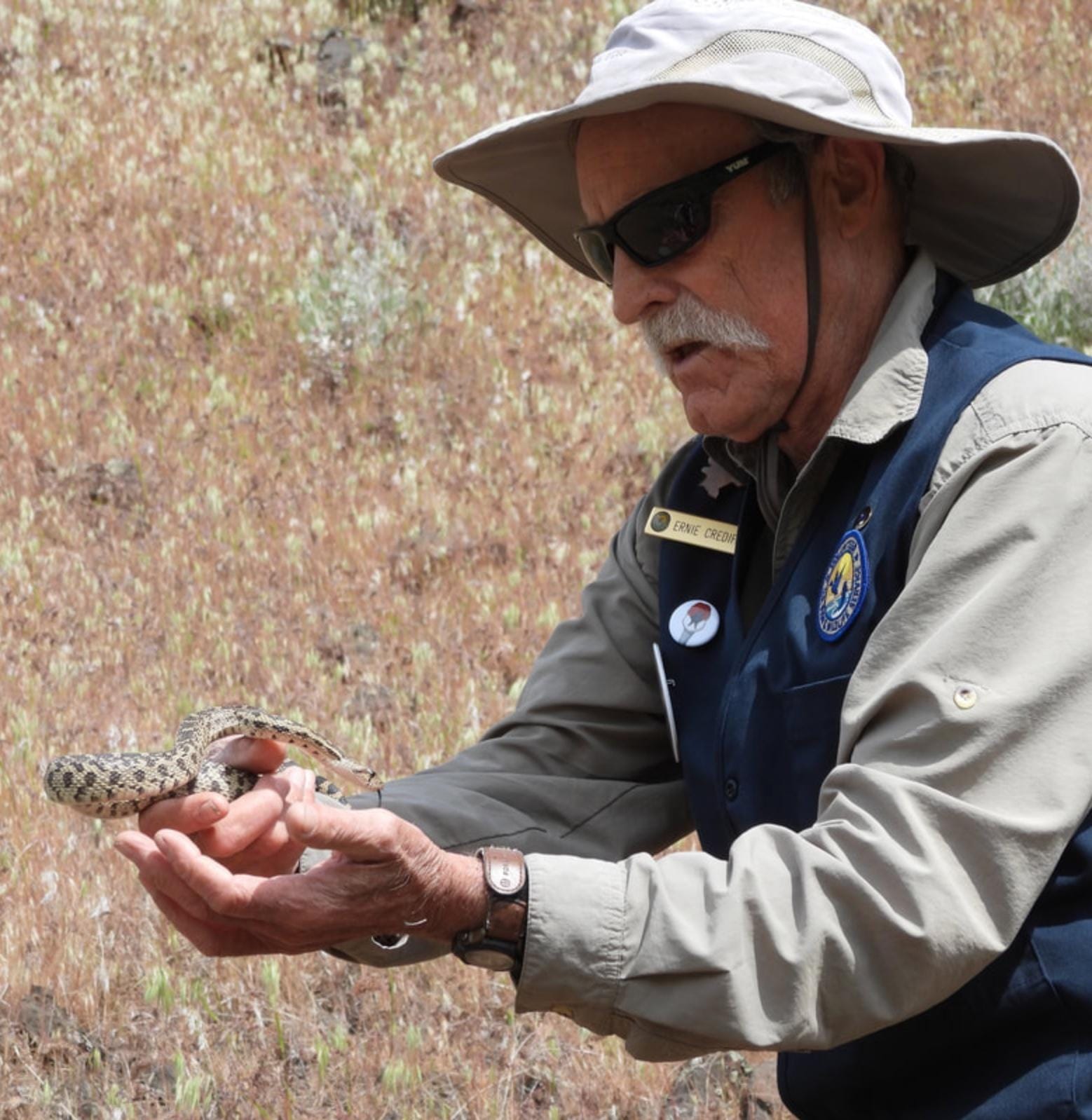
Engagement requires active demonstrations. While climbing Badger Mountain with a group, I pulled out my spray bottle of water as we approached a star moss. Janelle Downs, a PNNL botanist, had taught me how to spray the moss with water to wake it from dormant to ‘Ah!! little green stars!’ — deeply impressing upon me the value of demonstration. Ben Legg, a young chemical engineer along for the hike, was impressed by this move.
“Ernie, near where you sprayed the moss there’s all kinds of caliche,” Ben explained. “In addition to your spray bottle you ought to carry a lemon with you. Caliche is a carbonate; if you spray an acid on it, foam appears like magic.”
Another tool for my show-and-tell kit.
Asked to consider leading fieldtrips, I thought: AVOID all the things that turn my brain off. I have a natural ability to ‘feel’ native plants, and I enjoy the challenge of their identification. If a person’s approach is to use scientific names, they might as well be speaking Chinese to me. Starting with the common name, then backing it up with a scientific name seems to me a much more effective way to engage people. Scientists from all over the world come here and identify plants with common names that differ from place to place. This is when a scientific name comes in handy. Even if we pronounce the names differently, we can find a common language for sharing the plants.
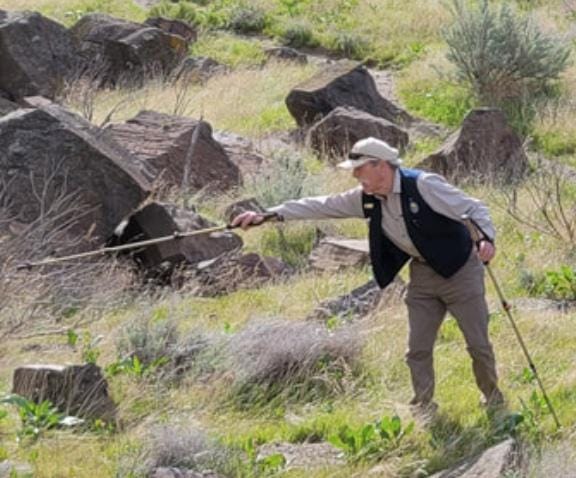
One January, Gretchen Graber and I went out near Mattawa to collect sagebrush seed. Our discussion about spiny hopsage led me to recall that as a kid, I’d notice what looked like a sagebrush that lost all its leaves in the summer. Wherever I saw that, I also found the scalaparus, a sagebrush lizard — what we called a bluebelly lizard — with two black patches, different from the sand lizard. Those were highly prized.
Out gathering seed, we noticed that spiny hopsage were mixed in with the sagebrush. Suddenly, I heard, “Ernie! Ernie!” Gretchen had discovered a sagebrush lizard impaled on one of the thorns of a spiny hopsage! A shrike had done this, an endorsement of what I’d been saying about the direct relationship of the lizard to the hopsage.
Describe how your childhood shaped you as a naturalist.
When I was a kid growing up, I had eczema. They'd put mittens and booties on me so I wouldn’t scratch at night. Scabs covered my arms, face, and hands. Some neighbors knew it was an allergy, others thought it was something they didn’t want their children near. So I was alienated a lot when I was a kid. But I lived two blocks from Zintel Canyon, and I routinely explored that canyon up towards the Horse Heaven Hills. When I was eight, I became mesmerized by a big-leaf lupine high in the canyon, zoning intensely on it for hours at a time. I knew even then that I was drawn to the wonder of wild vegetation.
So you spent your childhood outside despite the eczema. How did you cope with the confinement of a classroom, knowing you were much more at home in the outdoors?
A mild form of dyslexia combined with a mother who didn’t teach us even the ABCs really handicapped me when I entered kindergarten. Flunking my first year, I had to do it all over again without my friends, as they all looked down on me.
Formal schooling didn’t really work for you; how did you survive?
I interacted with nature whenever possible. We’d go camping, and I’d claim an ice chest to capture and transport a menagerie. I’d return home with snakes, frogs, toads, all kinds of critters, and release them into Zintel Canyon. I wanted those creatures living near me.
I’d turn over rocks in Columbia Park to find crawfish and keep them alive in a bucket. A nearby barber would give me two cents apiece for them, as he sold them as fish bait. Later on I indirectly sold rattlesnake skins to the same guy. When I brought home a bunch of baby rattlers I’d found, everyone freaked out. My pet bull snake Smiley was over 6 feet long, and lived with me for three years in a terrarium before a neighbor killed it. My kangaroo rat was always escaping my hamster cage to sneak into the vacuum bag to be with all the fuzzies. I’d keep all kinds of animals until they got hungry, then I released them.
You grew up living two distinctly separate lives, one indoors struggling with ‘book learning’ and one outdoors learning directly from nature. Did you manage to graduate from high school?
No, I dropped out halfway through my senior year, when they told me I’d have to go to summer school. I was being drafted and felt uncertain about my future, so I chose to take control of it.
At my induction physical, they sent me to a specialist because I had a heart murmur, which [put] me on a one-year stay. I drove to Vashon Island, lived in a barn, and worked various outdoor jobs. A year later, a 4F designation relieved me of military service, so I returned to working outdoors.
Finally escaping Seattle’s rain, I returned to the Tri-Cities in 1993.
What led you to focus on native plants?
A turning point came one day while I was on a birdwalk with the Audubon folks on nearby Bateman Island. The birders were naturally scoping up in the trees while Jack and Murrel Dawson were studying something on the ground.
“What’s so interesting?” I inquired.
They pointed to a native plant in full bloom and excitedly shared some relevant details.
Surprised by such enthusiasm, from a birder no less, I asked, “You know about native plants?”
My discovery on Bateman Island that day was immense. The Dawsons clued me in about the local chapter of the WA Native Plant Society. I couldn’t believe such news — a whole community focused on what I’d been cultivating in my yard for years! My mind exploded, unlocking tumblers, freeing me to walk the path of ecosystem learning and sharing everything I could about the plants of our region. The knowledgeable folks who volunteer locally for environmental work — conservation, preservation, restoration, and education — truly enrich my life. We may disagree on details, but we share the fundamental value of nature.
Folks from the Columbia Basin Chapter of WA Native Plant Society and Friends of MidColumbia River Wildlife Refuges have graciously supported me throughout my journey as a budding field interpreter.
A commitment to the challenge of understanding native plants in their shrub steppe ecosystem is my personal mission. It’s been a somewhat intimidating learning curve. I’m learning to work with whatever audience shows up. I don’t mind repeating myself.
Back about 2013, you were inspired to create a public living tribute. Tell us about the project.
Hiking up Badger Mountain, seeing all the purple sage in bloom, I imagined a ‘purple heart garden’ planted with purple sage in full bloom on Memorial Day. Raised in the Vietnam era, many of my friends returned from the fight bearing invisible wounds. In a way, this could be a tribute to them. Liking my idea, fellow members of the Native Plant Society funded and helped build a 15-by-15 foot heart-shaped plant bed off Columbia Park Trail near the boat launch at Wye Park. Crushed basalt and sage plants were framed in fine gold rock. The sage plants had been rescued from areas cleared for development. After three years, a vandal ripped out every sage plant. Local business and an anonymous citizen donated new plants to restore purple blossoms in time for Memorial Day. It’s a project I’m proud of, as it now belongs to the community.
This place shaped your youth through so many interactions with the natural environment. From rattlesnake and coyote hunting to lizardkeeping and wholesale transfer of various species from one habitat into another, your actions were all experimental, some damaging. How do you square your impactful past with your current more ecologically aware endeavor?
Ecosystems are amazing! My enthusiasm for their workings comes from unbounded discovery in my chosen classroom, the field. I love to lead wildland walks with interested people. As a youth, I’d ‘had a way’ with the natural environment of this region. Now I share some of my favorite places through interpretation. Informed by lessons from past experiences, I now try to model how to carefully interface with and learn from what is wild. Sharing what I can about wild species and their interconnectedness feels like a sort of redemption.
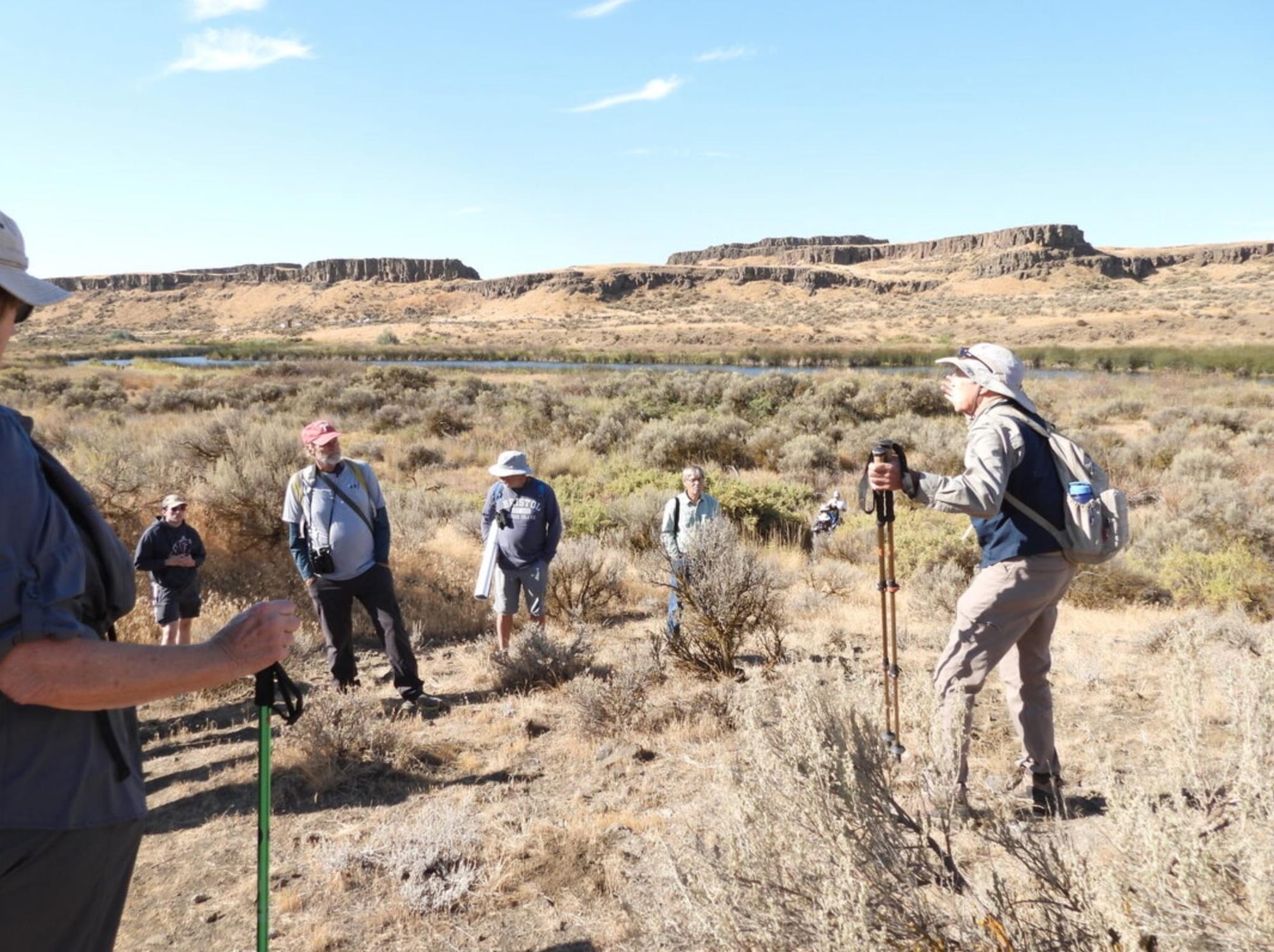
I love showing people where and when the wildflower blooms occur. The rewards of doing so are as varied and special as each encounter. Receiving the Tri-Cities Conservationist of the Year award from Tapteal Greenway in 2021 was quite an unexpected honor.
A precious bit of feedback came when I led a field trip for Jim Castle’s CBC Environmental Science students up at Columbia National Wildlife Refuge.
Together we hiked the Ridgeline Trail, a route that used to be called Frog Lake.
In response to my somewhat passionate interpretive style, several students commented that they want to be like me when they’re my age. That really meant a lot to me.
More Boots in the Basin: https://tumbleweird.org/topic/boots-in-the-basin/
