
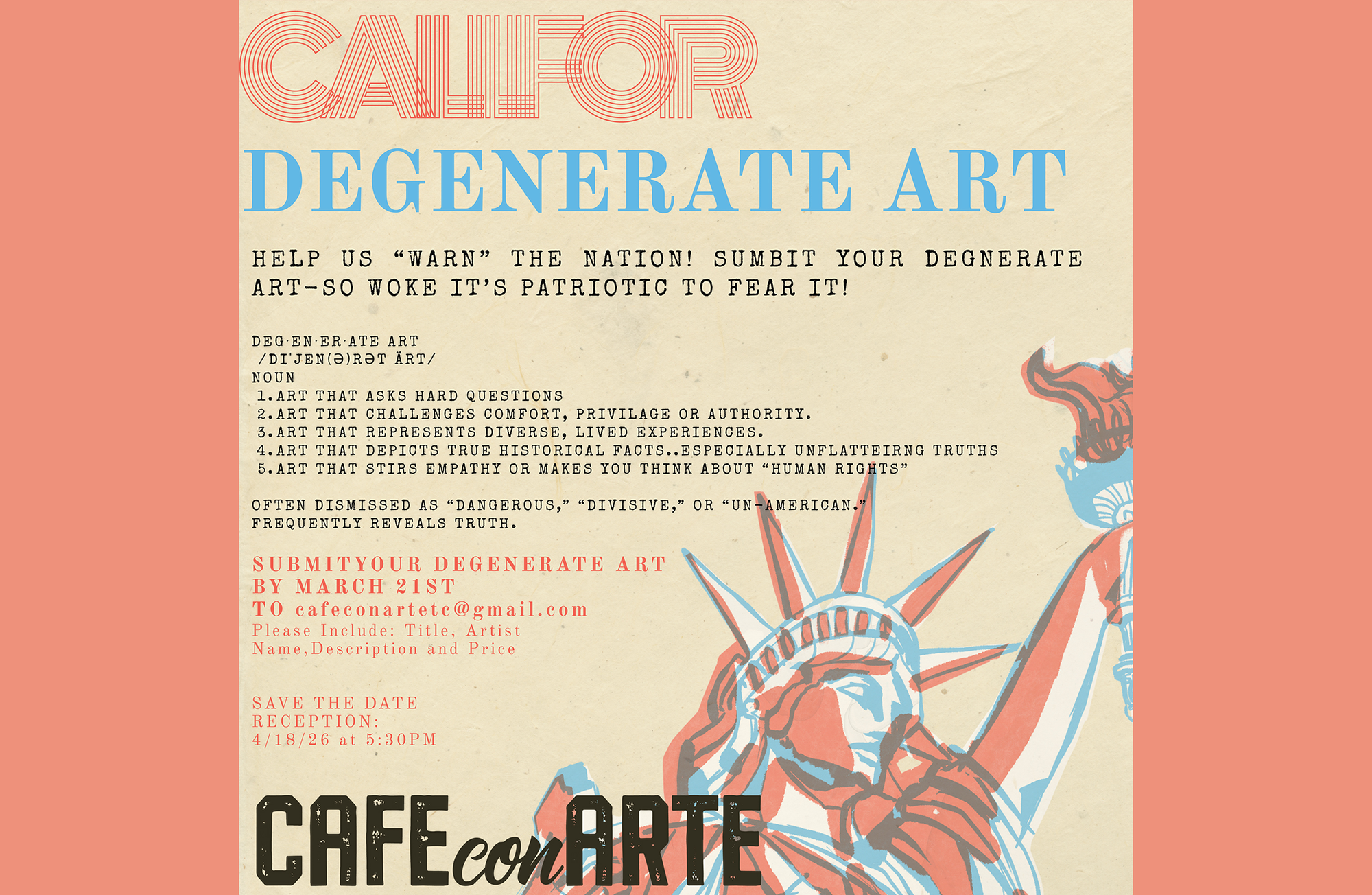
Note: This is a continuation of the satirical essay ‘How to protect fine, upstanding Americans from degenerate artists’ from the November 2025 issue of Tumbleweird.
“Degenerate.” “Unpatriotic.” “Dangerous.” “Immoral.”
Across time and space, art that poses a risk to the status quo — whatever that may be — is labeled and ridiculed as a way to dismiss and invalidate the questions it raises and the truth it reveals.
It is easy to look at the Nazi Degenerate Art Exhibition (Entartete Kunstof) of 1937 — which stole and displayed artwork the Nazi regime described as a danger to society — and draw parallels with what we see happening today, as our artistic and cultural institutions are gutted of artwork that represents truths about our country that the current administration finds inconvenient.
Entartete Kunstof displayed artwork within a controlled environment where it was mocked, labeled, and shown in the most unflattering way possible. Their aim was to condition viewers to believe that the art was disgusting, perverse, and dangerous, and that the artists who created it were criminals.
Today, American exhibits are being cancelled or altered for addressing issues like colonialism, racism, police violence, and gender identity. Queer artwork is being removed from public spaces and labeled a threat to children. Monuments which critique the horrors of U.S. history are being labeled ‘anti-American’ by our government. The White House has even gone so far as to release a list of “objectionable” work, perhaps the most direct similarity to the Degenerate Art Exhibit.
But regardless of the similarities between the terrifying trends we see in our country presently and the ones seen in the past by our distant German neighbors, it is incredibly important to remember that censorship is an American tradition.
Not only are the systems of systemic exclusion we uphold expertly designed to support and promote artists who are largely white, able bodied, straight, and male; our government has also launched campaigns similar to the Degenerate Art Exhibition many times throughout history.
From the 1940s to the 1960s during McCarthyism, hundreds of artists — visual, literary, and performing — were blacklisted for their political affiliation, or for creating work that in any way questioned labor laws, or depicted important themes, such as poverty or racial inequity. This art was labeled “anti-American” (and often “red” or “communist”), and therefore dangerous. It went beyond being blacklisted for many artists and performers who were viewed as threats to national security; hundreds of them were monitored, investigated, harassed, and put on trial (literally and figuratively), and even deported.
During the Civil Rights Movement, art depicting state violence, centering Black voices, or connecting capitalism to racism was labeled “inflammatory” as a control tactic. Labels such as these were used to dampen the impact of powerful art and imagery by mocking, dismissing, or criminalizing it. This led to artists being censored, surveilled, and excluded from funding. Many lost exhibiting and publishing opportunities. For example, newspapers wouldn't print certain photographs showing how Black people were being treated, stating that they escalated violence. Murals depicting Black leaders and resistance movements were destroyed and defaced. Emory Douglas, the Minister of Culture in the Black Panther Party, was heavily surveilled, and constantly received threats of violence against him for the work he depicted and created.
The efforts we are seeing now — and have seen throughout history — to censor art, silence artists, and punish inconvenient truth telling is all the evidence we need of how imperative it is that we keep creating, exhibiting, buying degenerate art!
Submit your Degenerate Art to cafeconartetc@gmail.com with the title, artist name, description, and price BY MARCH 21 for the opportunity to be featured in the Cafe Con Arte Degenerate Art Show in April 2026. Save the date for the reception on April 18 at 5:30pm.
Ashleigh Rogers is an artist, art instructor, and facilitator in Tri-Cities, Washington. Her work explores the themes of connection and intergenerational stories through experimentation in painting, photography, installation, and sculpture. Ashleigh is passionately dedicated to facilitating accessible arts programming in her community.
Find her on Facebook: fb.com/AshleighRogersArt or Instagram: ashleigh.a.rogers
