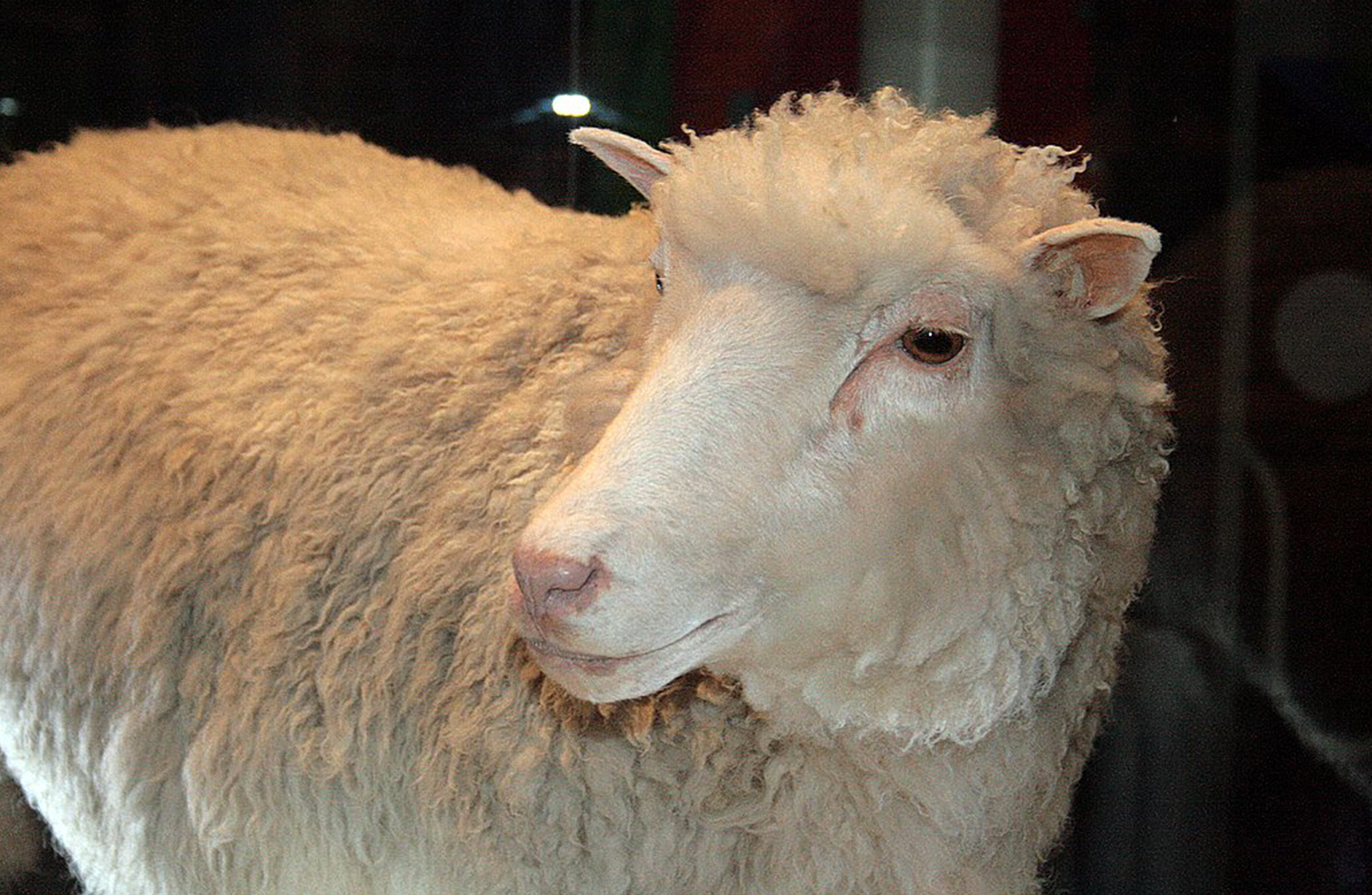
Dolly the Sheep’s exhibit at the National Museum of Scotland in 2009 / Photo by Toni Barros / CC BY-SA 2.0
Around 2020, I noticed a truck with lettering on the side spelling out TRANS OVA. I wondered if it was an LGBTQ+ organization, so I looked it up when I got home. It turns out Trans Ova is a cloning facility.
A cloning facility? Here in town?
Okay, that definitely took a turn. Since when did cloning become legal? In the 2000s, there was quite a controversy about Dolly the sheep, who had been cloned in China. Was all of that uproar a lie? Is cloning more prevalent than we think? Cloning farm animals appears to be widely accepted here in the United States now, according to the Trans Ova website. Since when?
Clustered Regularly Interspaced Short Palindromic Repeats (CRISPR), a technique for gene editing, came to be used in certain animals in the United States around 2015, although genetic modification was used earlier. Gene editing and cloning go hand-in-hand; as Trans Ova says:
Together, we leverage our expertise in reproductive technologies and gene editing to develop innovative solutions that enhance animal health, sustainability, and genetic progress. This synergy allows us to offer industry-leading solutions for livestock improvement, empowering producers with precision genetics to meet the demands of modern agriculture.
Even if gene editing is legal, its implications may be worrying to some. But there are apparently a lot of applications being used in medicine and other spheres of interest.
Some examples of ‘transgenic’ animals that use cloning technology currently are:
- Glow-in-the-dark cats that detect feline AIDS
- Mice that have human-gene-altered squeaks (plus a website where you can order any genome replacement in a mouse online)
- Glow-in-the-dark zebrafish that detect pesticides in water
- Mosquitoes that kill themselves off
- Cows that produce human milk
- Goats that produce spider silk in their milk
- Pigs that produce plasma and pharmaceuticals
Anyway, I’m not sure how many people knew this. You can decide how you feel about it. I wonder how many more companies there are that specialize in this field?
References:
- transova.com/service/cloning-services
- Zielinski, Sarah. “The Glow-In-The-Dark Kitty.” Smithsonian Magazine, 13 September 2011, smithsonianmag.com/science-nature/the-glow-in-the-dark-kitty-77372763
- ozgene.com/humanized-models
- biology.ucdavis.edu/news/fluorescent-zebrafish-help-identify-pesticides-do-reproductive-harm
- “Genetically Modified Mosquitoes | Mosquitoes.” CDC, 20 April 2024, cdc.gov/mosquitoes/mosquito-control/genetically-modified-mosquitoes.html
- isaaa.org/kc/cropbiotechupdate/article/default.asp?ID=7651
- digitalcommons.usu.edu/student_showcase/11
- “Genetic modifications of pigs for medicine and agriculture.” PMC, pmc.ncbi.nlm.nih.gov/articles/PMC3522184
