
Narrated by Ted Miller
"The nine most terrifying words in the English language are: 'I’m from the government and I’m here to help.'"
— Ronald Reagan, August 12, 1986
Last month, voters in the Kiona-Benton City School District rejected an extension of the schools operating levy, which will force painful cuts to school programs. Ki-Be is not alone. Other tax measures have recently failed, reflecting an anti-tax sentiment that has been growing for decades. But is taxation for the common good something that should always be opposed?
The idea of rugged individualism has been part of our story since this nation was founded — the ‘self-made man’, the pursuit of the American Dream, the idea that each of us can be whomever we choose to be and can achieve anything if we just work hard enough. But although we are a land of opportunity, opportunity knocks more often for some than others, and doors don’t always open as equally as we want to believe.
There is nothing wrong with individual initiative. Adam Smith, author of The Wealth of Nations, explained with his economic theory of “the invisible hand” that individuals acting in their self-interest drive the economy and inadvertently benefit society as a whole. But he also warned that governments must ensure fairness, prevent fraud, and protect the public. In other words, capitalism must be regulated to balance the drive for profit with the welfare of the people. He believed that a society could not succeed with a concentration of wealth in the hands of a few while a majority of the people struggle just to survive.
Collectively, we the people of the United States, as we call ourselves in the Preamble to the Constitution, are able to do more for the common good than any of us could do alone. In 2012, Barack Obama gave a speech to praise how we help each other and how the government has helped. He was referring to infrastructure like roads, electricity, and the internet. He talked about public education, fire departments, and scientific research. He reminded us of “this unbelievable American system that we have that allowed [us] to thrive.”
Referring to that infrastructure, Obama told successful businesses, “You didn’t build that.” And he clarified by saying, “The point is that when we succeed, we succeed because of our individual initiative, but also because we do things together.”
Politicians twisted that statement out of context as an attack on individualism and to discredit good government.
I’ve never understood the anti-government, anti-tax sentiment that willfully ignores the benefits of a government that works for us. When someone here in the Tri-Cities complains about paying federal taxes, do they not remember that we have an influx of billions of federal dollars into our local economy every year? Even more astounding to me is when those complaints come from someone whose entire career, including their current retirement pension and health care benefits, has been paid for with federal contracts here at Hanford. Locally, we were largely insulated from the 2008 recession with nearly two billion dollars from the American Recovery and Reinvestment Act. And just imagine the long term environmental and health risks we would be facing without a government that continues to fund Hanford cleanup work.
Government has always worked to improve the quality of life on the local, state, and national levels. Labor laws ensure workers have fair and safe working conditions — like the 40-hour work week enacted with the Fair Labor Standards Act of 1938. Financial regulations protect our investments and bank accounts — like FDIC insurance and the Securities Act of 1933 enacted after the Great Depression. Environmental regulations have significantly improved our air and water quality — like the CERCLA Superfund enacted following the Love Canal environmental disaster. The rate of fatalities from traffic accidents has decreased by over 90% in the last 100 years due to government regulation of vehicle safety and investment in safer road design.
And these are just a few examples of how government can work for the people.
Locally, our tax dollars pay for police and fire departments to protect us. Our public schools educate the next generation. Our health departments regularly inspect restaurants and food suppliers so we can trust what we eat. Our water supply is regularly monitored to ensure we have safe drinking water, something we often take for granted. Earlier this year, the City of Kennewick discovered low levels of so-called ‘forever chemicals’ in drinking water that exceed the state limits considered to be safe. The city is now working on an improved water treatment design to address the problem.
So, what good is government? I don’t agree with Ronald Reagan that government help is terrifying. To the contrary, a government that is accountable to the people can meet its purpose as defined in the Constitution.
Without government, how many more people would have died from preventable and treatable diseases? How many more seniors would be without health care? How many more of us would be defrauded by unscrupulous businesses or injured from unsafe consumer products? How could farmers and businesses be as successful without government infrastructure of highways, electricity, water, and the internet? How could science and medicine have achieved so much so quickly without government investment?
And government has the capability to do so much more. No child should go hungry. No one should die or go bankrupt because they can’t afford health care. No one should be without shelter. In the United States, we can afford to care for the people while promoting economic growth. As Adam Smith said, the individual’s drive to get ahead, to make a profit, and to provide for their family can drive an economy with a government that works to ensure a level playing field.
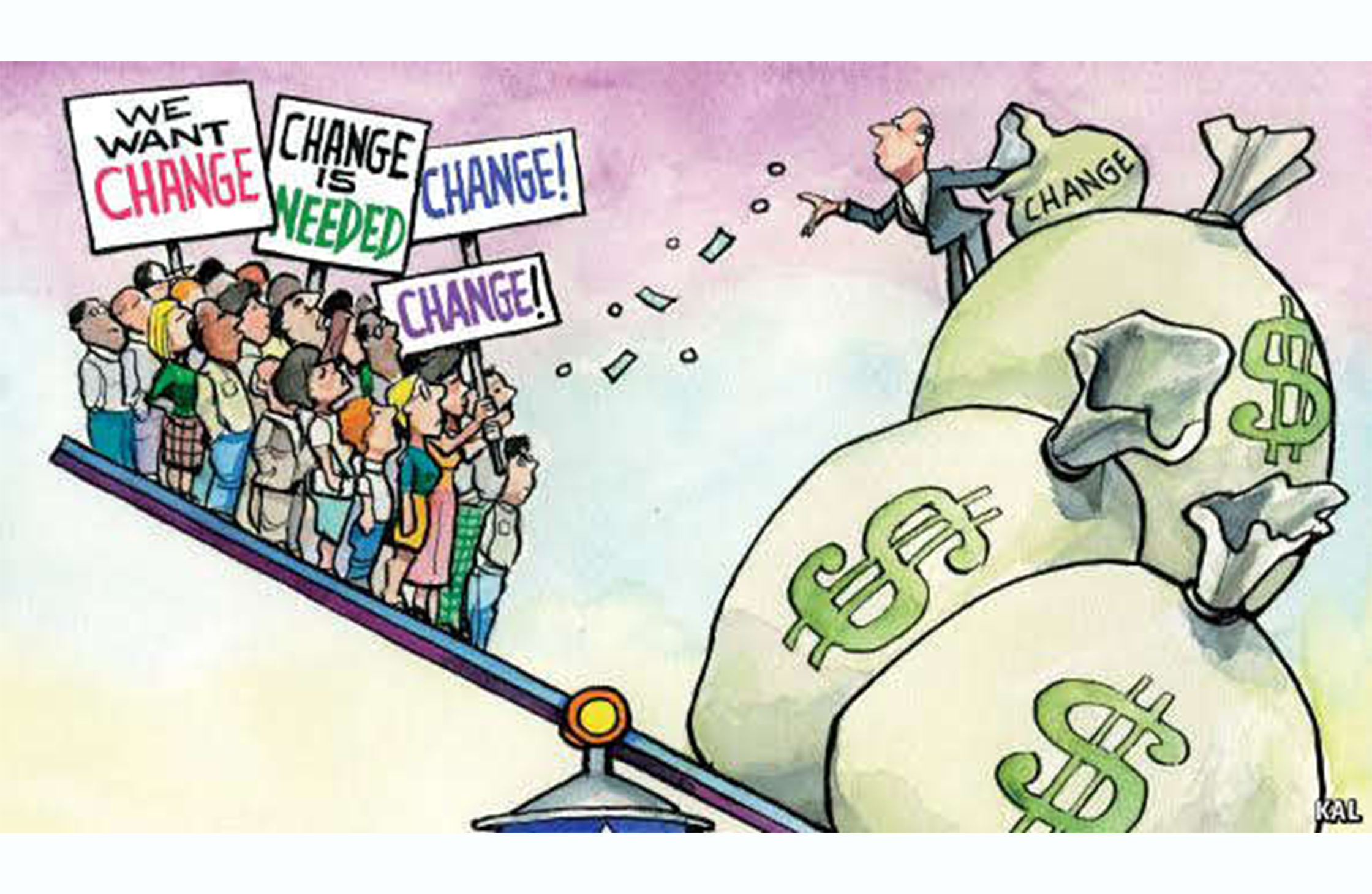
Since long before Reagan told us to fear government, there have been those who have tried to undermine and discredit the power of government to do good. But when you take a closer look at who would benefit and who would suffer from a dismantling of government rules and regulations, it’s not the people who benefit from lower taxes and deregulation; it’s corporations and the wealthy.
We can have a free market AND we can take care of the people. After World War II, the government helped build the strongest middle class in history. But over the last 50 years, that middle class has been hollowed out as $50 trillion has moved from the bottom ninety percent to the top one percent. That is $50 trillion that did NOT go to wages, benefits, and improvements for the lives of the middle class.
I don’t begrudge successful businesses. I think regulated capitalism can produce a thriving economy. My point about the concentration of wealth isn’t about class warfare but about fairness.
No one needs to be a trillionaire. We don’t need more billionaires. We need a level playing field so that as individuals, we can lift the economy together and continue to build a society that works for all the people.
Instead of fearing our government, let’s make our government work to help all of us.
Ted Miller grew up around the world but now lives in Richland with his wife. He’s a runner, actor, singer, nuclear engineer, and graduate of the U.S. Naval Academy.
Ted believes that if more people worked toward love and understanding instead of giving in to fear and divisiveness, the world would be a better place.
