
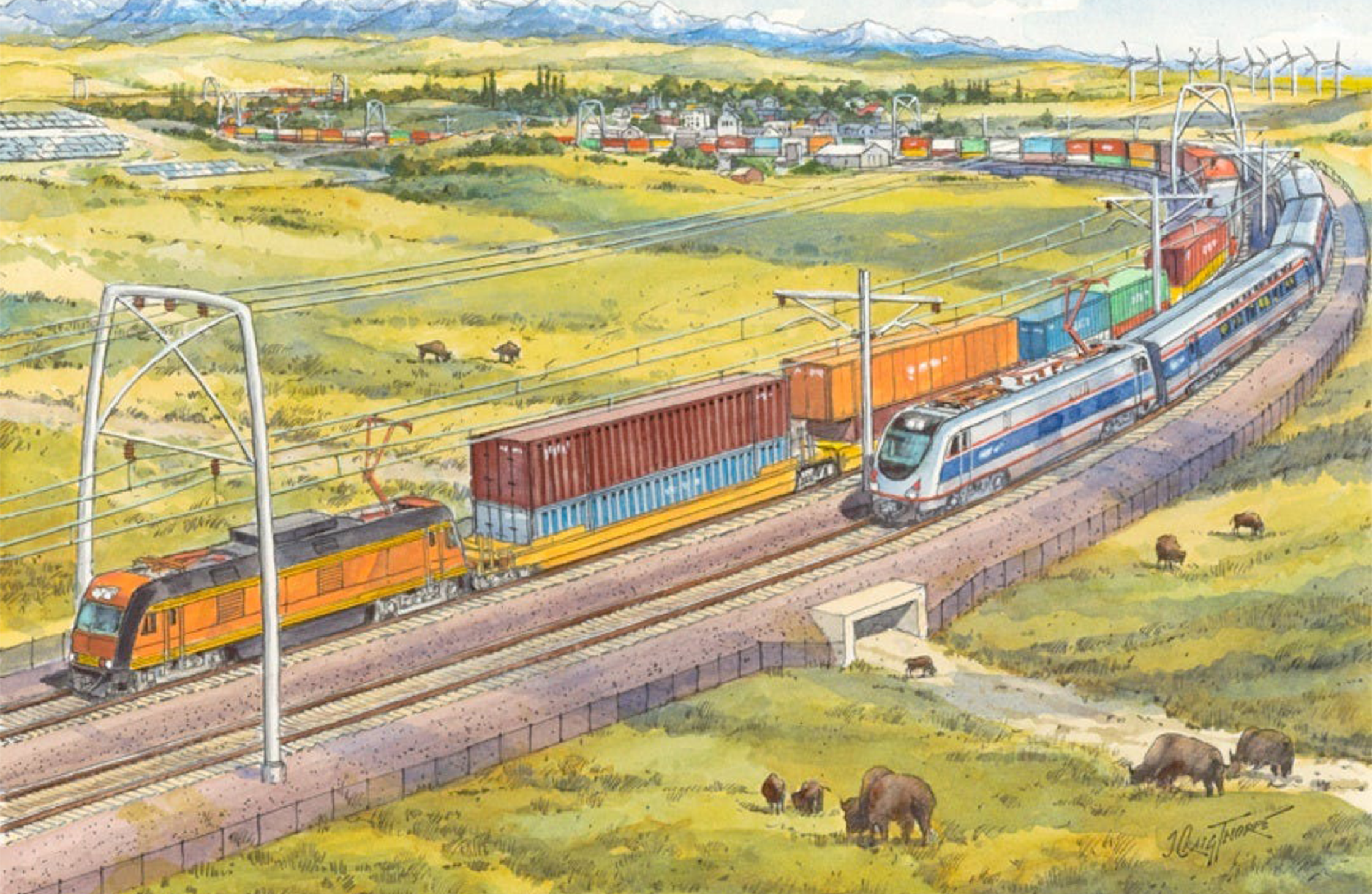
Illustration from solutionaryrail.org
Imagine traveling to another city at 125mph in comfortable seats while watching the scenery pass by. So fast, safe, and relaxing!
You’re not in an autonomous vehicle, stuck in stop-and-go traffic. And you’re not on an Amtrak train, waiting for a diesel freight train to pass through.
You’re taking Solutionary Rail, a big improvement over Amtrak. The major trunk lines have been upgraded to support 125mph travel by passenger trains and 80mph transport by freight trains most of the way. Double tracks are available all throughout to eliminate waiting for oncoming trains to pass, and the engines are electric rather than diesel, with electrical lines overhead most of the way and batteries to power through the gaps.
With their faster (and therefore more popular) service, Solutionary Rail trains can run more frequently than the ones used by Amtrak. Freight transport capacity is also increased, which reduces congestion on highways. What’s more, the train corridors also serve as electrical transmission corridors, benefitting electricity producers.
When you arrive at your train station via Solutionary Rail, you’re already downtown, so you have no need to pay for transportation into town, or for parking. And the system is integrated with other public transit; Google Maps tells you where the nearest transit stop is, which routes will take you to your destination, and when the next bus is arriving. If you have a lot of luggage, you can always grab an Uber or Lyft. All you need is your phone and a debit card.
Solutionary Rail
Improved rail systems
The Solutionary Rail vision for a national rail system was proposed in 2017. Although the U.S. rail plan issued at the end of the administration of President ‘Amtrak Joe’ Biden focused on electrification, and identified federal funding for it, very little of the vision has been realized or is even being actively pursued. The Trump administration canceling billions in transportation improvements is obviously part of the explanation, but there’s more to it than that.
Despite setbacks, several rail lines are moving forward with improving ground transportation in their cities. Here is a brief rundown of where we are when it comes to railways in the U.S.
Right now, the Acela Express runs between Washington DC and Boston at speeds up to 150mph, and trains on other lines between Miami and Orlando — and between New York and several other cities — operate at up to 125mph. Of these, only the Acela line is electric.
California is using a combination of state and federal funds to proceed with the development of its 220mph electric High Speed Rail (HSR) between Los Angeles and San Francisco. The project is expected to cost $100 billion, of which only $22 billion has been secured so far.
Brightline is using private investment and federal funds to build an electric 200mph train between Los Angeles and Las Vegas.
The Pacific Northwest (where Amtrak service is currently limited to 79mph on the Empire Builder and Coast Starlight, for lack of advanced traffic control and signals along the routes) also has HSR aspirations. HSR has also long been a dream of Cascadia Rail, but the cost for a new dedicated track between Vancouver, Washington and Vancouver, British Columbia is between $24 – $40 billion. It would also take 30 years to design, acquire property, and construct the tracks and 90 miles of tunnels that would be required. In other words, don’t count on it happening anytime soon.
Amtrak Cascades has written a Preliminary Service Development Plan that raises the maximum speed to 90mph and adds more diesel trains on the existing tracks between Portland and Seattle. More recently, the Climate Rail Alliance has called for adding 200 miles of a third non-electrified track in the same corridor between Vancouver, Washington and Vancouver, British Columbia, with a top speed of 110mph. The cost for that upgrade is relatively modest, at $12 – $15 billion over ten years.
While the Vancouver, British Columbia to Portland, Oregon corridor is justifiably getting the most attention, we in the Tri-Cities are far more likely to use the Empire Builder to Portland or Spokane, or a train that runs more directly to Seattle. All Aboard Washington has been the leading advocate for train service to Seattle via Yakima, but as it stands, it would still take six hours to get to Seattle from Pasco. Thankfully, a feasibility study by the Washington State Joint Transportation Committee concluded that making this faster route available could be financially viable, perhaps because the alternatives for those without motor vehicles are slower or more expensive. So, if you want direct train service from the Tri-Cities to Seattle, tell that to your state representatives!
For the Empire Builder, no organization is currently advocating improvements.
Train holdups
So, why has Solutionary Rail largely failed to gain traction? The problem is track ownership. Amtrak is a public train system operating on privately owned rails. Solutionary Rail proposes public funding and ownership of electrification systems (which is consistent with Biden’s U.S. rail plan), but relies on tracks owned by private rail companies that serve freight traffic. If the safety systems and double track required for faster trains and greater capacity are not installed by private rail companies, electrification systems offer limited value.
Why aren’t the private railroad companies willing to invest in their own rail systems? You might be surprised to learn that, consistent with the monopolistic history of the railroad industry, they have seized priority for freight on their lines, even though Amtrak passenger service has the legal right of preference. Upgrading tracks from single to double would therefore primarily benefit Amtrak. Right now, trains full of passengers are often made to wait while freight passes through. With freight taking priority, freight trains are the largest cause of delays of passenger trains.
The Association of American Railroads has spent millions of dollars blocking Congress’ efforts to establish metrics and minimum standards for inter-city passenger rail service, and the Surface Transportation Board’s efforts to define an acceptable level of on-time performance. Only once has the Department of Justice sued a freight railroad for interfering with Amtrak service. Amtrak has filed complaints with the Surface Transportation Board, and Members of Congress have engaged on the issue on behalf of both the freight haulers (legislation removing Amtrak’s right of preference) and passengers. You can help demonstrate political will for improved passenger service by calling or writing to your members of Congress urging enforcement of the Amtrak legal right of preference.
If the priority of passenger trains were respected, you can be sure the rail companies would upgrade their systems to ensure adequate capacity. Improvements would allow faster speeds, fewer delays, and service competitive with highway travel, benefitting freight as well as passenger transport.
If the Solutionary Rail system can be realized, it will benefit many people. By greatly accelerating the capacity and reliability of the rail system, workloads will become much more predictable, so that rail workers can enjoy set schedules and better working conditions. Passengers will enjoy faster and more predictable transit times. Farmers will have access to increased capacity, for faster, lower-cost, transportation of their bulk and perishable crops. Trackside communities would breathe air free of diesel exhaust. Producers of electricity would have access to new transmission lines to get their energy to broader markets. The railroad industry would gain increased market share and greater demand for their services.
And the dream of fast, safe, relaxing transportation will become a reality.
Climate scientist Steve Ghan leads the Tri-Cities Chapter of Citizens Climate Lobby.
