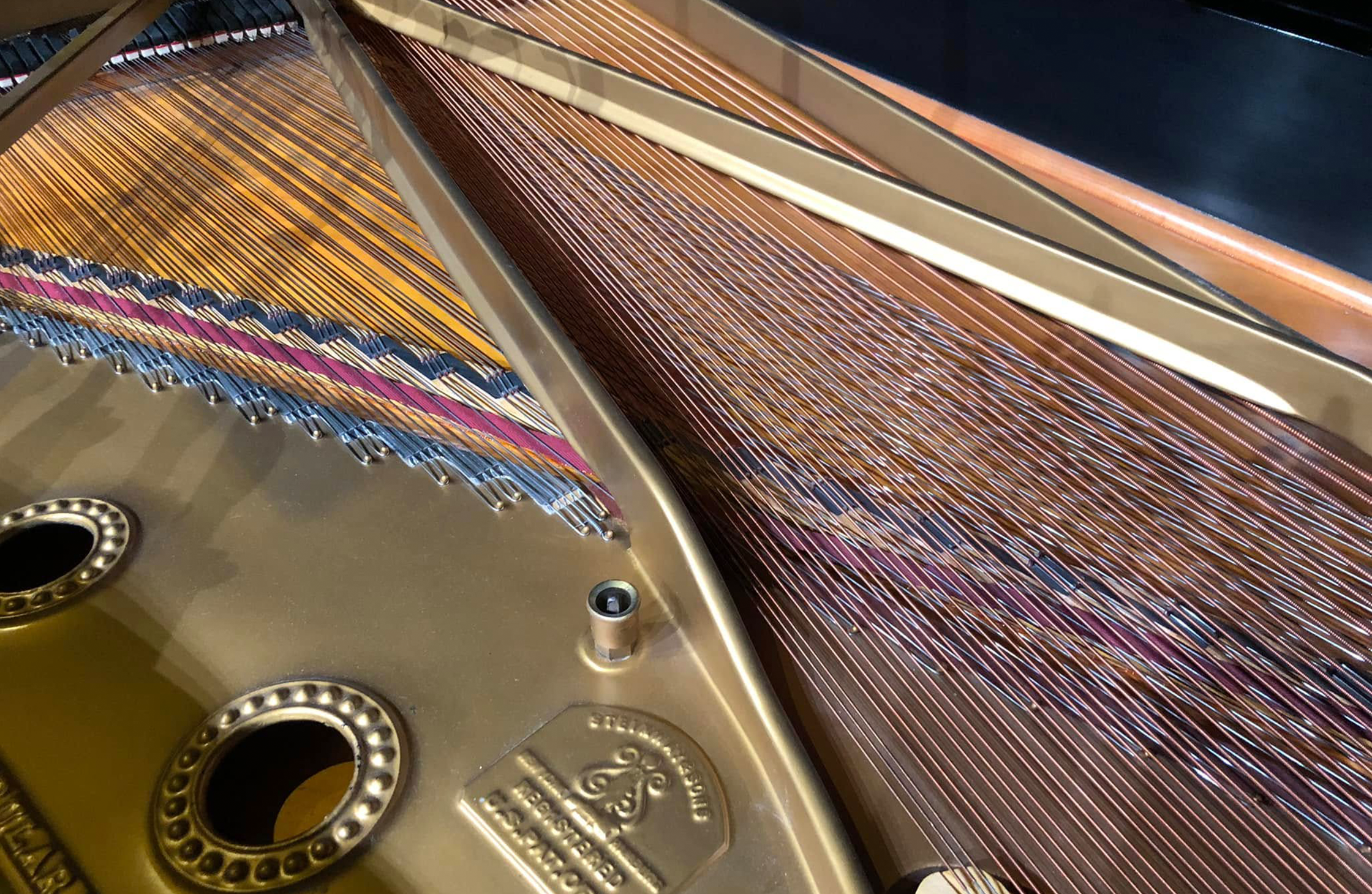
Inside the Richland Steinway / Mary Hartman
If you’ve ever attended a show at the Richland High School auditorium, you have likely had the privilege of experiencing the Steinway grand piano which resides there. But are you aware that the history of that instrument is entwined with the top-secret Manhattan Project and a 1940s radio star?
In 1944, Richland was a boomtown. Forty thousand construction workers were building something very secret under very tight security. To keep them and their families entertained and out of trouble, their government employers hired Kay Kyser, a celebrity band leader, radio host, and movie star, to put on a show. Kyser, who traveled with his orchestra and his 1916 Steinway, was a hit with the audience. But after the concert, there were some logistical complications around security, and Kyser had to leave in a hurry, abandoning his precious piano.
Decades later, on May 21, 1983, Kyser reminisced about the experience in a letter he sent to Marjorie M. Peterson, Secretary of the Richland Community Concert Association, saying:
I recall that the minute our show was over and I got to my dressing room, there appeared two FBI or CIA or Secret Service men, wanting to know who gave me permission to say on the air the previous Wednesday [on the popular ‘Kollege of Musical Knowledge’ radio program] that we’d be appearing [at Hanford]! It was nip and tuck for a moment, but all turned out okay and we didn’t lose the war!
The Steinway was never returned. Instead, it was passed from the Army Corps of Engineers to the U.S. Atomic Energy Commission, and finally to Richland Public Schools. After the Richland Community Concert Association (now Community Concerts of the Tri-Cities, or CCTC) was established as a nonprofit in 1944, they assumed responsibility for the use, care, and maintenance of the piano, including a number of significant repairs.
The most extensive repair was in 1968 and took almost a year to complete. The piano was shipped to the Steinway Company in New York to receive a new soundboard. On this occasion, the Mid-Columbia Symphony and Mid-Columbia Musical Theatre chipped in to cover the cost.
Another repair happened in front of an audience, when two keys stopped working during a performance in 1981:
…Then came the surprise — two keys on the piano were dead and would make no sound. It just so happened that the pianist [James Gemmel] had a former college classmate, Steven Hesla… who was in the Tri-Cities, and he had volunteered to be the pianist’s page-turner. He ended up being more than that. Gemmel announced that if he had a screwdriver, he and Hesla could fix the hammers of those two keys. Stagehands gathered a handful of various sizes, and amidst appreciative laughter from the audience, the piano was disassembled, and the pianist and his college professor page-turner went to work… It was a successful operation, and in less than seven minutes, all was in order.
(Tri-City Herald, February 25, 1981)
Mary Hartman currently serves as Secretary of Community Concerts of the Tri-Cities.
CCTC continues to bring world-class performers to the Tri-Cities, with two shows remaining to round out the 2025/26 season:

Project Convergence (a dance troupe melding classical Indian dance and American tap)
March 7 at 7:30pm
Gentlemen’s Quartet (a multi-genre group featuring strings, piano, and vocals)
March 23 at 7:30pm
More information can be found at CommunityConcertsTC.org, or call (509) 547-6243
And follow us on Facebook: @CommunityConcertsTC and Instagram: @communityconcertstc
