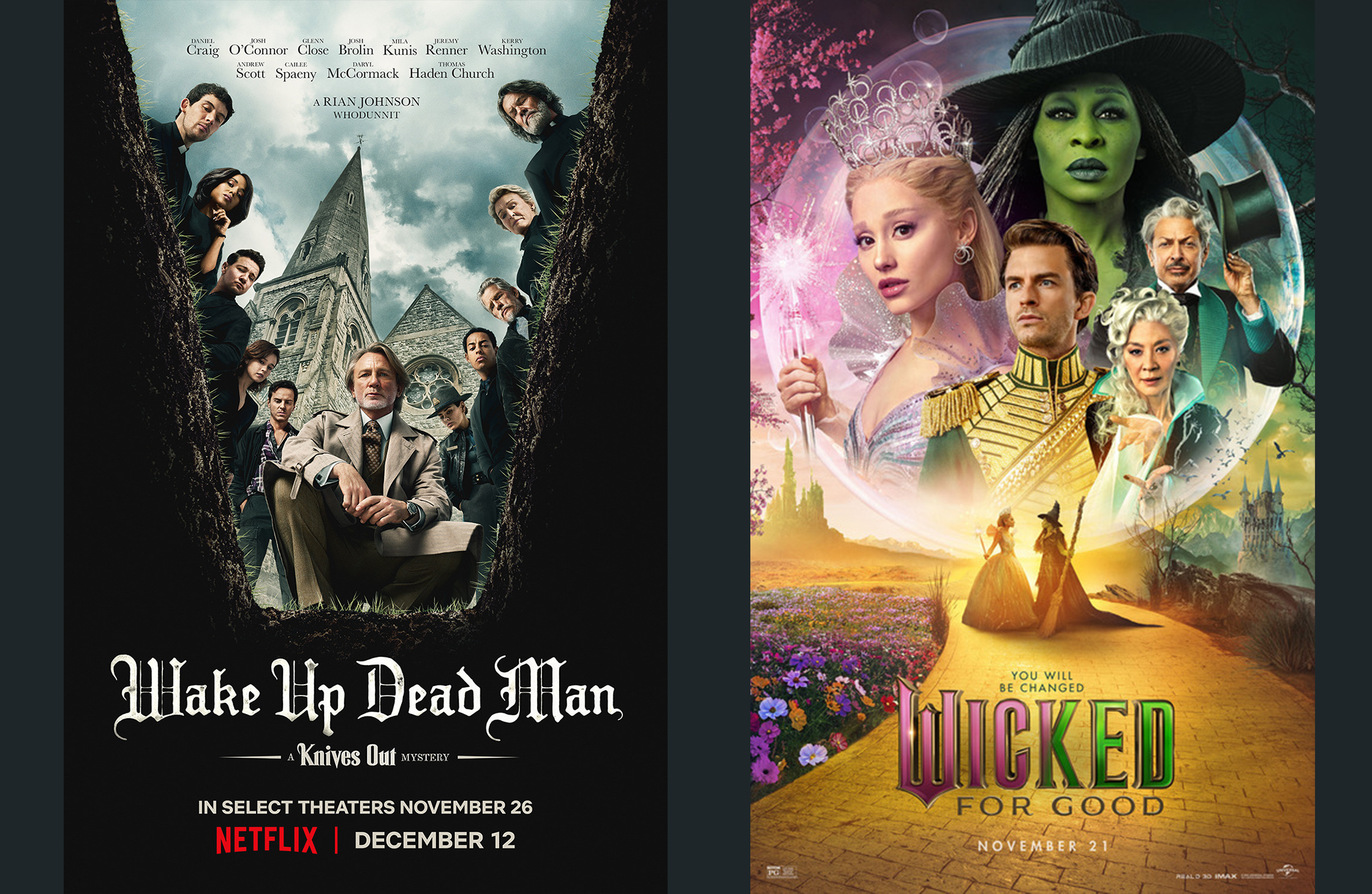
Wake Up Dead Man: A Knives Out Mystery
Until a few years ago, one might have been forgiven for considering the murder mystery genre a relic. With roots in the genteel Edwardian drawing rooms of Agatha Christie and Dorothy L Sayers novels, the murder mystery movie has spent the last half-century dormant, like an old Clue set gathering dust in an abandoned closet. It’s been over 50 years since Hollywood’s last stab at a lavish ensemble murder movie — Sidney Lumet’s Murder on the Orient Express. Until, that is, this classic Agatha Christie novel was revisited by Kenneth Branagh in 2017, became an unexpected hit, and brought the murder mystery genre back from the dead for a new generation of movie-goers.
It was a couple of years later that director Rian Johnson (Star Wars: The Last Jedi) created a brand-new super-sleuth for the modern era: master detective Benoit Blanc, an eccentric Deep-Southern crime solver poured from the same mold as Hercule Poirot and Miss Marple, played with scenery-chewing gusto by Daniel Craig. Now in its third installment, Johnson’s Knives Out series has hit on a successful formula, paying homage to the classic ‘whodunnit’ trope while casting a satirical eye at modern society.
Every Knives Out installment has delivered sharp social commentary. While Johnson’s last film, Glass Onion, took a savage swipe at the vapid lifestyles of the billionaire class, this latest escapade has organized religion squarely in its sights — specifically, the Catholic church.
Jud Dupencity (Josh O’Connor) is a troubled but earnest young priest, given a ‘last chance’ assignment at a rural parish in upstate New York after he punches an obnoxious deacon. Dupencity is tasked with playing second-fiddle to the tyrannical local pastor (Josh Brolin), who styles himself ‘Monsignor’ Jefferson Wicks (an epithet which may only be bestowed by the Pope). Wicks thunders fire-and-brimstone from his pulpit every Sunday, leading his flock with a righteous rod of iron and precious little human kindness. He has cultivated a pocket-sized personality cult around him — a circle of devoted, wealthy parishioners, each of whom has a collection of personality flaws ripe for exploitation by the taciturn vicar. When Wicks suddenly turns up dead in the middle of Sunday Mass, the victim of a seemingly-impossible stabbing, his motley crew of sycophants immediately points an accusatory finger at newcomer Dupencity, who teams up with Detective Blanc to find Wicks’ true killer and clear his name.
Taking its inspiration from Edgar Allen Poe as much as Agatha Christie, Wake Up Dead Man tempers its dry humor with a darkly Gothic sensibility, personified by the monstrous presence of Brolin’s ‘Monsignor’ Wicks. His twisted cult of rage holds a mirror up to the present-day U.S. in a deeply unsettling way.
As the film moves toward the revelation of the true murderer, it prompts a conversation on the nature of faith itself, through a wonderfully subtle performance by O’Connor. He imbues the thoughtful, empathetic Jud Dupencity with a steely determination to do the right thing no matter what.
Rian Johnson has yet to put a foot wrong with this increasingly impressive series.
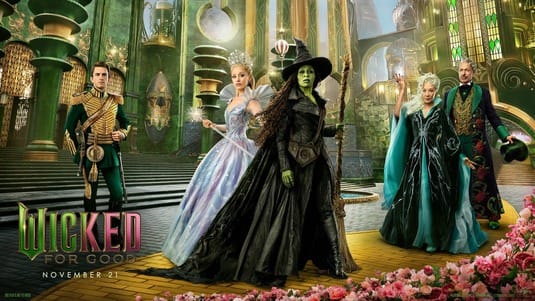
Wicked: For Good
It’s been a year since director Jon M. Chu delivered the first half of his cinematic adaptation of the long-running musical Wicked (created by Steven Schwarz), which is based on the novel Wicked: The Life and Times of The Wicked Witch of The West by Gregory Maguire. The novel is a meditation on the subjectivity of ‘evil’; it reframes the classic Wizard of Oz books by Frank L Baum as told from the perspective of Elphaba Thropp, the ‘wicked’ witch. Despite its somewhat excessive runtime, Wicked succeeded in translating the deeply-maligned Elphaba’s journey from talented magic student to public enemy number one through a series of expertly-staged and photographed set-pieces, framed against a profoundly relevant contemporary political backdrop in which Oz, governed by the Wonderful Wizard — a mendacious, authoritarian con-man — serves as a metaphor for the U.S. in 2025.
Twelve months after bringing down the curtain on Act One, the house lights dim for the conclusion. Elphaba is now a hunted fugitive, her face contorted in a grotesque snarl on ‘WANTED!’ posters across the land. The Wizard’s chief propagandist, Madame Morrible (Michelle Yeoh), devotes her energy to stoking fear and hate for Elphaba amongst the gullible citizenry, while Elphaba’s erstwhile roommate and best friend Galinda (Ariana Grande) has become ‘Good Witch Glinda’ — the pastel-pink, saccharine-sweet public face of the Wizard’s repressive regime, despite her privately-held unease. Railroaded into a public engagement to the dashing Prince Fiyero (Jonathan Bailey), Galinda finds herself mired in deception, and holds her glittery, ostentatious (but distinctly non-magical) wand in an ever less-certain grip.
Events come to an explosive head when Madame Morrible engineers the twister which brings Dorothy Gale, farmhouse and all, to the land of Oz, setting in motion the events of Baum’s original novel. In this tale, Dorothy and Toto are barely a footnote; their arrival serves only to reveal the origin stories of the Tin Man, the Cowardly Lion, and the Scarecrow — all of which are very different from their portrayals in the 1939 film.
It’s here that Wicked: For Good comes unstuck. As the story lumbers to its end — after more than five long, long hours — it loses any semblance of narrative cohesion, and the audience is left with myriad loose ends, contradictions, and questions. On the other hand, like many musicals, cohesive plot matters less than feelings, and there are plenty of big feelings to be felt here. Act Two veers away from the satirical world-building of Act One in favor of a laser-focus on the damaged but unbreakable friendship between Galinda and Elphaba. While Wicked: For Good fails to go out with the explosive punch of its predecessor, superb performances from Cynthia Erevio and Ariana Grande tell a moving story of two imperfect friends irrevocably changed by each other.
Recently arrived in the Tri-Cities from Scotland, Damian Beagan is a former freelancer who wrote movie and music reviews for a variety of UK websites.
