
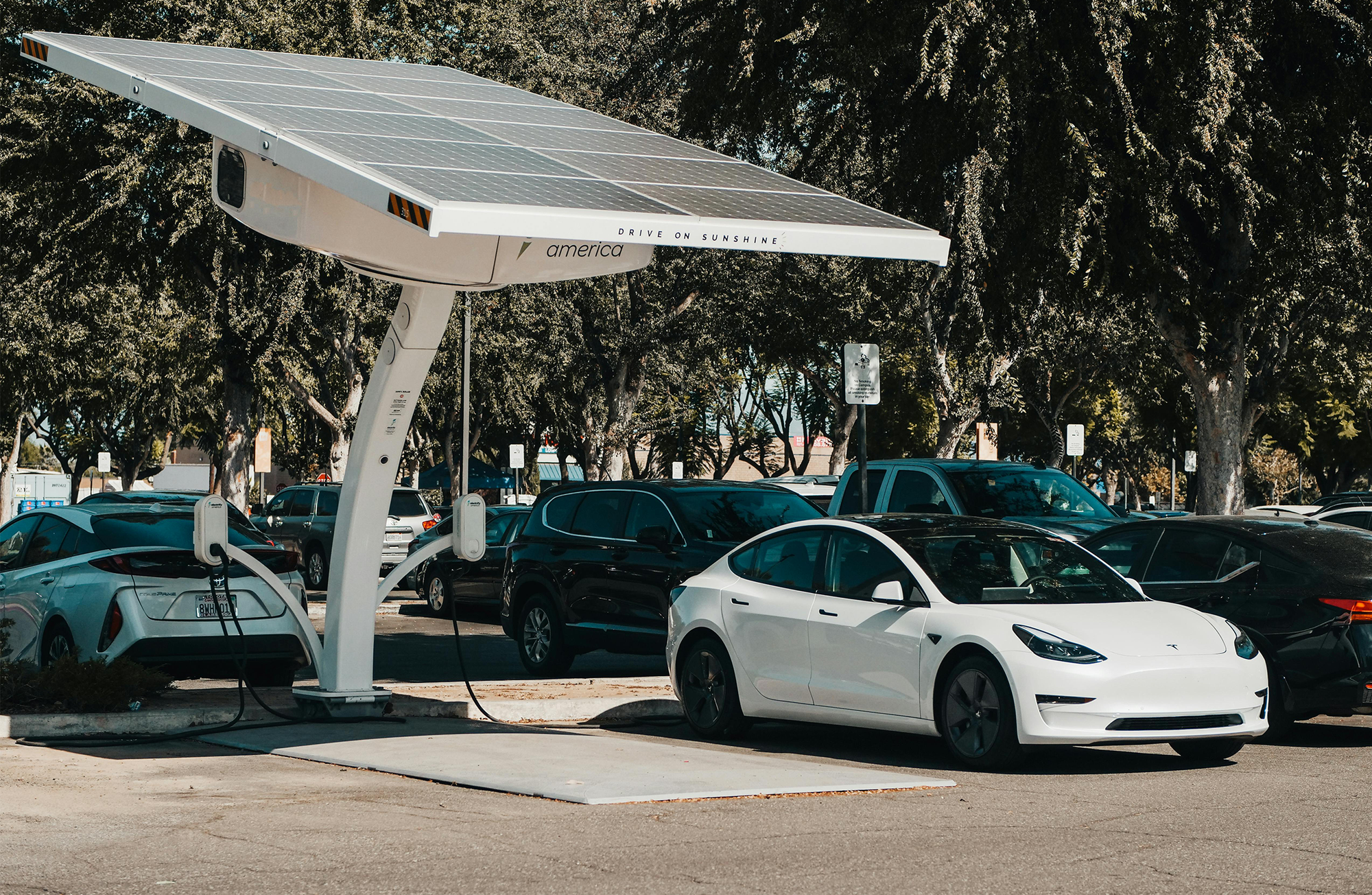
Photo by Kindel Media
The Climate Commitment Act (CCA), Washington State’s signature climate legislation, survived a challenge by Initiative 2117 last year. But it’s not out of the woods yet. Here’s how we can help it survive.
The CCA is complex, but its primary mechanism for driving down emissions is quite simple: the sale of ever fewer carbon permits each year. That guarantees reductions in the use of fossil fuel, which is a primary goal of the CCA. But unless fossil fuel demand decreases faster than the number of permits, the cost of those permits will continue to rise. That drives up the cost of fuel, which motivates opposition to the CCA.
Fossil fuel demand can decrease as more electric vehicles replace internal combustion vehicles. If fewer people use fuel burners, fewer people will even care about the price of fuel. That will reduce resistance to the CCA.
But the number of people switching to EVs is likely to be less than expected, because the One Big Beautiful Bill Act (OBBA) has phased out the $7500 EV tax credits that made EVs less expensive to purchase and operate. In addition, the phase out of federal funding for the installation of charging stations will also slow the adoption of EVs. If fuel demand doesn’t decrease, the price of fuel in Washington State will rise.
Clearly, the best protection from the rising cost of fuel is to electrify your transportation and heating systems. The federal tax credits from the Inflation Reduction Act were helpful before they were phased out. Last year, Washington CCA funding supported an EV rebate program for low-income residents, which helped over six thousand people to purchase or lease an EV before the program ran out of funds. It was not funded this year.
So, neither tax credits nor rebates are available for people to purchase EVs. However, that might not be as bad as it sounds. EV prices will come down, both because the subsidies are gone and because manufacturers are learning how to make them at a lower cost.
Indeed, the new Chevy Bolt will debut next year at a price below $29,000. It charges three times as fast as the old Bolt, uses a heat pump for climate control, and has a range of 255 miles.
Another obstacle to the purchase of EVs is the limited availability of EV charging stations. While both federal and state funding have accelerated their installation of them, the OBBA phases out Inflation Reduction Act subsidies for charging stations in June of 2026 instead of 2032. The Trump Administration suspended funding for the $5 billion National Electric Vehicle Infrastructure program in February 2025, but a lawsuit successfully forced the administration to restore the funding from the Bipartisan Infrastructure Law in August.
The Washington State Climate Commitment Act has awarded $98 million to install 5300 charging ports in 533 stations. Eighty-eight percent of the charging ports are level 2 chargers (most for multifamily residences) suitable for charging an EV overnight, and twelve percent are much faster level 3 (DC) chargers useful for travelers.
The state now has 1818 level 3 ports in 433 locations, and 5754 level 2 ports at 2381 sites. Although there are charging gaps in remote places, the network is now sufficient for EVs to go just about anywhere in Washington.
But will the chargers be available when you need them? That depends on whether the number of chargers continues to rise as the number of EVs increases. The number of EVs per charger should be low enough to ensure an adequate supply. The current ratio is 146 EVs per DC port. If every EV needs to charge in a public DC port for 30 minutes every week, the ratio would have to be lower than 168, assuming ports are charging 12 hours a day. This means that 146 EVs per DC port is barely enough if every EV charges every week. However, most EV charging happens at home, so the supply of DC ports is adequate for now. But clearly, the number of DC chargers must continue to rise as more EVs are on the road.
Some businesses are learning that having level 3 chargers on their premises can bring in more customers who linger for 30 minutes and purchase products and services. Hotels are also learning that chargers are an attractive feature for guests.
The CCA affects home heating in a similar way. The declining number of carbon permits makes natural gas more expensive. People who use natural gas for cooking and heating their homes or water can eliminate their exposure to higher fuel costs by replacing their gas stoves, gas furnaces, and gas water heaters with electric stoves, heat pumps, and heat pump water heaters. Again, federal subsidies are being phased out by the end of 2025, but some state funding remains. The CCA Home Electrification and Appliance Rebate program awards limited grants (a total of $29 million for 2026) to third-party administrators to distribute to small businesses and low- and moderate-income single- and multi-family households with household income of 150% or less of Area Median Income ($127,000). Such funding is helpful, but it is only sufficient for about 3% of homes heated with natural gas. It will have to be sustained over decades to make a substantial difference.
With the rapid phase-out of federal subsidies for electric vehicles and heat pumps, fewer people will electrify their transportation and heating systems than with the rebates, so more people will remain sensitive to the price of fuel. This continued sensitivity increases the vulnerability of the CCA to calls to repeal it as the number of carbon permits decreases and the price of fuel increases.
To survive another repeal effort, the CCA therefore needs to deliver more of its considerable income to those most sensitive to fuel cost (i.e, those using fuel-burning vehicles and appliances).
Total CCA revenue is now $3.2 billion. Of that, only 7% is for electrifying transportation, and 10% is for buildings. To secure the CCA, more of the CCA revenue should be allocated to rebates for EVs and heat pumps.
It would be best for the climate if the distribution of the CCA revenue is based on its effectiveness in reducing emissions or increasing natural removal. Basing the distribution on how well it will diminish resistance to the CCA is not necessarily the same thing. For example, giving the revenue to everyone in equal shares (which is prohibited by the Washington State constitution) might be effective in maintaining support for the CCA, but it will not as effectively help people overcome the higher upfront costs of EVs and heat pumps. Moreover, despite Canada distributing revenue from a similar program to its citizens, its price on carbon lost support and was recently dropped. Shifting more of the revenue to rebates for EVs and heat pumps might be the sweet spot that both reduces resistance and reduces carbon emissions.
Climate scientist Steve Ghan leads the Tri-Cities Chapter of Citizens Climate Lobby.
