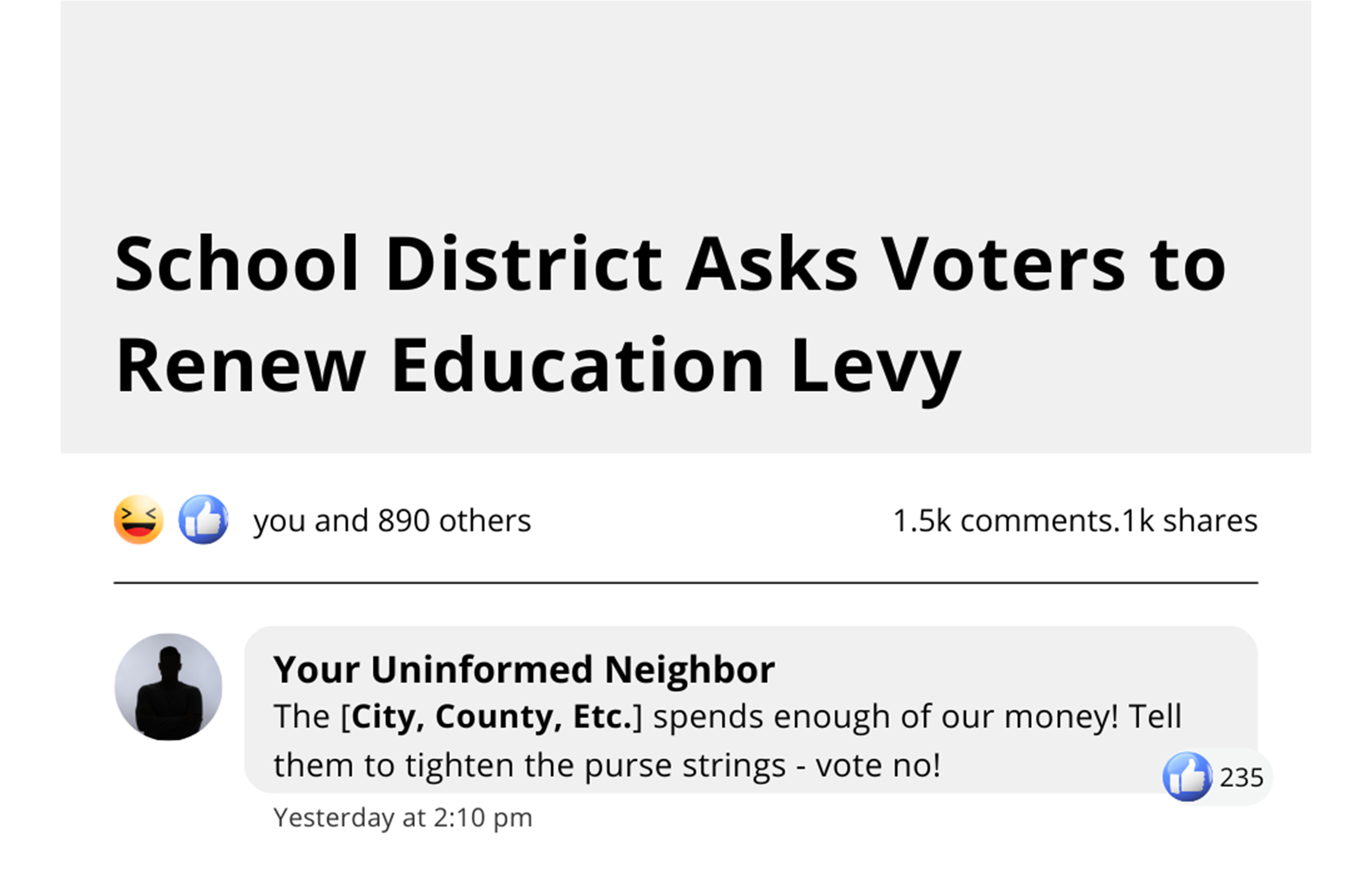
Several local and regional school districts have levies on the upcoming mid-term election ballot. These measures often spark strong opinions — and unfortunately, a lot of confusion. I’ve seen smart, well-intentioned friends share compelling (but inaccurate and misleading) information on social media.
This information often falls into three categories: inflated estimates of the actual costs to taxpayers, comments on otherwise factual information falsely blaming unrelated government excess, and falsely representing or misrepresenting replacement levies as ‘new’ taxes.
Bond vs. Levy
“Bonds are for building, levies are for learning” is the phrase I found most often while researching this article. It’s a great starting point, but it doesn’t tell the whole story of how schools are funded — or why both bonds and levies are necessary.
The basics boil down to how Washington State defines basic education. Even after decades of litigation and legislation, basic education funding still trails behind actual costs. The standard funding model — often referred to as a prototypical school formula — is the deciding factor of how much money schools receive.
Bonds
Bonds are a property tax assessed for ten to twenty-five years to repay the cost (plus interest) for bonds sold to finance school construction. While I plan to follow this article with a more in-depth series on bonds and school construction, for now, the most important information to know is that bonds and unvoted debt capacity are essentially the only way for districts to fund the gap between what the state provides to support basic education and the actual cost of construction. The Office of the Superintendent of Public Instruction published figures in 2024 demonstrating that the state funds at most 67% of the actual costs of construction — and that doesn’t even take into consideration the costs of property acquisition, stormwater, roads, playgrounds, or other site improvements.
Levies
Levies are a property tax assessed and authorized for a few years at a time to cover the actual cost of providing basic education and services not covered by the state’s allocation to a district. While generally falling into three categories — transportation (2 years), enrichment (4 years), and capital expenditures and technology (6 years) — levies cover athletics, teachers and support staff, supplies, materials, maintenance, and operational expenses. Like bonds, levies are essentially the only way for districts to fund the gap between what the state provides to support basic education and the actual costs of educational programming and associated operational expenses.
So, why does this matter?
We all have ‘Uninformed Neighbors’ who don’t understand bonds and levies. Confusion is the primary obstacle to successful bond and levy passage — passage that school districts must rely upon to provide basic education.
Eight school districts in Benton and Franklin Counties have levies on the upcoming mid-term ballot. If any of those levies fail to be renewed, the programs currently funded by those levies will be at risk, and any state matching assistance will be rescinded.
As renewal levies, besides inflationary adjustments, there is no net increase in the rate between the expiring and renewal levy. But even though the levy rate didn’t increase, you may be paying more, because schools aren’t immune to the realities of inflation or increasing home valuations.
THE BOTTOM LINE:
Voting YES for school bonds and levies doesn’t mean you’re paying higher rates. It means you’re continuing to pay for local schools to fund basic education and school personnel.
Voting NO for school bonds and levies would result in our schools losing state funding, and being forced to cut important school programs and services.
These are renewals, not new taxes.
For more information about your school district’s bonds and levies, the League of Education Voters has an FAQ here: https://educationvoters.org/local-levy-faq/
You can also visit your school district’s information page.
Kennewick: https://ksdlevyvote.org
Pasco: https://www.psd1.org/departments/finance/levy2026
Richland: https://www.rsd.edu/district/bonds-levies/2026-levy
References:
- esd112.org/bond-levy
- puyallupsd.org/about-us/departments/capital-projects/contact-us/story-detail/~board/news/post/public-school-funding-understanding-the-vital-difference-between-levies-and-bonds
- wasa-oly.org/WASA/images/WASA/6.0%20Resources/Bond-Levy%20FAQs.pdf
- tri-cityherald.com/opinion/editorials/article314338049.html
- paramountduty.org/basic-education-defined
- projects.seattletimes.com/2016/education-funding
- ospi.k12.wa.us/sites/default/files/2023-10/c4-enhancing-school-construction-assistance-program-funding-formula.pdf
