

Photo by Stephan Seeber
Can nature help stabilize carbon dioxide concentration? Fortunately, the answer is YES.
Last month, we wrote about the remarkable ability of natural removal of carbon dioxide (CO2) from the atmosphere. This removal capacity grew alongside the rise in carbon emissions from 1960 to 2012, and then leveled off when emissions subsequently plateaued after 2012. In our observations, natural processes have consistently removed about half of the carbon emitted by human activity.
This raises the question: To what extent can we rely on natural processes to remove a substantial fraction of carbon emissions? If humanity succeeds in bending the curve of emissions from increasing to decreasing, can natural removal help stop the accumulation of CO2 in the atmosphere? Can it help restore concentrations to levels that stop — or even reduce — the planet’s warming? Or, will natural removal slow as emissions are reduced?
This is because the physics and chemistry of CO2 drawdown is dominated by the amount of CO2 in the atmosphere. Natural removal rates will only decline as atmospheric levels fall.
Until recently, the scientific community has focused on conservative scenarios, which do not give much credit to natural carbon sinks, or their ability to continue passively capturing carbon from the atmosphere. This has led to assertions that emissions must decline to ‘net zero’ by 2050 to limit global warming to 2 degrees Celsius — an unrealistic scenario, as it turns out. However, more recent investigations of the carbon cycle have shown us the robust nature of natural removal processes, such that the sinks can continue to draw down atmospheric CO2 at high rates even without reducing emissions to zero.
To explore these possibilities, we’re going to use a simple carbon cycle model and express natural removal in terms of atmospheric concentration. This is because it is the concentration, not emissions, that drives natural removal. Mass transfer from the atmosphere to the ocean depends on atmospheric concentration, as does photosynthesis.
We’re considering two options:
a) A linear treatment, in which natural removal is expressed in terms of atmospheric CO2 concentration using the least squares method, and
b) A quadratic treatment, in which natural removal is expressed in terms of atmospheric CO2 concentration and its square, again using the least squares method.
To develop this model, we first compared historical removals with the linear and quadratic fits. Without going into too much detail, both approaches generate reasonable results, with the quadratic fit presenting slightly better statistics.
We then applied those fits to the future carbon cycle, as illustrated in the figure below.
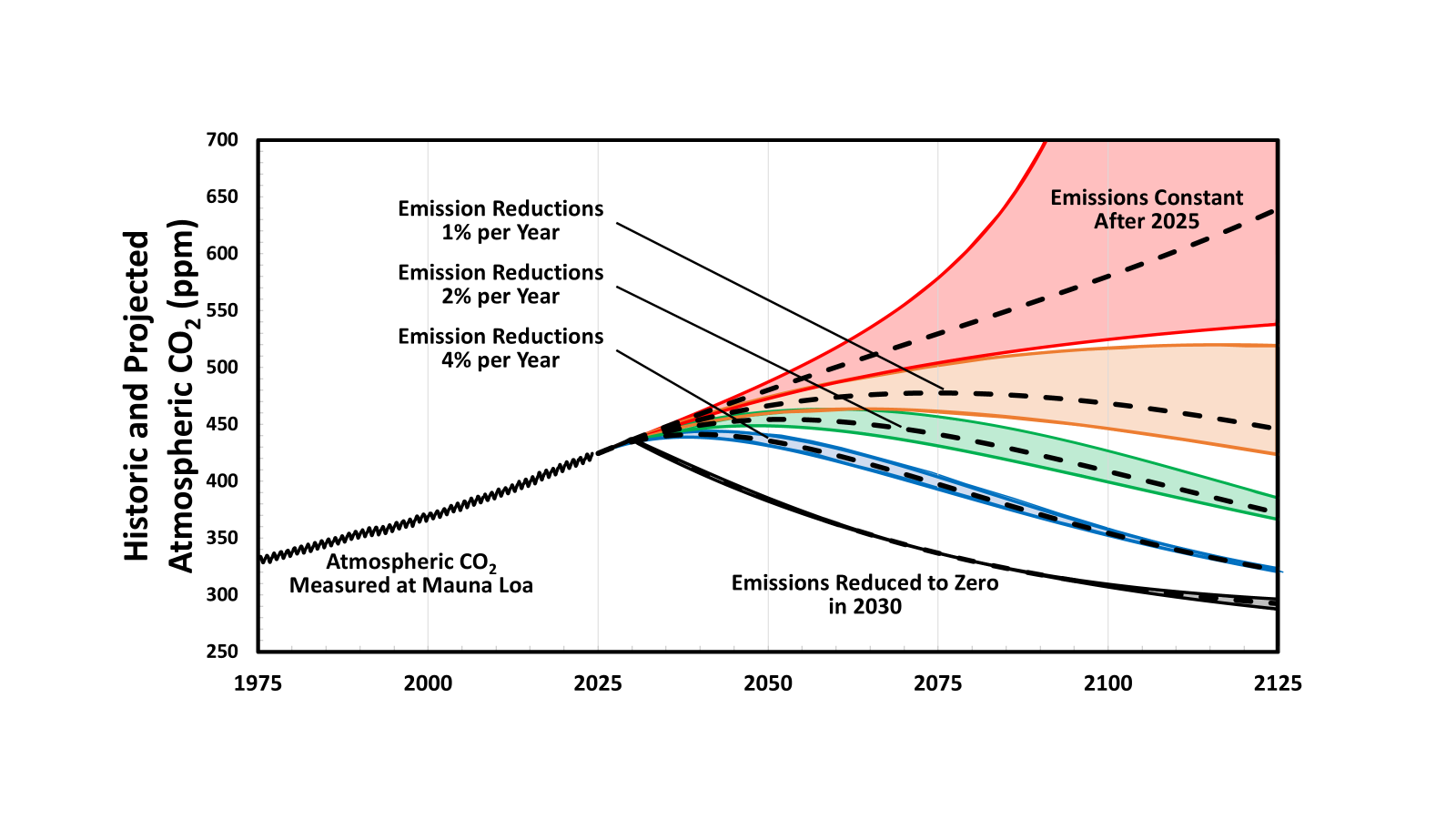
As you can see, the linear and quadratic fits yield very different results when emissions are not reduced, but tend to agree when emissions are rapidly reduced. For the quadratic fit, the scenario with no change in emissions appears to lead to a runaway carbon cycle. While the quadratic fit is consistent with the data between 1960 and 2025, applying that fit 100 years into the future is unreliable. The very different results for the linear and quadratic fits in the constant emissions case illustrates the uncertainty in natural removal for that case.
However, in order to actualize this balance, we need the world to reduce CO2 emissions, just as the U.S. has over the last twenty years. We’ll discuss emissions reductions in greater detail next month.
The results suggest that the rise in CO2 concentration can be reversed by the end of this century with as little as 1% reduction in emissions. This is good news! We already have an example in the U.S. reducing CO2 emissions by a little over 1% per year since 2005, and it is likely that other countries can do the same. Of course, to further limit the negative effects of climate change, even greater annual emission reductions would be better.
The lesson here is that if humanity can decrease emissions at an achievable rate of just 2% per year, CO2 concentrations can be restored to sustainable values (below 400 ppm) before 2100. However, if we fail to reduce emissions (which have only recently leveled off), natural removal will not prevent CO2 concentrations from continuing to increase.
This is doable. But only if we work together!
Read next month’s column for Part 3, where we will talk more about how emissions might be reduced by 2% per year.
Climate scientist Steve Ghan leads the Tri-Cities chapter of Citizens Climate Lobby.
Bob Wegeng, an engineer who worked in the energy industry before joining the Pacific Northwest National Laboratory as a technology developer, is the co-holder of three R&D 100 awards and is now the president of a startup company in the Tri-Cities.
