

Photo by Matthew Smith
Part 1: Natural carbon sinks and advanced technologies are helping us limit atmospheric greenhouse gases
We’re writing this series to discuss relatively recent developments in scientific understanding of the Earth’s carbon cycle, as well as technological advances that we believe can help get climate change under control. To begin, we have observed several success stories in the last twenty years that have helped the U.S. economically reduce its emissions of carbon dioxide (CO2) and other greenhouse gases.
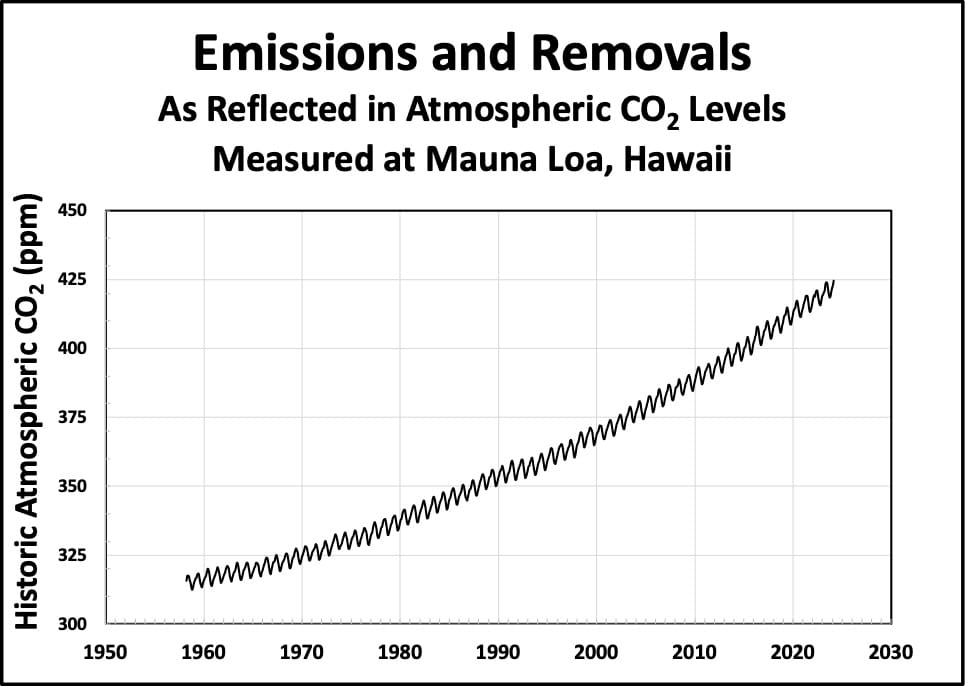
You may have heard the disheartening statement that even if we ceased the use of fossil fuels overnight, the high levels of CO2 that have built up in our atmosphere would remain for hundreds of years, perhaps even more than 1000 years. This is not correct.
Natural processes — such as the dissolution of CO2 in the ocean, and the uptake and use of CO2 by plants (photosynthesis) — are removing a lot more CO2 from the atmosphere than they were 200 years ago. We know that for at least the last 65 years, these natural processes have removed about half of the CO2 that human activity emits into the atmosphere annually. Without natural removal, fossil fuel combustion would have increased the atmospheric CO2 concentration from a little under 300ppm (parts per million) in 1850 to around 600ppm today. Instead, we find a current value of 425ppm.
To understand the role of natural carbon sinks, we need to discuss the carbon cycle in more detail.
Natural processes remove CO2 from the atmosphere through photosynthesis in plants on land, and by dissolving in the ocean, where it is converted to hydrocarbons by photosynthesis in phytoplankton, and to calcium carbonate in shellfish. Data and modeling over the last 65 years suggests comparable contributions of land and ocean to carbon removal from the atmosphere.
Drawdown of atmospheric CO2 by the natural land and ocean carbon sinks is actually in direct proportion to the atmospheric CO2 inventory. This means that, as we begin to decrease emissions, we will start seeing more months each year when drawdown exceeds emissions. Following that, as emissions are further decreased, we can expect to also see annual decreases in CO2 concentrations.
Photosynthesis is the conversion of CO2 to hydrocarbons using the power of the Sun, and the process depends on the availability of CO2 as well as sunlight, water, and nutrients. Therefore, photosynthesis has increased with increasing atmospheric CO2 concentrations.
Similarly, the transport of CO2 to the ocean and photosynthesis in the ocean do not depend directly on emissions. Rather, the rate of drawdown into the ocean depends on the difference between atmospheric CO2 concentrations and the concentration of CO2 on the surface of the ocean.
CO2 concentration increases with emissions caused by human activity, but concentrations can still increase even if our emissions do not increase. The proportionality of removal by photosynthesis to emissions is simply because emissions and concentrations have both increased, at least until about 2012.
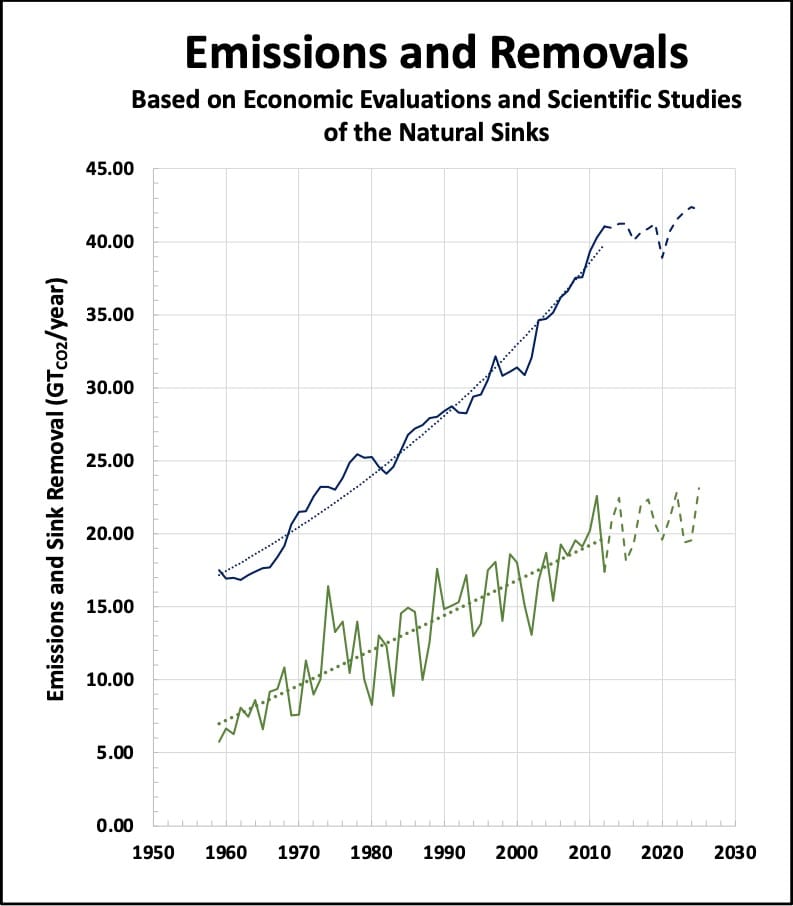
Near the middle of the 20th Century, driven by economic interest, CO2 emissions from fossil fuel combustion began to increase exponentially. However, technology advances in the early 2000s have shifted both how we use fossil fuels, and the mix of fossil fuels that we use, reducing the overall CO2 intensity of our energy choices.
In the U.S. and the European Union, CO2 emission reductions over the last twenty years have averaged about 1% per year and, as a result, worldwide emissions have moved off the exponential track. Simply put, the rise in annual emissions has slowed, largely because we are developing and deploying technologies that are economically advantageous and more efficient, while also being less ‘carbon-intensive’.
These include hybrid and electric vehicles, which use less gasoline; fracking technology, which has made natural gas less expensive and has resulted in the shut-down of hundreds of coal-fired power plants; and solar and wind power systems, which augment other electricity production and reduce reliance on fossil fuels.
Both work in favor of limiting CO2 concentrations in the atmosphere.
Given the important role that natural removal has played in limiting the growth of atmospheric CO2 concentration over the last century, the response of natural removal to global warming will continue to have a significant impact on the carbon cycle, and consequently on global warming.
Next month, we’ll use a simple model of the carbon cycle to explore how atmospheric CO2 concentrations can be engineered to fall, with the goal being to find a balance between emissions and removals, reduce atmospheric CO2 levels during this century, and eventually attain a specific atmospheric CO2 target.
Stay tuned!
Climate scientist Steve Ghan leads the Tri-Cities chapter of Citizens Climate Lobby.
Bob Wegeng, an engineer who worked in the energy industry before joining the Pacific Northwest National Laboratory as a technology developer, is the co-holder of three R&D 100 awards and is now the president of a startup company in the Tri-Cities.
Sources:
- https://science.nasa.gov/earth/earth-observatory/the-carbon-cycle
- https://globalcarbonbudget.org/gcb-2025/the-global-carbon-budget-faqs-2025
- https://en.wikipedia.org/wiki/Carbon_cycle
- Friedlingstein et. al. “Global Carbon Budget 2025, Earth System Science Data Discussions.” https://essd.copernicus.org/preprints/essd-2025-659/essd-2025-659.pdf
- https://science.nasa.gov/earth/climate-change/co2-is-making-earth-greenerfor-now
See also:
- Jones et. al. “Global rise in forest fire emissions linked to climate change in the extratropics.” Science, 2024: https://www.science.org/doi/10.1126/science.adl5889
- https://ourworldindata.org/grapher/annual-carbon-dioxide-emissions
- https://www.whoi.edu/ocean-learning-hub/multimedia/co-solubility-pump-3
